How to Start a Futsal Venue in Australia: Courts, Formats and Your First Season
Opening a futsal venue involves more decisions than most people expect — court count, surface type, hire formats and comp structure all need to be right before you open the doors. This guide walks you through each call, in order.
On this page
If you want to start a futsal venue in Australia, the footprint is compact, the demand is real, and the game practically runs itself once people know where to find it. But achievable doesn't mean straightforward. The operators who fill their courts from month one have usually made a handful of good calls early: the right court count for their site, a surface that handles the volume, hire formats that generate reliable income, and a comp structure that keeps players coming back each season.
This guide covers those calls in order. It's aimed at anyone working through how to start a futsal venue in Australia — whether you're converting a warehouse, building a stand-alone facility, or adding courts to an existing multi-sport site.
Why futsal venue economics reward getting the basics right
Futsal is a high-utilisation game. A standard court (roughly 38–42 m × 18–22 m) can run eight-to-ten sessions a day across casual hire, recurring bookings, open games and evening comps. That density is the business model. When you fill it, the numbers work well. When courts sit idle, they're expensive air.
The decisions you make at the start — court count, surface, formats, comp structure — determine your utilisation ceiling. Getting them right early means you're optimising a working system; getting them wrong means you're fixing a broken one while trying to run sessions at the same time.
How many courts do you actually need to start a futsal venue
The honest answer is: start with fewer than you think, and design the space to add more.
Two courts is a viable first footprint for most operators. It lets you run concurrent sessions (one hire, one open game), host a small comp on a single night, and test what your local market actually wants before you commit further capital. If demand is there — and in most Australian metro areas it will be — you can expand.
Four courts is the typical sweet spot for an operator who wants to run a meaningful competition alongside casual hire. With four courts you can run a six-to-eight team comp on a weeknight, keep at least one court open for casual play, and generate enough revenue to support a small staff.
Venues we've worked with that opened on two courts and added a third in year two usually made more in year one than the ones that built six and spent the first season staring at empty timber.
Six-plus courts starts to look like a dedicated futsal centre. The economics get better per court, but you need genuine competition capacity to fill them — think multiple divisions, multiple nights. That's a different operational challenge and a different upfront investment.
If you're also planning a multi-sport venue with netball or basketball alongside futsal, the court-count logic shifts. The guide to multi-location and multi-sport venue management covers how operators handle that complexity without drowning in admin.
Choosing your surface and line markings
Futsal is played on hard court — traditionally a sprung wooden floor (parquet) or a synthetic hard surface. The choice affects everything from player comfort to maintenance cost to what other sports you can accommodate.
Sprung timber is the premium option. It's kind on joints, performs consistently, and is the surface used in formal futsal competition. It's also expensive to install and doesn't love wet-in/wet-out from outdoor footwear. If your clientele is serious club players, it's worth it.
Synthetic hard court (polyurethane or similar) is more forgiving operationally. It handles recreational play, takes wear well, and suits venues that want to run futsal alongside other court sports. Most community futsal venues in Australia use this category of surface.
Hybrid turf (short-pile artificial grass) is common in warehouse conversions. It's not regulation futsal but it works fine for social comps and hire, and many players actively prefer it for the softer feel. Be aware that the ball behaves differently — pace and bounce vary from hard court, which matters if you're running graded competition.
Line markings deserve more thought than they usually get. If you plan to run multiple sports, multi-sport line packages (colour-coded by sport) are worth the extra spend at fit-out. Retrofitting lines once a court is live is disruptive and costly.
Hire formats: casual, recurring and open games
Hire is typically your first revenue stream and your most reliable one. Structure it clearly from the start.
Casual hire is a one-off booking — a group rings up (or books online) and takes the court for an hour. It's your highest-yield format per session but the hardest to fill reliably. Pricing casual hire well is a whole conversation on its own; the court hire pricing guide covers the mechanics in detail.
Recurring hire is where the money gets stable. A team books the same court, same time, every week for a term. They pay upfront (or at least on a regular schedule), you fill the slot before you even open for the week. Getting paid upfront on court hire is one of the single biggest improvements most new venues can make — the detail is in this post on getting paid upfront.
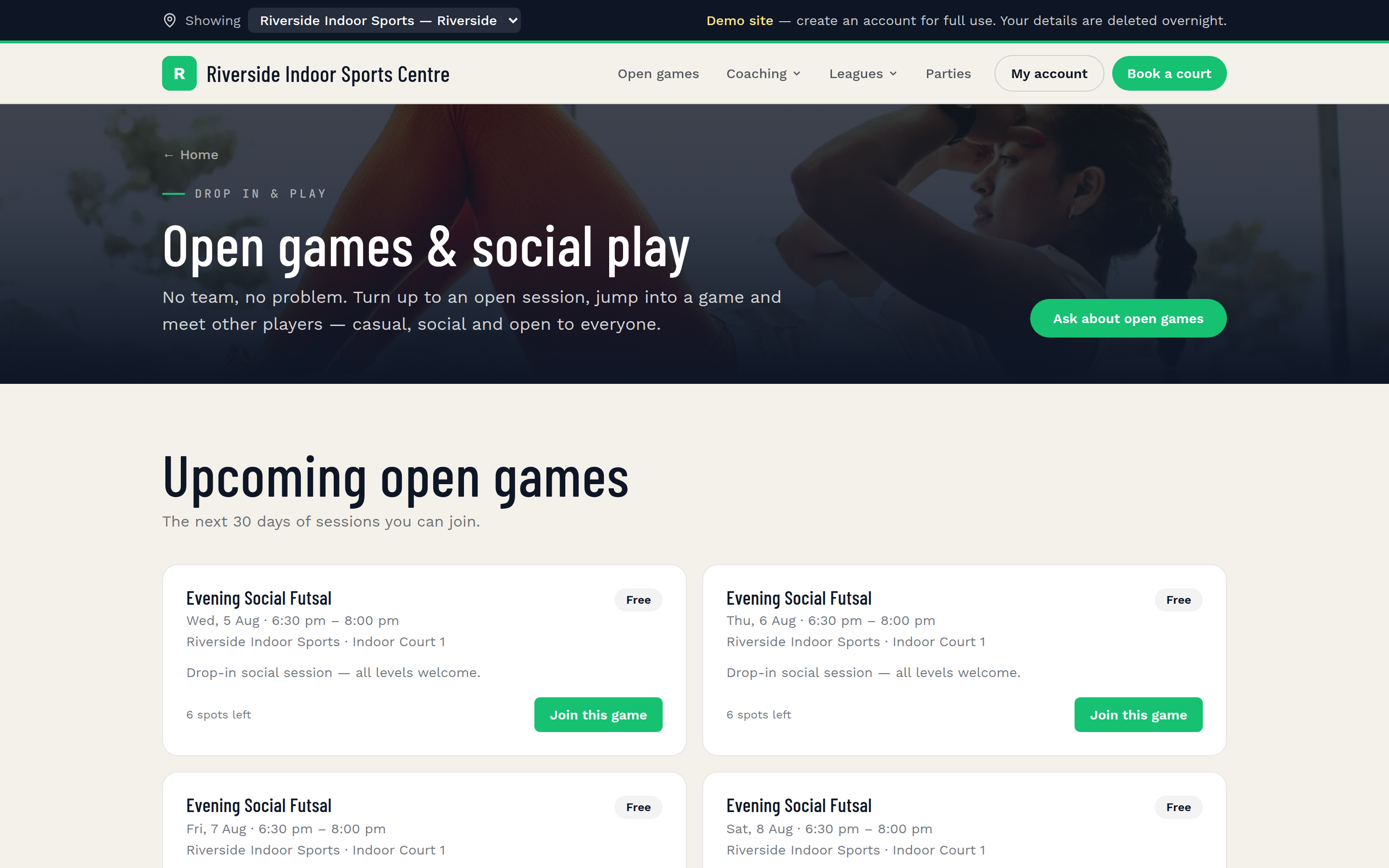
Open games — drop-in sessions where individual players book a spot and you assemble the teams — are a powerful format for filling gaps and building your player base. They're lower yield per court-hour than group hire, but they introduce new players to the venue and often convert into team hire or competition registrations later.
Structuring your booking flow so players can actually find and book these sessions without calling you is non-negotiable at this scale. The online booking guide for sports venues is a good reference for what that should look like in practice.
Structuring your first competition season
This is where most new futsal venues under-invest in thinking. A comp is not just a fixture list — it's a retention engine. Players who are in your comp come back every week, they recruit their mates, and they re-register each season without you having to chase them.
Format first. For a first season with limited courts, keep it simple: round-robin across the season, top four into a finals series, grand final on the last night. Resist the urge to run a complex ladder structure before you've proven demand. The sports tournament formats guide lays out the options if you want to compare.
Division structure. Even with eight teams in your first season, split into two divisions if the skill spread is wide. Mixed-ability comps frustrate everyone. Grading is straightforward when you have match history; in the first season, a short pre-season round of games or a self-nomination process is usually enough. The grading teams into divisions post has a practical framework for this.
Fees and registration. Collect team fees upfront before the season starts. Chase-downs mid-season cost you real time and create awkward conversations. Set up your registration with a clear payment deadline — no payment, no draw.
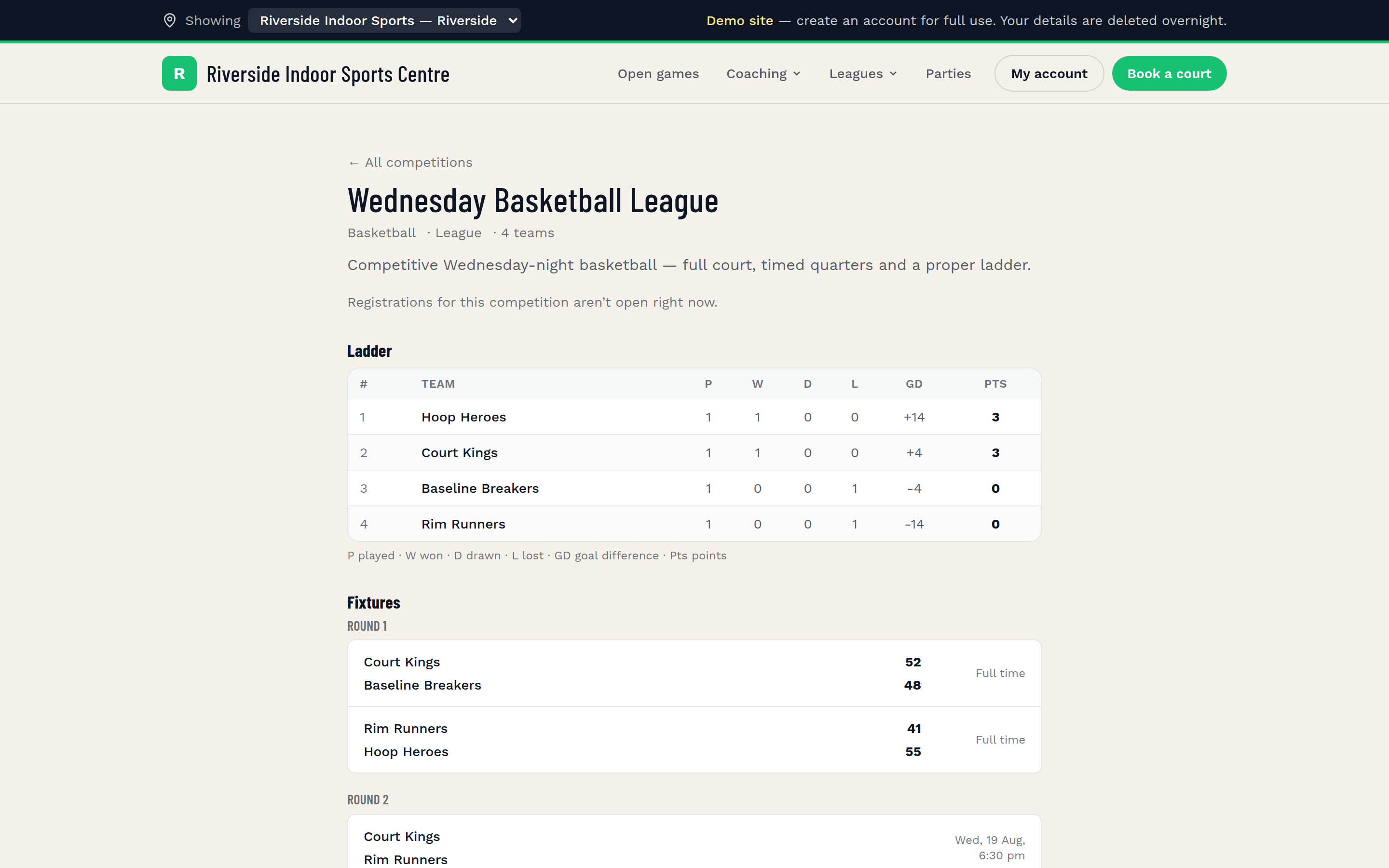
The fixture and ladder. Players need to find their games without calling you. A public-facing competition page — with the draw, results and ladder updated after each round — dramatically reduces inbound questions and makes your venue look professional. It also helps with retention: players check the ladder, they care about where they sit, they keep showing up. The competition ladders and results guide explains what this looks like in practice.
Running courts and comps at the same time
Once hire and competition are both live, scheduling complexity increases fast. A court that runs a comp on Tuesday and Thursday needs the hire calendar to block those slots automatically. A change to the comp draw needs to flow through to whatever comms your teams receive.
The operational reality of a two-to-four court venue mid-season: you're managing dozens of individual bookings, a competition draw across multiple rounds, results entry after each game night, and player comms that need to go out reliably. That's a lot to carry in your head or across three separate tools.
Venues that manage this well tend to use one system that connects bookings, the competition, and comms — so a change in one place flows through to the others rather than requiring manual updates across multiple platforms. Sweepa's features page covers how those pieces connect for a venue running hire and comps concurrently.
The admin load nobody warns you about
The game is easy. The admin is where new venue operators get caught out.
Chasing a team for their registration fee at 10 pm on a Tuesday is not how you want to spend your time. Texting twelve people because the court heater is broken and tonight's session is cancelled. Updating a PDF fixture list and emailing it to sixty players because round five had to shift.
Each of these tasks is small. In aggregate, they consume hours every week — hours you could spend on the court, on recruitment, or simply not working. The cost of running on disconnected tools puts real shape to how this adds up.
The answer isn't hiring an admin person (you're not at that scale yet). It's making sure the tools you use from the start are connected enough that these tasks happen automatically or in one place. Getting this right in your first season, before habits form and workarounds multiply, is significantly easier than fixing it later. If you've ever felt like your venue has outgrown a spreadsheet setup, this post describes the inflection point most operators recognise in hindsight.
The venues that grow — that go from two courts to four, from one comp night to three — are almost always the ones that got their operations clean early and then focused their energy on building community, not chasing paperwork.
FAQ
How much space do I need to build a futsal court in Australia?
A regulation futsal court is 38–42 metres long and 18–22 metres wide, with run-off space around each boundary — typically at least one metre, more if budget allows. For a two-court venue you're looking at roughly 1,800–2,200 square metres of internal floor space once you factor in run-off, storage and amenities. Warehouse conversions and purpose-built facilities are both common approaches in Australia; local council planning requirements and building codes will determine the specifics for your site.
How many teams do I need to run a viable futsal competition?
Eight teams is a workable minimum for a round-robin season — enough for a meaningful ladder and a four-team finals series. Below eight, byes become frequent and the competition feels thin. Twelve to sixteen teams across two divisions is the target for a healthy first season. If you can't get to eight on your first sign-up round, consider running a shorter pre-season series to build interest before committing to a full competition calendar.
Should I charge per team or per player for comp registration?
Most futsal venues charge per team rather than per player for competition registration. It simplifies collection — you deal with one captain per team rather than tracking ten individual payments — and it's the norm players expect. Collecting the fee from the team captain upfront before the season starts is strongly recommended; chasing outstanding payments once the season is live is time-consuming and creates friction with your players.
What's the best way to handle wet-weather or court-unavailability cancellations?
The key is speed and a single communication channel players actually check. Decide early whether SMS, email or a venue app notification is your primary channel, and make sure players know that's where cancellations will appear. A clear policy on credits or rescheduling — published before the season starts — removes most of the difficult conversations. For indoor futsal venues, weather cancellations are rare, but equipment failure, line marking issues and facility incidents still happen. Having a comms system that lets you reach all affected players in one action is worth setting up from day one.
Do I need a licence or approval to run a futsal competition in Australia?
This depends on your state, your council, and whether you're affiliated with Football Australia or a state federation. Running a social competition at a private venue typically requires a business registration and any venue-specific permits your local council requires. Affiliation with Football Australia or your state body (e.g. Football NSW, Football Victoria) brings its own requirements and benefits — including insurance frameworks and access to registered referees. Check directly with Football Australia and your state federation for current affiliation rules, and confirm insurance requirements with your broker before you open.