Sports venue payment collection: getting paid upfront for court and field hire
A practical guide to sports venue payment collection — why chasing fails, how pay-at-booking works, and the deposit, invoicing and payment-method choices that make getting paid for court and field hire close to automatic.
On this page
The debtors spreadsheet every venue recognises
Every venue we've come across eventually grows one: a spreadsheet, a sticky-note pad, or a running note in someone's phone, usually titled something like "Outstanding" or "Chase list." It's the ledger of who booked a court and still hasn't paid for it — the Thursday regular who "banked it in cash next time," the Saturday casual who paid a deposit and never settled the rest, the corporate group that booked six weeks of Tuesday nights and is now three sessions behind. Sports venue payment collection usually starts life exactly like this: informal, reactive, and entirely dependent on someone remembering to chase it.
It doesn't feel like a crisis in week one. By week eight, it's a standing Monday-morning job — cross-checking who played, who paid, and who needs a text. Multiply that across two or three courts and a handful of regular hirers, and the debtors list stops being a side task and starts being a second job nobody signed up for.
Why chasing payments fails
Chasing fails not because operators are bad at it, but because it puts the wrong person in an awkward spot at the wrong time. By the time you're sending a "just a friendly reminder" text, someone has already used the court, and now you're asking them to pay for something that's already happened — a much weaker ask than "pay to confirm your booking." The debt is also invisible until it isn't: nobody notices three unpaid Tuesday sessions accumulating until the total is large enough to be genuinely uncomfortable to raise.
There's a relationship cost too. Regulars are often mates, teammates of your kids, people you'll see next week regardless of whether they've paid. Sending a payment chase to someone you'll be nodding to at training on Thursday is a genuinely awkward piece of admin, and it's one every venue operator recognises even if nobody talks about it much. Chasing also scales badly: doubling your bookings roughly doubles your chase list, because the underlying process — book now, pay eventually, hope — never actually changed.
Pay-at-booking as the default for sports venue payment collection
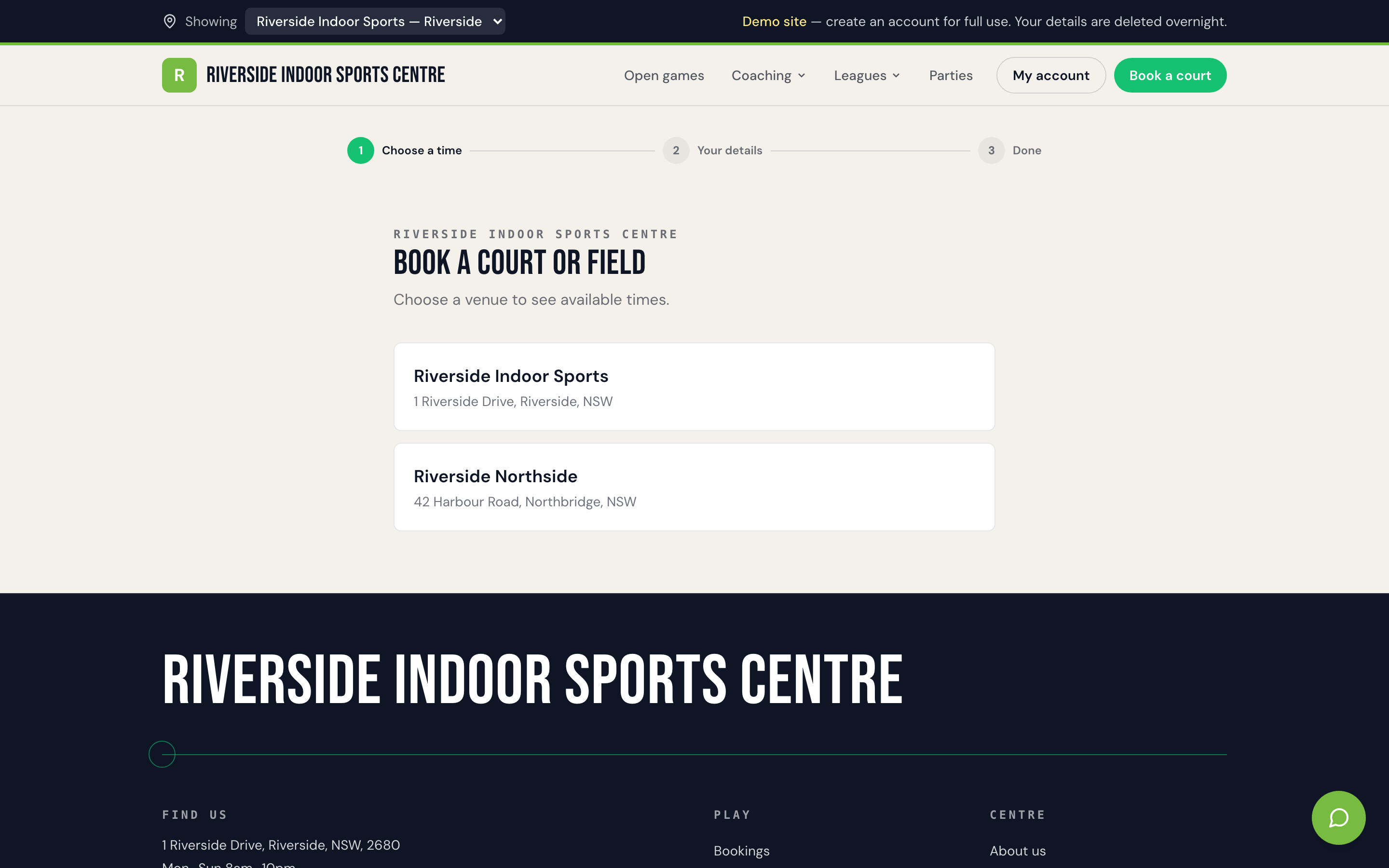
The structural fix is simple to state and genuinely effective in practice: take payment at the moment of booking, not after. When a slot is only confirmed once it's paid for, the chase list disappears from the process by design — there's nothing to chase, because there's nothing unpaid sitting on the books. That's the real difference between "held" and "confirmed." A held slot is a promise. A paid slot is a fact.
This is what modern sports venue payment collection actually looks like day to day: the booking flow and the payment flow are the same flow. A hirer picks a court and time, sees the price, and pays there and then — card, Apple Pay or Google Pay — before the slot is theirs. No separate invoice to raise, no "we'll sort it out later," no reconciling a calendar against a bank statement at the end of the month. Sweepa's booking and payments features are built around exactly this — Stripe-native payment captured at the point of booking, not bolted on afterwards.
It's worth being honest about the trade-off: pay-at-booking does add a moment of friction at the point of sale, and a small number of long-time regulars may grumble about a habit changing. In practice, most venues find that friction is short-lived — people adapt within a booking cycle or two — and it's a fair trade against a debtors list that never shrinks on its own.
Deposits vs full payment
Not every booking suits full payment upfront, and it's worth deciding this deliberately rather than defaulting to one rule for everything. Casual hire — a one-off hour on a Tuesday night — is the easiest case: charge in full at the time of booking, because there's little reason not to. Parties and larger blocks often suit a deposit model instead: enough paid upfront to make the booking real and cover your cost if it falls through, with the balance due closer to the date or on arrival. Recurring bookings sit somewhere in between, and get their own treatment below.
The deciding question isn't "what feels friendliest" — it's "what happens if this booking cancels." If a no-show costs you a court slot you couldn't resell in time, take a deposit that reflects that cost, at minimum, and consider full payment upfront for anything genuinely hard to refill. If the booking is low-risk and easy to backfill, full payment upfront removes admin without much downside either way. Whichever you choose, write the rule down once and apply it consistently — most debtors lists grow from exceptions to a policy, not from the policy itself. If you haven't settled your pricing yet, it's worth reading our guide on how to price court and field hire before you lock in a payment policy on top of it.
Recurring hirers and court hire invoicing
Recurring hirers — the Tuesday-night five-a-side crew, a rep squad's weekly booking, a school using your courts for term-time training — are usually where "pay at booking" gets complicated, because nobody wants to re-enter card details every single week. This is where proper court hire invoicing earns its place alongside instant payment, rather than replacing it.
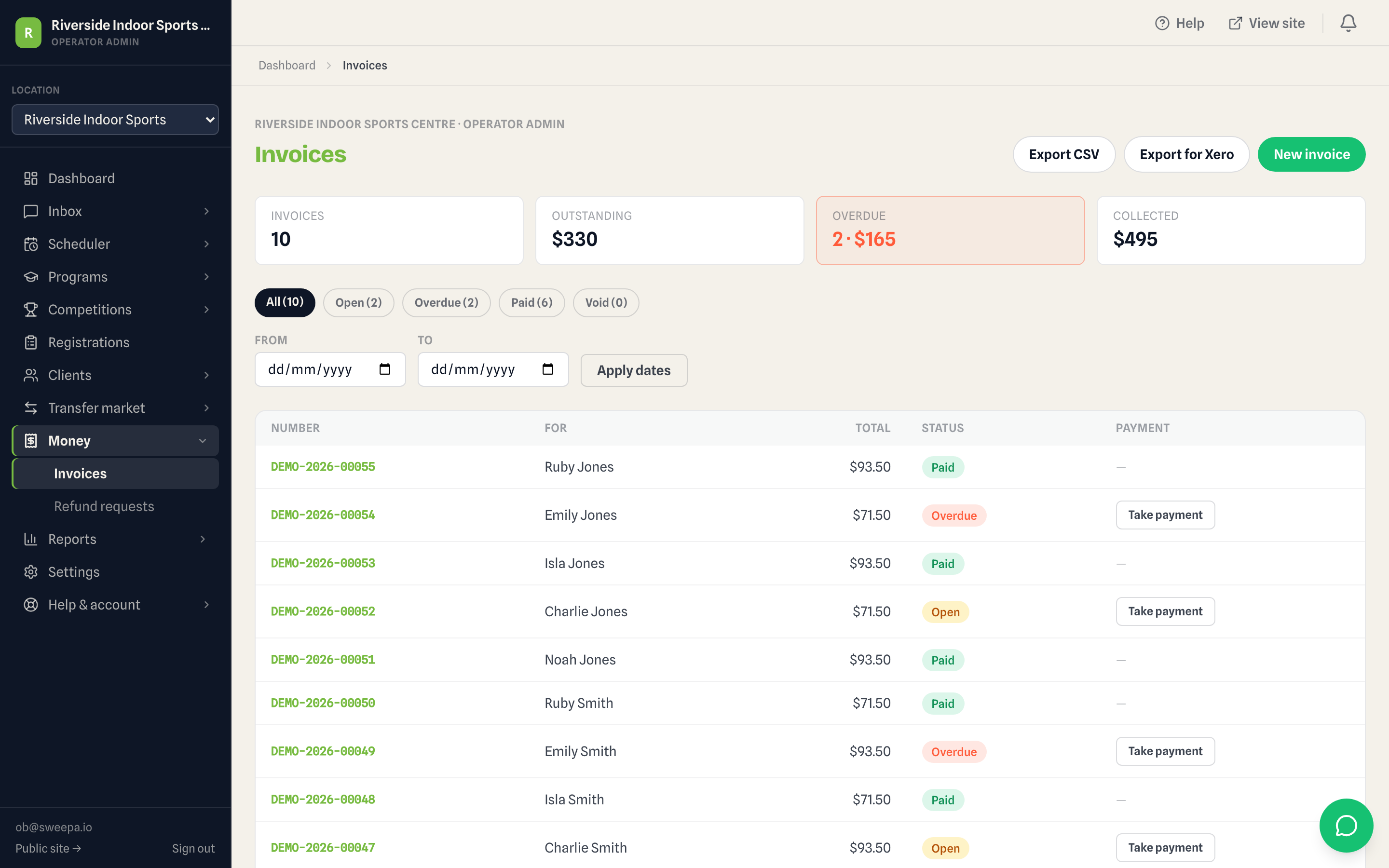
The cleanest version most venues land on: a recurring hirer is invoiced on a set cadence — weekly, monthly, or per term — with invoices issued under your own numbering and prefix, so it's clear at a glance which venue and which season a payment belongs to. Where you want to keep the "confirmed only once paid" principle intact even for regulars, some venues take payment upfront for a block of sessions — a term's worth, a month's worth — rather than session by session. That gets most of the certainty of pay-at-booking with noticeably less weekly admin on both sides.
Whatever the cadence, the same rule applies: decide it once, put it in writing when the recurring hire is set up, and don't let "we'll figure out billing later" become the actual policy — that's how recurring hire quietly turns into the biggest chunk of any debtors list. If team fees rather than court fees are your main headache — a league or club chasing rosters for payment rather than a venue chasing hirers — our guide to team registration payments covers that side of the problem specifically.
Modern payment methods people actually use
Part of why chasing persists longer than it should is that the payment options on offer don't match how people actually want to pay. Someone standing at a court gate with five minutes before their game starts isn't going to dig out a chequebook or log into internet banking on the spot — they'll tap a phone or a card, or they'll walk off and "sort it later," which is exactly the outcome you're trying to avoid.
Card payments, Apple Pay and Google Pay cover the fast, no-friction case — a booking confirmed in the time it takes to tap a phone. Where you've enabled it, Afterpay or Zip can help with larger bookings, like a birthday party or a season's worth of recurring hire, by letting the payer split a bigger upfront cost into pieces they're comfortable with, without you carrying that debt while they pay it off. The point of offering a few well-chosen options isn't variety for its own sake — it's removing every excuse to defer payment because the easy way to pay wasn't available at the moment it mattered.
Policy wording that keeps it friendly
The venues that pull off pay-at-booking without upsetting regulars usually have one thing in common: they say the policy plainly, once, up front — not as a surprise buried in a confirmation email's fine print. A line as simple as "all bookings are confirmed on payment; casual hire is paid in full at time of booking, parties require a deposit to secure the date" does more work than a page of terms and conditions nobody reads.
Tone matters as much as content. "Payment required to confirm your booking" reads as a normal part of how things work. "Please note we now require payment upfront due to non-payment issues" reads as a rebuke aimed at everyone for the sins of a few — and it's the kind of line that makes regulars feel accused rather than informed. Say what the policy is, not why you were forced into it.
It's also worth naming, briefly, when upfront payment isn't the right call. A longstanding council partner working from a standing purchase order, or a school with its own internal invoicing cycle, might reasonably sit outside the standard flow. The goal isn't a rule with zero exceptions — it's a default that covers the vast majority of bookings, with a short, deliberate list of who sits outside it and why, so the exception never quietly becomes the norm.
FAQ
Is it normal to require full payment before a court booking is confirmed?
Yes — it's increasingly the standard approach for casual and one-off court or field hire, and it removes the need to chase payment after the fact. Most venues that switch to pay-at-booking find regulars adjust within a few weeks; the trade-off is a small amount of friction at checkout in exchange for a debtors list that no longer grows on its own.
What's a fair deposit to charge for a party or block booking?
There's no single right number — it depends on how costly a cancellation is for you. A useful starting point is to charge enough that a no-show or late cancellation doesn't leave you out of pocket for the slot, with the balance due closer to the date. Many venues land somewhere between a flat booking fee and around half the total value for larger bookings, then adjust once they've seen how their own cancellation patterns behave.
How do I set up recurring invoicing for regular hirers?
Agree the cadence upfront — weekly, monthly or per term — and issue invoices under your own consistent numbering and prefix so hirers can match payments to the right period. Platforms like Sweepa support this alongside instant pay-at-booking, so you're not forced to choose one model for every hirer on your books.
What happens if a regular hirer's card payment fails?
Treat it as an exception, not a routine chase. With pay-at-booking, failed payments are rare and immediate — you'll typically know within the booking flow itself rather than discovering it weeks later, which makes it a quick follow-up rather than a standing admin task.
Do I need to accept Afterpay or Zip for court hire?
It's not essential, but it can help with larger upfront costs — a party package or a term's worth of recurring hire — where a payer might otherwise hesitate at the full amount. It's worth enabling as an option alongside card, Apple Pay and Google Pay rather than relying on it as your primary method.
How do I introduce a pay-upfront policy without upsetting long-time regulars?
Announce it plainly and in advance rather than springing it on people at their next booking, explain what's changing in one sentence, and keep the tone neutral rather than apologetic or accusatory. Most regulars care more about knowing the rule than about the rule itself — the venues that get pushback are usually the ones that changed the policy quietly and let people find out mid-booking.