Grading Teams into Divisions Fairly: The Method That Survives the First Round of Complaints
A bad grading call follows you all season. Here's a practical method for grading teams into divisions that holds up when captains start asking questions after round one.
On this page
Grading happens once. The consequences run for sixteen rounds.
Get it right and your competition hums along — close games, engaged teams, a waiting list for next season. Get it wrong and you spend the first month fielding calls from a captain whose team is getting belted by thirty goals every week, while another captain complains their division is too easy to bother showing up for.
This guide walks through a practical method for grading teams into divisions that is defensible, consistent, and — crucially — survives the first round of complaints.
Grading teams into divisions: Why grading is the highest-stakes decision you make before a ball is kicked
Every other pre-season decision is reversible. You can shift a fixture time, swap a court, update a fee. Division placement is different. Moving a team mid-season is disruptive for fixtures, ladders, and the teams they leave behind. Most organisers avoid it unless the situation is genuinely untenable — which means a bad grading call compounds for weeks.
The pressure comes from two directions at once. Teams that are placed too high drop out or deregister early. Teams placed too low stop trying and eventually stop coming. Both outcomes hurt your retention numbers and your reputation for running a fair competition.
The goal of grading is not perfection — it is defensibility. You want to be able to explain, calmly and specifically, why each team landed where they did. That explanation, delivered before the season, prevents most complaints from escalating.
What information actually predicts division fit
Before you build any grading framework, collect the right inputs. The more concrete the data, the easier the conversation when a captain pushes back.
Prior season performance. Ladder position and points differential (goals for vs goals against) are the most reliable single indicator. A team that finished mid-table in Division 2 last season belongs in Division 2 until something changes.
Roster changes. A team that lost four of its best six players is not the same team. Ask captains to flag significant departures or additions at registration. Most will tell you honestly — it's in their interest to land in a division they can be competitive in.
Self-assessed grade. Include a grading question on your registration form. "What division do you think your team belongs in?" Teams systematically underrate themselves slightly (they want to win), so if a captain says Division 2, you're probably looking at a Division 1 or 2 team. The self-assessment is a signal, not a verdict.
New player mix. A team with several new or returning-from-injury players is legitimately harder to place. Flag these for a closer look.
Forfeit and attendance history. A team that forfeited three times last season is a risk in any division. Factor it in — not punitively, but practically.
If your registration process isn't capturing this information cleanly, the team registration and payments guide has practical advice on structuring what you collect at sign-up.
The grading methods — and when to use each
There is no single correct method. The right approach depends on how much historical data you have and how much time you can invest.
Carry-over grading uses last season's ladder results directly. Fast, objective, and easy to explain. Works well when your competition is stable — most of the same teams returning, minimal new entrants. Limitation: it rewards teams that sandbag (deliberately play below their level) and doesn't account for roster changes.
Grading games are pre-season scratch matches where you observe teams live before placing them. High accuracy, high overhead. Practical only for competitions with twelve or fewer teams and a venue that can absorb the extra court time. The results also need to be interpreted carefully — teams don't always field full rosters for grading games.
Weighted points frameworks sit between the two. You score each team on a small set of criteria, weight those scores, and rank teams into divisions accordingly. More work than carry-over grading, more scalable than grading games. This is the method most organisers should default to.
How to grade teams into divisions using a simple points framework
Grading teams into divisions with a points framework takes about thirty minutes once you have your data. Here's a version that works for most social sport competitions.
Score each team on four criteria (0–3 points each, 12 points maximum):
- Prior season ladder position — top quarter of their division: 3; middle half: 2; bottom quarter: 1; new team or no data: 0.
- Points differential — positive: 3; within ±10%: 2; negative: 1; large negative (bottom of the table): 0.
- Roster stability — mostly the same group: 3; some changes: 2; significant turnover: 1; entirely new roster: 0.
- Self-assessed grade — bump one point if their self-assessment aligns with or exceeds their score; subtract one point if they significantly under-assessed (common with teams that sandbaged).
Once every team has a score, rank them in descending order. Draw your division cut lines based on the number of spots per division. Teams within two points of a cut line are your border cases — those get individual attention.
For border cases, go back to your qualitative notes: roster changes, any conversations you've had with the captain, attendance patterns. Make a call and document it.
The framework is not the final word — it's a starting point that gives you something concrete to refer back to. When a captain calls on Thursday night after round one, you can say: "We scored every team on four criteria before the season. Here's where your team sat." That conversation is very different from "We just had a feeling."
For more on running fixtures and results once divisions are set, how competitions, fixtures and ladders work in Sweepa is a useful next read.
Handling the edge cases: new teams, mixed rosters, and walk-ins
New teams with no history are the hardest to place. A few approaches that reduce the risk:
Put them in the middle. When you genuinely don't know, place a new team in Division 2 of a three-division competition. They can earn promotion quickly if they're too strong; you can move them down after a review if they're struggling. Starting in the middle minimises the damage either way.
Ask who they've played before. Experienced players know who they've come up against. "We played in a Tuesday night comp at [another venue] last year, mid-table" is useful information even without a formal ladder to reference.
Use a conditional placement. Tell the captain upfront: "We're placing you in Division 2 based on what we know. If you win your first two games by a significant margin, we'll review your division before round four." That sets expectations and gives you a structured off-ramp.
Mixed rosters — where experienced and newer players are on the same team — tend to perform at the level of their best two or three players in the first few rounds. Weight your placement accordingly.
Walk-ins (teams that register close to the deadline) are always a disruption. The how to run a sports league post covers cut-off dates and late registration policy in more detail.
Building a paper trail that protects you
Document your grading process before you publish divisions. This doesn't need to be elaborate — a simple spreadsheet with each team's scores and a one-line note on any border-case decisions is enough.
When you announce divisions, send every team a short message that explains the method you used. Something like: "Divisions were set based on last season's results, roster changes reported at registration, and self-assessed grade. Teams within a close range of division cut-lines were reviewed individually. If you have a question about your placement, reach out before round one and we'll walk through it with you."
This does two things. It invites genuine conversations before the season starts, when you can still make adjustments. And it signals that your process was deliberate — which usually defuses complaints before they become arguments.
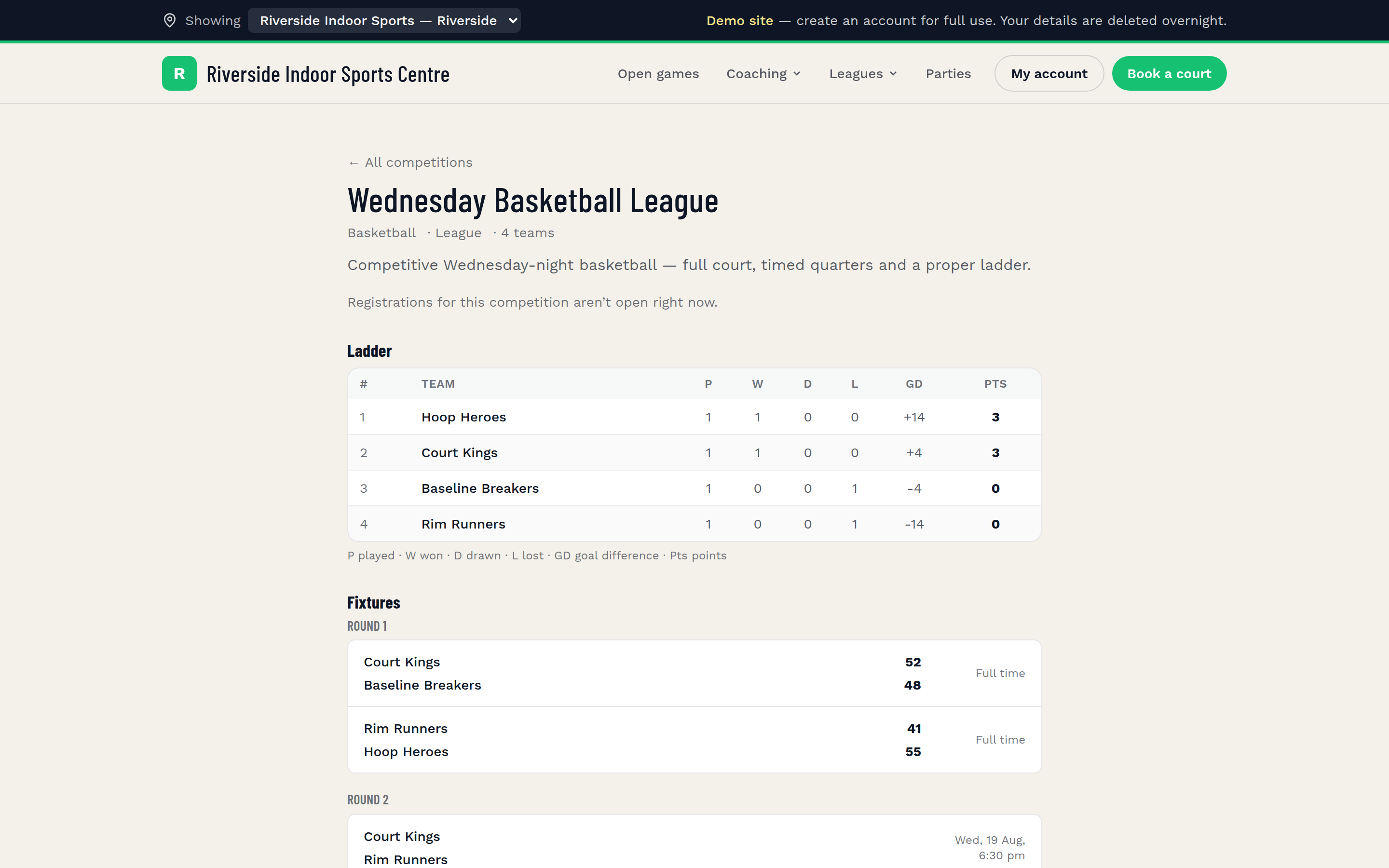
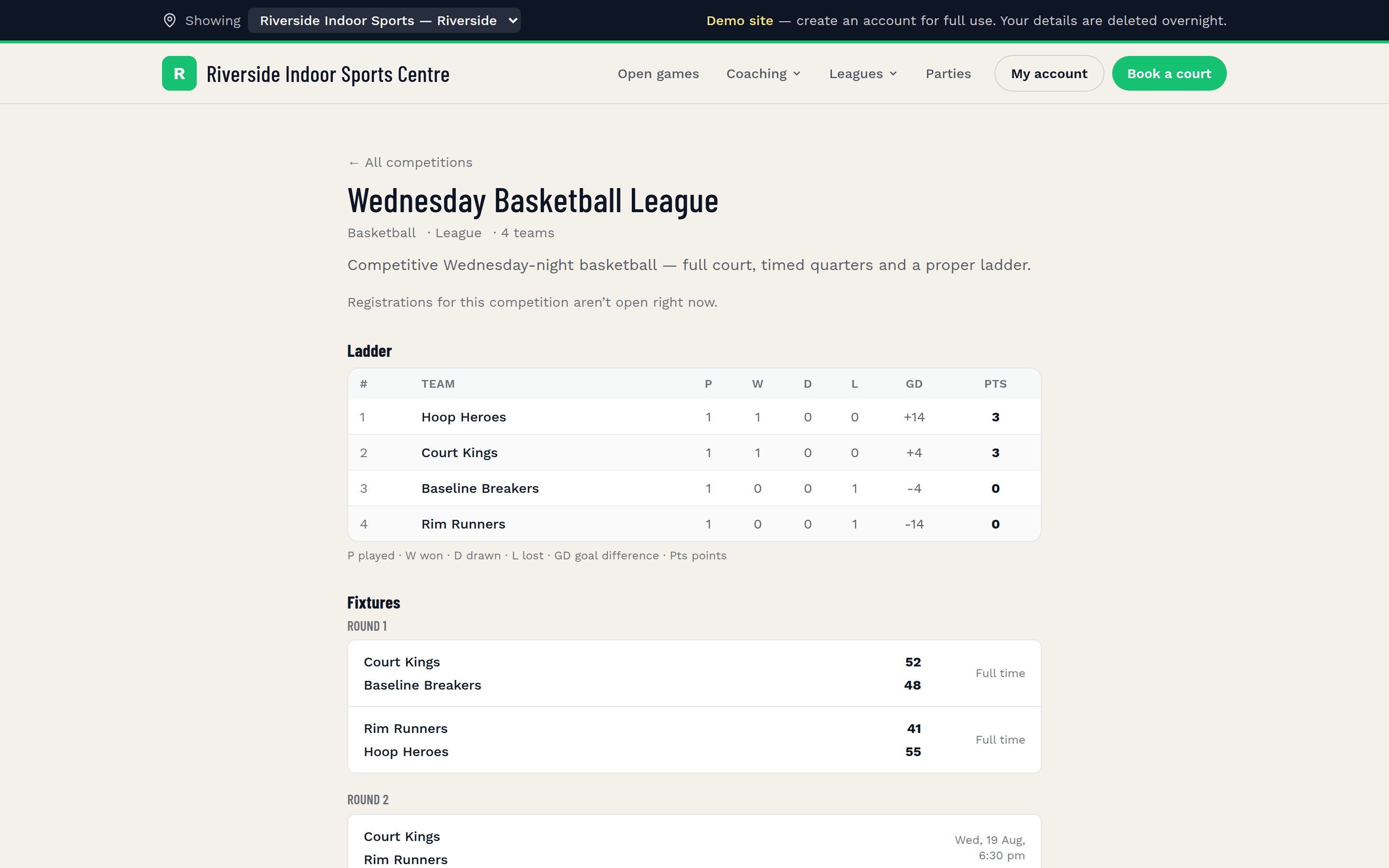
Publish your ladder and fixtures somewhere teams can find them without calling you. A public competition page — one that updates automatically as results come in — removes the "I didn't know" complaint entirely. Sweepa's competition features include a public-facing comp page that teams can bookmark, which cuts down the round-one admin significantly.
What good looks like by round three
By the end of round three you'll have a read on how the grading landed. Signs it worked: games are reasonably close across most matches, no team is winning or losing by embarrassing margins consistently, and captains are focused on the football rather than the admin.
Signs you may need a review: one or two teams are clearly misplaced, there are unusual dropout or forfeit patterns in a specific division, or you're getting repeated complaints about the same matchup.
A mid-season correction isn't a failure — it's part of running a live competition. The key is to have a formal review point (after round three or four works well), communicate it upfront so teams expect it, and apply the same structured criteria when you move anyone.
Retention across the full season — and into the next — is covered in the end of season playbook, which is worth reading once your divisions are settled and you're thinking about what comes after the grand final.
Grading is never going to make everyone happy. But a clear method, documented and communicated well, means the unhappy teams are arguing with a process rather than accusing you of favouritism. That's a conversation you can manage.
FAQ
How many divisions should I run?
As a rule, aim for at least six teams per division — fewer than that and a forfeit can dramatically skew the ladder. If you have fewer than twelve teams total, a single division with a graded finals format (top half vs top half, bottom half vs bottom half) often works better than splitting into two thin divisions.
Can I move a team between divisions mid-season?
Yes, but do it before round five if you can. Later than that and the ladder impact becomes significant — the team's results stay on the ladder even after they move, which affects other teams' standings. Communicate the move to all affected teams in writing, explain why, and update the fixture schedule immediately.
What if two teams protest their placement at the same time?
Deal with them separately, using your documented scoring for each. Avoid letting one team's complaint influence another's outcome. If both have genuine grounds, prioritise the team with the stronger case for movement and put the other on a formal review at round three.
Should I let teams self-select their division?
Partial self-selection — where you use the captain's preference as one input among several — works well. Full self-selection (teams pick their own division with no override) leads to sandbagging in lower divisions and teams in over their heads in higher ones. Use self-assessment as a signal, not a decision.
How do I handle a team that wants to be promoted from last season even though their ladder record doesn't support it?
Ask for specifics: who did they add to the roster? What changed? If there's a genuine reason — like three new players who played at a higher level — you can factor that in and document it. If the reason is just ambition, hold the line and tell them to earn it in round one.