Sports Venue Booking Spreadsheet: 7 Signs You've Outgrown It
Double bookings, payment chasing and a sheet only one person understands aren't quirks — they're signs your sports venue booking spreadsheet has hit its limit. Here's how to tell, and how to move off it in 30 days.
On this page
Spreadsheets got you here — respect
Almost every venue we talk to started with the same thing: a sports venue booking spreadsheet, built by someone who just needed a grid — courts down one side, half-hour slots across the top, a name typed into whichever cell was free. It worked well enough that nobody ever replaced it. That's a smart first move, not a mistake. A spreadsheet is free, everyone already knows how to open it, and it does exactly what a single court with a handful of regulars needs it to do.
That's worth saying plainly before we get into what's wrong with it: your spreadsheet did its job. It got you from nothing to a running venue. The problem isn't that whoever built it did it badly — it's that most venues eventually grow past what a shared grid of cells was ever designed to do. A spreadsheet can't take a deposit, can't stop two people booking the same slot at the same moment, and can't show a customer what's free at 9pm on a Tuesday without someone answering the phone. It didn't fail you. You outgrew it.
The seven signs your sports venue booking spreadsheet has hit its limit
Most operators don't wake up one day and decide to replace the sheet — they notice the same handful of manual booking system problems piling up until the admin load stops being background noise and starts being the job. Here's what that usually looks like in practice.
- You find out about double bookings when two teams show up. Not before, not from a warning. Two groups arrive for court 2 at 6pm, and now you're the one standing between them working out who gets the court and who gets an apology.
- Payment chasing has become a part-time job. Invoices sent by text, EFT references manually reconciled against a bank statement, no-shows who were never charged a cent because there was no way to take payment upfront. Friday afternoons go on chasing money for games played three weeks ago.
- Two staff can't touch the calendar at the same time. Someone opens the sheet to add a booking while someone else is already in it, and one of you loses your changes. On a busy changeover day, that's not a minor annoyance — it's a booking that quietly vanishes.
- Customers ring or message because there's nowhere else to check. No public page shows what's free, so every booking starts with a phone call or a string of texts back and forth, most of them outside business hours.
- You've bolted on a second sheet, then a third. One for casual hire, one for parties, one for the comp draw, and none of them talk to each other — so a court can be double-committed across two sheets and nobody notices until someone turns up.
- One person understands how the sheet actually works, and they're on leave. The colour coding, the hidden tabs, the formula nobody else dares touch — tribal knowledge that lives in one head instead of the system.
- You can't answer "what's on court 2 at 3pm Thursday" without opening three tabs. If a simple availability question takes longer than the booking itself, the tool has stopped saving you time and started costing it.
If two or three of these sound familiar, that's not a coincidence — it's the pattern almost every venue we talk to describes right before they replace their booking spreadsheet.
What the manual system really costs
The costs are easy to underestimate because they're spread thin across a week rather than showing up as one big bill. Add them up and they're rarely small.
The most obvious cost is time — hours every week spent on jobs a proper system does automatically: chasing payments, resolving clashes, answering "are you free Thursday?" messages, manually merging two people's edits back into one sheet. That's time not spent coaching, selling a party package, or fixing the thing that's actually broken on court 3.
The less obvious cost is trust. A regular who turns up to a double-booked court doesn't blame the spreadsheet — they blame the venue. Enough of those moments and people quietly start booking somewhere else, or stop trusting your availability enough to commit to a season. A missed payment chase isn't just lost revenue either; it's a debt you now have to awkwardly ask a customer to settle after the fact, which is a worse conversation than asking for it upfront ever would have been.
There's also a ceiling cost that only shows up when you try to grow. Adding a second location, a comp draw, or a new coaching program onto a system built for one court and one sheet usually means another tab, another workaround, another thing only one person understands. The manual system doesn't just cost time today — it caps how much venue you can realistically run before the admin model buckles. We go into this in more depth in our guide on running a sports facility well, where the booking system is one of several foundations that either scale with you or quietly hold you back.
What to move first
You don't need to replace everything on day one, and trying to is usually how a migration stalls. Start with whatever causes the most pain, most often — for most venues, that's the shared court or field booking calendar, because it's where double bookings happen, where payment gets chased, and where every staff member and customer needs a single source of truth.
Get the core calendar — casual hire, recurring bookings, and upfront payment — onto a proper system first and let it run for a full cycle before you touch anything else. Comp draws, coaching registrations and multi-location rollouts can all wait a few weeks; a venue that still double-books its main calendar doesn't need a fancier competition ladder yet, it needs the basics solid. Once the calendar is genuinely reliable, moving the next piece — a term program's registrations, say, or a second site's bookings — is a much smaller step than trying to do it all in one weekend.
A 30-day migration path
A full replace-your-booking-spreadsheet migration doesn't need to be dramatic. Spread over a month, in parallel with running your venue as normal, it looks something like this.
Week 1 — audit and set up. Export your current spreadsheet as a permanent record (you'll want it for tax and history, not for booking). List every booking type, price, and rule you currently run off the sheet — casual hire, member rates, cancellation windows, deposit amounts — because half of what makes a spreadsheet workable is knowledge that never got written down anywhere else. Sign up for a trial and start entering your courts, spaces and opening hours.
Week 2 — configure and test. Build out pricing rules, availability windows and your cancellation policy in the new system. Connect payments so bookings are charged upfront instead of invoiced after the fact. Get every staff member who currently touches the spreadsheet to make a handful of test bookings and flag anything that doesn't match how the venue actually runs.
Week 3 — run in parallel. Start taking new bookings on the new system while the spreadsheet stays open purely as a reference for anything already committed under the old process. This is the week that catches edge cases — a recurring booking with an odd cadence, a long-standing discount nobody wrote down — before they become customer-facing problems.
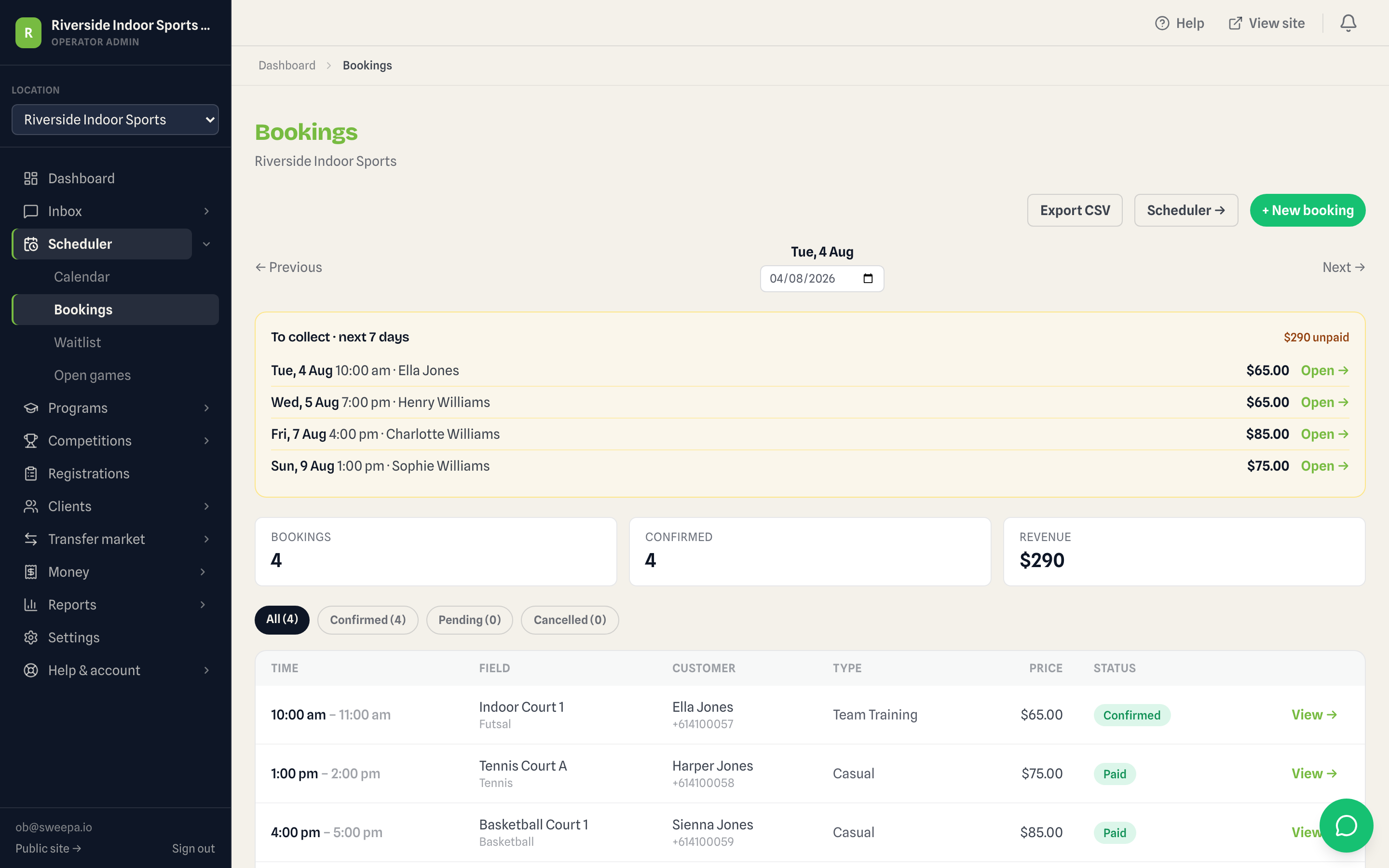
Week 4 — cut over. Retire the spreadsheet for new bookings entirely and point every customer, staff member and booking link at the new system. Archive the old file somewhere safe rather than deleting it — it's still your historical record. By the end of the month, the question "what's on court 2 at 3pm Thursday" should have a one-glance answer.
What's fine to keep in a spreadsheet
Not everything needs to leave. It's worth being honest about this, because the point of moving off a booking spreadsheet isn't to distrust spreadsheets generally — it's to stop asking one to do a job it was never built for.
A one-off sign-up sheet for a working bee or a single working weekend is still a perfectly good spreadsheet job. So is a rough waiting list for a holiday clinic that only ever runs once, an equipment maintenance log, or a simple roster for a two-person casual staff team. Budget tracking, ad hoc planning notes, a list of sponsor contacts — none of that needs a booking platform underneath it, and forcing it into one adds complexity for no real gain.
The line worth drawing is between things that are booked, paid for and clashed over, and things that are just a list. If a venue genuinely runs a handful of bookings a week off one court and everyone who needs to see the sheet can see it, there's no shame in staying there until growth actually forces the issue. The seven signs above are the test — not "do you use a spreadsheet," but "is the spreadsheet costing you more than it's saving you."
If the signs are stacking up, Sweepa's booking and payments features bring the calendar, upfront payments and staff access onto one shared system, so the calendar stops being the thing that only one person understands. It's also worth reading how we think about taking online bookings for a sports venue if self-service booking is the piece missing from your current setup.
FAQ
How do I know if my venue has really outgrown its booking spreadsheet?
Look for the pattern rather than any single incident: double bookings you only find out about when both parties show up, payment chasing that eats a regular chunk of your week, two staff unable to edit the calendar at once, and no public page customers can check themselves. One of these on its own might just be a bad week. Two or three together, most weeks, is a sign the spreadsheet has reached its limit.
What's the biggest risk of sticking with a manual booking system?
Double bookings are the most visible risk, but the bigger long-term one is trust — a regular who turns up to a clash blames the venue, not the spreadsheet, and enough of those moments push people to book elsewhere. There's also a growth ceiling: a manual system built for one court rarely stretches cleanly to a second location or a new program without becoming even more fragile.
Do I need to replace my whole spreadsheet system at once?
No, and trying to usually stalls the whole migration. Start with the shared court or field booking calendar first, since that's where double bookings and payment chasing actually happen, and let it run for a full cycle before moving comp draws, registrations or a second location across.
Can I still use spreadsheets for anything once I've moved off the booking one?
Plenty. One-off sign-up sheets, a waiting list for a clinic that only runs once, an equipment maintenance log, a simple roster for a small casual staff team — none of that needs a booking platform underneath it. The line is between things that are booked, paid for and can clash, and things that are just a list.
How long does it take to move off a booking spreadsheet?
A phased 30-day path — audit and set up, configure, run in parallel, then cut over — is realistic for most single-site venues. Full staff comfort and a fully clean cutover, including catching the edge cases nobody wrote down, usually settles in over a full season rather than the first month.
Will regular customers notice when I switch off the spreadsheet?
Mostly, and mostly positively — they gain a public page to check availability and book themselves instead of texting or calling, plus automatic confirmations and reminders. The main thing to communicate clearly is where to book from cutover day, since that's the one habit that needs to change.