Competition Ladder Software: Ladders Players Actually Check
A ladder nobody can find is a ladder nobody trusts. Here's what good competition ladder software actually needs — from fast results entry to a public comp page people check from the bar.
On this page
Why competition ladder software needs a public comp page
A ladder that only exists in the competitions secretary's spreadsheet isn't a ladder. It's a private document that happens to describe a public competition. The moment your Tuesday night comp finishes round six, every captain, every player, and a decent chunk of their families want to know one thing: where do we sit. If the honest answer is "I'll email it out by Thursday," you've already lost the argument for why anyone should care about round seven.
This is the gap competition ladder software is supposed to close. Not a scoring app for the committee — a public page, reachable from a phone, that shows the current table, this week's results and the draw, updated the same night the last game finishes. Publish sports results online properly and the comp starts running itself, in the sense that matters most: people stop asking you and start checking the page.
The stakes are higher than they look. A league ladder online that's wrong, stale or hard to find doesn't just annoy one captain — it erodes trust in the whole competition. Teams start keeping their own tally "just in case," disputes multiply because nobody's working off the same numbers, and the volunteer running results entry becomes the bottleneck for a comp that should run itself by round three. Get the public side right and most of that friction disappears before it starts.
Sweepa publishes a live comp page for every competition — ladder, results and draw, all public, no login required — as part of the competitions and fixtures features. It's built to be the single source of truth captains actually use, rather than one more channel competing with a group chat.
Entering results fast (or it never happens)
Here's the operational truth behind every stale ladder: results entry that takes more than about ninety seconds per game doesn't get done on the night. It gets done "when I get a chance," which in practice means Wednesday, sometimes Thursday, occasionally not until someone complains.
Think about what actually happens courtside or pitchside at 9:40pm. The last game of the night finishes, the ref or duty manager is packing away, three other things are competing for their attention, and the last thing anyone wants is to log into a desktop admin panel to type in a score. If entering a result requires finding a laptop, that result is getting entered from memory two days later — and memory is where scorelines go to get slightly wrong.
The fix isn't a better spreadsheet. It's making results entry something that can happen from a phone, on the spot, by whoever's actually there — a duty manager, a ref, sometimes a team captain if you allow it. Tap the score in, confirm, done. The ladder recalculates itself and the public page updates without anyone touching a formula.
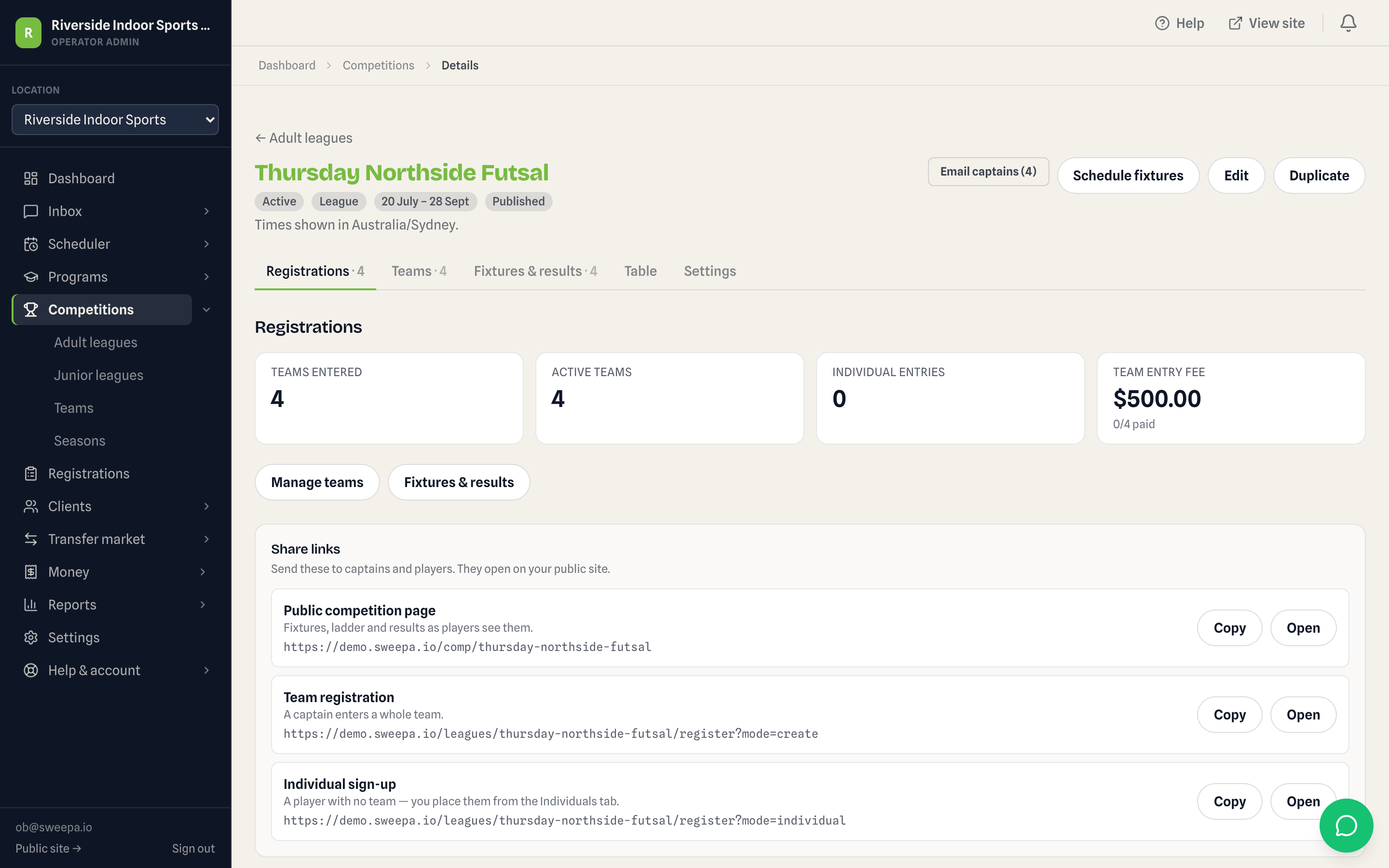
Speed matters more than polish here. A results screen that takes four taps beats one that looks beautiful but takes four screens. If your current process involves a paper scoresheet that gets photographed, texted to someone, then manually typed into a table later, every one of those handoffs is a place where a result goes missing, gets duplicated, or gets attached to the wrong team. Cut the handoffs and the ladder stops lagging the actual competition.
Ladder rules: points, percentage, tiebreaks
Most comps run on some version of the same points system — a win's worth more than a draw, a draw's worth more than a loss, byes get a flat allocation — but the exact numbers vary by sport and by comp, and getting them wrong (or applying them inconsistently) is one of the fastest ways to lose a room's trust in the ladder.
When two or more teams sit level on points, the usual next check is percentage — for-and-against, expressed as a ratio or a differential depending on the sport. A netball or basketball comp typically works in points for divided by points against; a soccer comp more often uses goal difference. After percentage, most rule sets fall back to head-to-head result between the tied teams, and after that, sometimes to games won or a coin toss for the truly stubborn tie. None of this is exotic — it's the same logic every local competition has run on butcher's paper for decades. What changes is whether the software actually applies it correctly, automatically, every round, instead of someone recalculating percentages by hand in a spreadsheet and hoping they didn't fat-finger a cell.
Worth being upfront about: ladder configurability varies. Sweepa's ladder logic covers the standard points-percentage-head-to-head pattern competition organisers actually run week to week, configured per competition rather than one fixed formula for every sport. If your comp has a genuinely unusual custom rule — some invented tie-breaking formula specific to one committee's history — it's worth checking that your particular rule set is supported before you commit a season to it, rather than assuming any competition ladder software handles every conceivable edge case out of the box.
Handling forfeits
Forfeits are where a lot of otherwise-decent ladder systems fall over, because a forfeit isn't really a result — it's a result plus a policy decision. Does the forfeiting team get a loss and the opponent a standard win? Does the winning side get a flat scoreline applied for percentage purposes, or the best score recorded so far that season? Is there a fee attached, or a warning system before a second forfeit costs points?
None of that's a software question first — it's a competition rules question, and it needs to be settled and communicated before round one, not improvised the first time a team doesn't show. But once the policy exists, the system needs to apply it the same way every time: same points allocation, same percentage treatment, same ladder update, whether it's round two or the second-last round of the season when a forfeit can change who plays finals.
What you want to avoid is a forfeit being entered as a normal match with a made-up scoreline, because that quietly distorts percentage for both teams involved and for anyone above them chasing the same tiebreak. A proper forfeit entry should be flagged as a forfeit, not disguised as a 5-0 result someone typed in to make the ladder balance. Get that distinction right in the software and forfeit disputes become a rules conversation, not an accusation that someone's been fiddling the numbers.
Designed for phones at the pub
Here's the scene that actually matters, and it's not a committee member at a desktop on Monday morning. It's Wednesday night, a team's just finished their game, half of them are still in their kit, and someone's standing at the bar with their phone out, thumb-scrolling to see whether a win tonight got them past the team two spots up. Nobody's going to type a full URL into a phone browser and squint at a table designed for a widescreen monitor. If the ladder isn't built for that exact moment — one hand, bad lighting, three beers in — it isn't really public, no matter how many people technically have the link.
A public comp page has to work as a piece of mobile-first reading: the ladder readable without pinching to zoom, this round's results visible without scrolling through four other things first, next week's draw one tap away. That's not a nice-to-have layered on top of a real ladder system — for most comps, a phone screen at the pub or in the carpark is the primary way the ladder actually gets read, more than any desktop view ever will.
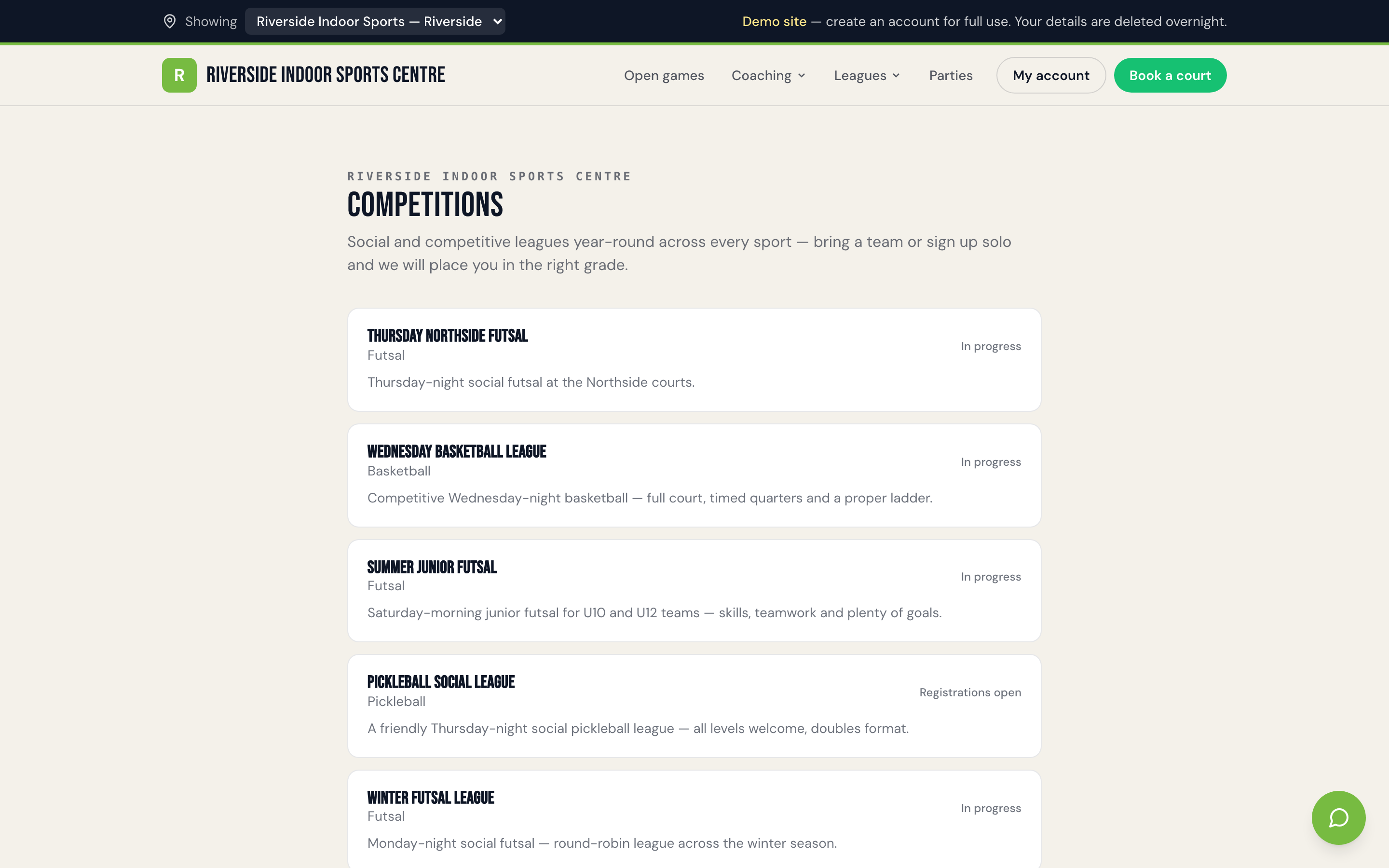
Sweepa's public comp pages are built for exactly that — no login, no app to download, just a link anyone can open on whatever phone's in their pocket. Share it in the team group chat once at the start of the season and it stays current without anyone re-sending it.
The comp page as next season's marketing
Here's the part organisers underrate: a good, live, accurate comp page isn't just administrative infrastructure. It's the best advertisement your competition has for next season, and it costs nothing extra once it exists.
Think about who actually looks at a ladder beyond the players in it. A parent deciding whether to put their kid in next term's comp. A mate a player's been trying to recruit for the team that's short numbers. Someone who played five years ago wondering if the Tuesday comp's still running. All of them are more likely to act on a page that looks alive — recent results, an up-to-date table, a draw that clearly extends into coming weeks — than on a stale page last updated in round three, or worse, no public page at all. A dead-looking ladder quietly signals a dying competition, whether or not that's true.
The comp page also does quiet work across a season that a spreadsheet never could — it's shareable, so a team can post their ladder position without anyone needing admin access; it's evergreen, so it keeps working as a reference weeks after the round it describes; and it compounds, because a competition that clearly runs itself well is easier to fill next season without a hard recruitment push. If you're already thinking about how fixtures set the season up in the first place, it's worth reading our guide to creating sports fixtures, since a well-built draw is what a good ladder is measuring in the first place. And for the broader picture of what running a competition well involves end to end, our guide on how to run a sports league covers the season from entries through to grand final.
None of this needs to be complicated software. It needs results entered on the night, ladder logic applied consistently, and a page built for the phone in someone's hand at the bar — not a laptop nobody's opening until Thursday.
FAQ
What's the difference between competition ladder software and a spreadsheet?
A spreadsheet can technically hold the same numbers, but it doesn't publish itself, doesn't recalculate percentage and tiebreaks automatically, and isn't something a captain can check from their phone without someone emailing a link every week. Ladder software does the calculation and the publishing in the same step results get entered.
How is a ladder tiebreak usually decided?
Most competitions work down a standard sequence: competition points first, then percentage (points or goals for versus against), then head-to-head result between the tied teams, occasionally falling back further to games won. The exact order and formula should be set in your competition rules before the season starts, and applied the same way every round.
How should forfeits be scored on the ladder?
That's a rules decision for your competition, not a software one — typically a standard win/loss allocation plus an agreed treatment for percentage purposes. What matters is that forfeits are recorded as forfeits, not disguised as an ordinary scoreline, so they don't quietly distort percentage for every other team chasing the same tiebreak.
Can players and parents see the ladder without logging in?
Yes, that's the point of a public comp page — a shareable link anyone can open on their phone, showing the live ladder, recent results and the upcoming draw, with no account or app required.
How quickly should results appear on the public ladder after a game?
As close to same-night as possible. The moment results entry takes more than a minute or requires a desktop, it tends to slip to the next day or later, and a ladder that's always a few days behind stops being something people trust or check.
Does every sport use the same ladder points system?
No — the general shape (win beats draw beats loss, byes get a flat allocation) is common, but exact points values and whether percentage is calculated as a ratio or a differential varies by sport and by comp. Check your governing body's standard rules for the sport before finalising your own.