The Real Cost of Five Different Tools vs. All-In-One Sports Management Software
Running a venue on a booking calendar, a rego tool, a fixturing spreadsheet, an invoicing app and an SMS service adds up in ways that rarely show on a single bill. Here's what that sports software stack actually costs, and what all-in-one sports management software has to prove before it earns your switch.
On this page
How the accidental stack happens
Nobody sets out to run a venue on five disconnected tools instead of one all-in-one sports management software platform. It happens one decision at a time: a booking calendar chosen in year one because it was cheap, a registration tool bolted on when the coaching program took off, a spreadsheet for the Saturday competition draw, an invoicing app because the booking tool's receipts looked unprofessional, and an SMS service because emails kept landing in spam. None of these were bad decisions alone. Each solved a real problem, at the time, for less money or less hassle than the alternative.
Two or three years later, you're logging into five things before lunch. That's the pattern we see constantly with venues, coaching programs and league organisers who come to us mid-growth: nobody chose fragmentation on purpose. It accumulated, quietly, the same way a garage fills up — one reasonable addition at a time, until one day you can't find the thing you actually need.

The stack usually grows along the lines of the business, which is exactly why it's hard to see from inside it. A facility adds a coaching program and reaches for whatever registration tool the coach already knew. A coaching program adds a competition and grabs a fixturing app built for exactly that job. A league adds team payments and picks whatever invoicing tool has the friendliest free tier. Each choice is locally sensible. The problem only shows up in aggregate — when you try to answer a question that spans more than one tool, like "which families haven't paid for both the term program and Saturday comp fees," and realise nothing in your sports software stack can actually answer it.
The four hidden costs of a disconnected sports software stack
The cost of running five tools instead of one rarely shows up as a single bill you can point to. It's spread thin across a week, in time and friction rather than dollars, which is exactly why it's easy to underestimate for years. Four costs show up again and again once you start looking for them.
Double entry
Every system that doesn't talk to the others needs a human to be the connector. A new sign-up gets typed into the registration tool, then re-typed into the comms platform's contact list, then re-typed again into the invoicing app so a bill can go out. Multiply that by every booking, every rego, every team fee, every season, and double entry stops being a minor annoyance and becomes a standing tax on your week — paid in the same handful of minutes, over and over, by whoever drew the short straw on data entry that day.
Blind spots
Five tools means five partial pictures, and nobody holds the whole one. The booking calendar doesn't know a family also owes camp fees. The comp fixture doesn't know a team's payment bounced. The registration tool doesn't know a coach flagged a behaviour issue in a text message that lives in someone's personal phone. Individually, each system might report accurately on its own slice. Together, they can't answer the questions that actually matter — who's really paid up, who's about to churn, which program is quietly losing money — because the answer lives in the gaps between systems, not inside any one of them.
Subscription creep
Five separate subscriptions rarely feel expensive individually. A booking tool at one price, a registration platform at another, a fixturing app that's "basically free," an invoicing tool riding on a broader accounting plan, an SMS service billed per message. Reviewed one at a time, on five different renewal dates, none of them looks like the thing to cut. Added up and reviewed once a year — which almost nobody does — the total is usually a surprise, and it tends to only go up as usage grows, since most of these tools price per booking, per message or per active family.
Support ping-pong
When something breaks at the seam between two systems — a payment that went through but never marked a booking paid, a registration that didn't trigger the confirmation text — you're stuck explaining the same problem to two different support teams, each of whom can only see their half of it. One says the payment left their system fine, the other says they never received it. Nobody owns the actual failure, because it happened in the space between two vendors who've never spoken to each other. That's the moment "cheap and simple" tools turn into the most expensive part of your week.
Put together, these four costs are why the pitch to replace multiple tools with one platform is less about tidiness and more about getting a straight answer to ordinary operational questions, quickly, without opening three tabs and cross-referencing by hand.
When point tools are genuinely right
Here's the part most vendor blog posts skip: an all-in-one isn't automatically the right call, and a good one should be honest about where it isn't. If your venue's bookkeeping needs go well beyond invoicing — multi-entity consolidation, complex GST handling, payroll integration — a dedicated accounting package with a proper bookkeeper behind it will out-perform any all-in-one's invoicing module every time, because that's not the job an all-in-one is built to do. Check with your accountant or the ATO's own guidance on what your structure actually requires, rather than expecting sports management software to double as tax software.
The same goes for niche sport-specific scoring. If you run a competition with scoring rules so particular — a specific tennis tiebreak variant, a sport with a small, dedicated national scoring body — that only a purpose-built scoring system handles it correctly, that specialist tool is doing a job worth keeping. A general competition module built to serve dozens of sports well is unlikely to out-match software written for exactly one sport's exact rules.
There's also a scale argument in the other direction: a single court with a handful of regulars who all have your mobile number doesn't need a platform at all yet. A shared calendar and a text thread is a perfectly good system until the volume outgrows it. Buying a full platform before you need one just adds a login nobody uses.
The honest test isn't "does a point tool do one thing better" — most do, that's what specialisation buys you. It's whether that one thing is important enough, and different enough from everything else you run, to be worth the double entry and blind spots that come from keeping it separate.
What an all-in-one sports management software has to prove before you switch
Given all that, the bar for consolidating your sports software stack should be high, not just "it's one login instead of five." Before you move, it's reasonable to expect a platform to prove a few things.
First, that it actually covers the ground you need — not a roadmap promise, but bookings, registrations, competitions and payments genuinely shipped and working today, not one strong module carrying four weak ones. Second, that the data connects the way the pitch implies: a family's booking, their camp registration and their comp team fee should all read off the same customer record, not sit in adjacent tables that happen to share a login screen. Third, that it doesn't just move the blind spots around — a dashboard that shows five things on one screen without actually reconciling them against each other isn't solving the problem, it's repainting it.
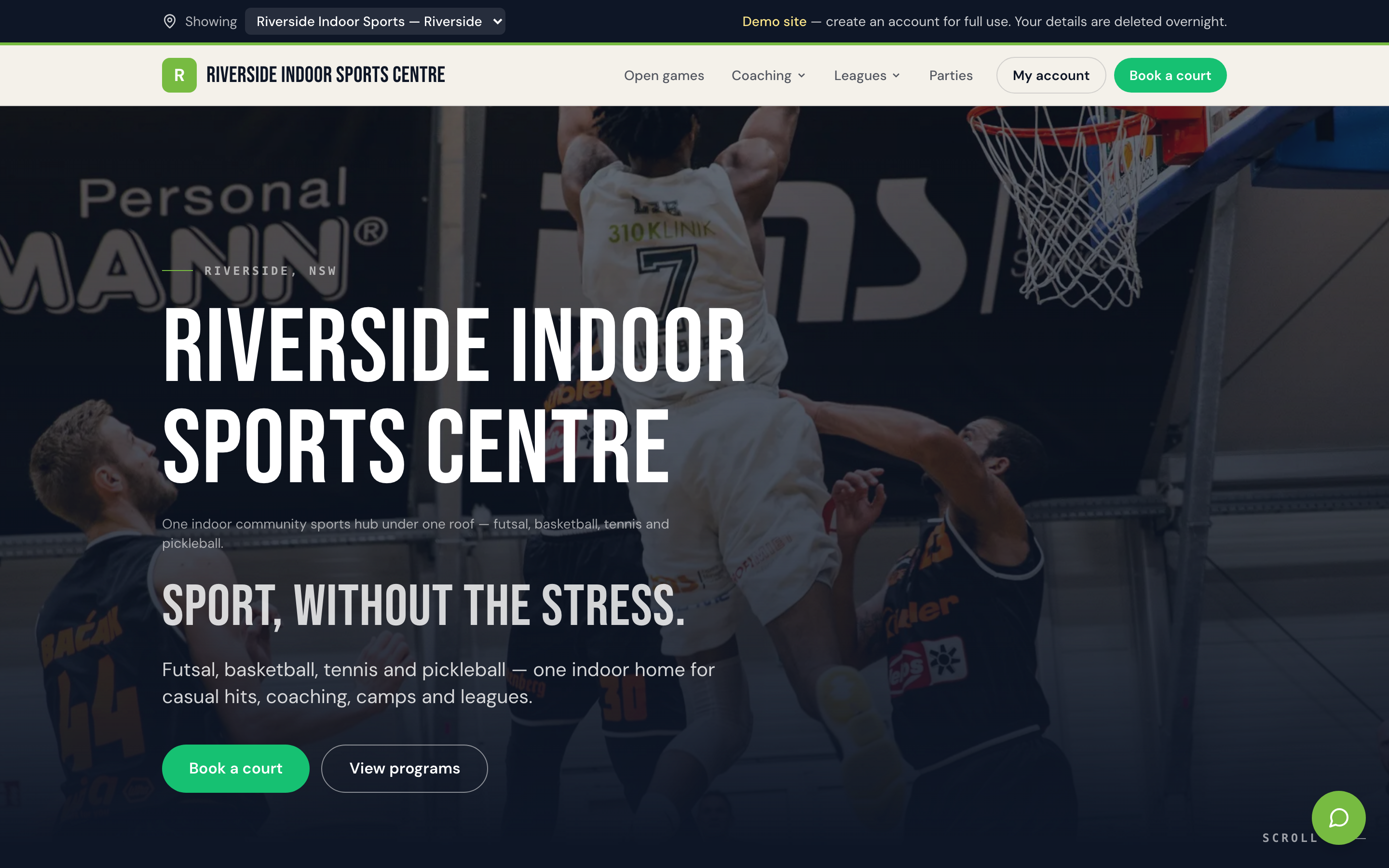
Sweepa's own answer to that bar is our features page, which lays out what's actually shipped rather than promised — bookings, registrations, competitions and Stripe-native payments running off one calendar and one customer record, with a branded site that shows all of it under one roof rather than five separate logins pointing at five separate brands. Our guide to what sports facility management software should actually do goes deeper on the non-negotiables worth checking with any vendor, including us, before you commit to a switch.
A migration path that isn't scary
The idea of moving five systems' worth of history into one platform is usually scarier than the actual work, which is why so many venues stay stuck on a stack they've outgrown. It doesn't need to happen in one weekend, and trying to do it that way is the most common way a migration stalls.
Start with the piece causing the most pain, not the piece that's easiest to move. For most facility operators that's bookings and payments, since that's where double entry and blind spots hit hardest, every single week. For a coaching program it's often registrations, waitlists and attendance. For a league, it's usually fixtures and team payments landing in the same place. Move that one piece first, run it for a full cycle — a month, a term, a season — and let your team get genuinely comfortable before adding the next.
Keep the old tools running in read-only mode as your historical record rather than deleting anything. You'll want last season's data for tax purposes and for context, even once new activity has moved across. And bring your people along deliberately: a staff member who's used a booking spreadsheet for three years needs a proper look at the new system, not a link in a group chat the night before it goes live. The venues that migrate calmly are almost always the ones that moved one piece at a time and gave each one room to bed in before starting the next.
The honest trade-offs
Consolidating onto one platform isn't free of trade-offs, and it's worth naming them plainly rather than pretending otherwise. You're trusting more of your operation to one vendor, which means that vendor's roadmap, support quality and uptime matter more than any single point tool's ever did. If a niche feature you relied on in a specialist tool isn't in the all-in-one yet, you either wait for it, work around it, or decide it's not worth losing everything else you'd gain. And switching costs are real in both directions — moving off five tools takes effort now, in exchange for not paying the double-entry, blind-spot, subscription-creep and support-ping-pong tax indefinitely into the future.
The trade worth making is usually simple to state, even if it isn't always simple to feel: a season or two of manageable migration effort, against years of a standing tax on your time that never really goes away on its own. For most facility, coaching and league operators juggling more than one system already, that trade tips clearly one way. It won't for everyone — and if your situation is one of the genuine exceptions above, a good all-in-one vendor should tell you that plainly rather than sell past it. We've written more about why we built one platform instead of stitching five together in why we built Sweepa, if you want the fuller story behind this particular bias.
FAQ
What's the real cost of running a venue on five different tools?
It rarely shows up as one bill you can point to. It's spread across a week as double entry (re-typing the same booking or family into three systems), blind spots (nobody can see the whole customer picture, so payment or attendance issues slip through), subscription creep (five small recurring costs on five different renewal dates that quietly add up), and support ping-pong (when something breaks at the seam between two tools, neither vendor can see the whole problem). None of these show up as a dramatic number, which is exactly why they're easy to underestimate for years.
Is all-in-one sports management software always better than specialist point tools?
No, and a credible vendor should say so plainly. If your venue's bookkeeping needs go well beyond invoicing, a dedicated accounting package with a proper bookkeeper will out-perform any all-in-one's invoicing module. The same applies to a competition with scoring rules so sport-specific that only a purpose-built scoring system handles them correctly. An all-in-one earns its place by covering the ground most facility, coaching and league operators need in one connected system, not by claiming to beat every specialist tool at its own narrow job.
How do I know if my sports software stack has become a problem?
The clearest sign is being unable to answer an ordinary operational question without opening three tabs and cross-referencing by hand, such as which families owe money across both a term program and a competition, or which bookings a payment failure actually affected. If getting that answer means logging into more than one system and reconciling manually, the stack has outgrown what it was meant to save you.
How long does it take to move from multiple tools onto one platform?
It doesn't need to happen in one weekend, and trying to usually stalls the whole migration. A realistic path moves the highest-pain piece first, often bookings and payments for a facility, or registrations for a coaching program, runs it for a full cycle so staff genuinely get comfortable, then adds the next piece. Most venues, programs and leagues can move fully across over one to two seasons without disrupting the season already underway.
Will I lose historical booking, registration or payment data when I consolidate?
Not if you handle the migration properly. Keep old tools running in read-only mode as your historical record rather than deleting them outright, since you'll want that data for tax purposes and context even once new activity has moved across. A straightforward vendor should be able to explain how to bring existing customer and booking records into the new system before you commit.
Does one platform actually work across facility, coaching and league operations at once?
It should, if it's a genuine all-in-one rather than one strong module with four weak ones bolted on. The value is a shared customer record: a family's court booking, their child's camp registration and their team's competition fees should all read off the same account, so a coaching program, a casual booking and a comp fixture can't quietly conflict with each other the way they can across five disconnected tools.