Sports Tournament Formats Explained: Round Robin, Pools and Knockouts
Round robin, pool play, single elimination — picking the wrong format costs you court time, player buy-in and a clean grand final. Here's how to match the format to your competition.
On this page
Choosing your sports tournament formats might feel like a back-office decision nobody cares about. Players just want to play, right? In practice, the format shapes almost everything: how many games each team gets, how long the event runs, how teams feel about their result, and whether your courts are used efficiently or sitting idle between lopsided semis.
Get it right and the comp runs itself. Get it wrong and you're fielding complaints from the team that went out in round one after one bad game.
This guide walks through the main formats — round robin, pool play, single elimination and double elimination — what each one is good for, and how most well-run Australian competitions combine them into something that actually works.
Sports tournament formats: Why the format decision matters more than most organisers think
A lot of smaller comps inherit their format without questioning it. "We've always done a round robin" is a perfectly reasonable position — until you add a fourteenth team and the season stretches to seventeen rounds with no finals structure to show for it. For the product surface behind public competition pages, bookings and registrations, see Sweepa features.
Format affects four things your players care about:
- Guaranteed games. How many matches does a team get before they can be eliminated?
- Meaningful games. Do results in the early rounds actually matter?
- Fairness. Does the best team usually win, or can a single bad day knock them out?
- Time. How long does the whole event run, and does it fit your court allocation?
Organisers care about two more: court utilisation and the complexity of building and managing the draw. A format that looks clean on paper can be a scheduling nightmare if it creates uneven byes, awkward rest periods or simultaneous knockout matches you don't have courts for.
No single format answers all of these perfectly. The right call is the one that best fits your team count, your court count, your timeline and the expectations of your competition.
Round robin: maximum games, maximum fairness
In a round robin, every team plays every other team once. The ladder at the end reflects the full picture — there are no one-game upsets, no lucky brackets. The best team across the competition almost always finishes first.
Best for: Regular seasonal competitions with eight teams or fewer; any comp where guaranteed game count matters to player retention; social-grade comps where the journey matters as much as the result.
The maths: With n teams, you get n(n−1)/2 total matches. Eight teams = 28 matches. Twelve teams = 66. That second number is why pure round robins hit a wall quickly — the season becomes enormous.
Trade-offs: Beyond eight or nine teams, the round count blows out. You also don't get a dramatic finals series; the comp just ends with a ladder. Some players find that anticlimactic. If you want a grand final moment, you'll need to bolt on a finals structure, which means the competition is no longer a pure round robin — it's a round robin regular season feeding into knockouts. That's a perfectly good design; just name it clearly so teams know what they're signing up for.
Pool play: the practical middle ground
Pool play splits a larger field into smaller groups, each of which runs an internal round robin. The top finishers from each pool advance to a knockout or another round of pools.
Best for: Tournaments and carnivals with ten or more teams; one-day or weekend events where you need to maximise meaningful games before cutting to a final; competitions where teams travel and expect guaranteed game time.
Example: Sixteen teams split into four pools of four. Each team plays three pool games (all guaranteed). The top two from each pool advance — eight teams into a single-elimination bracket. Total matches: 24 pool games + 7 knockout games = 31. Every team gets at least three games. The final eight have six.
Trade-offs: Pool seeding matters a lot. If you seed poorly — or randomly — you risk unbalanced pools where the top two teams are in the same group and one of them goes home early despite being good enough to make the semis. Use prior results, grading games, or registration-based seeding wherever possible. Unbalanced team counts across pools also create fairness headaches, so try to keep pool sizes even.
Single elimination: simple brackets, high stakes
One loss and you're done. Single elimination brackets are clean, easy to follow and build genuine tension in every game. The format is also brutally efficient — n−1 matches to produce one winner from n teams.
Best for: Finals series at the end of a regular season (when teams have already had plenty of games to earn their position); events where court or time availability is tight; situations where participants understand and accept the high-stakes format.
Trade-offs: The same qualities that make knockouts exciting make them unfair as a standalone format. One injury, one off-day, one referee decision, and a strong team exits after a single game. This is why single elimination almost never appears alone in a well-designed comp — it works best as the finals structure fed by a fairer qualifying format.
For the bracket to work without byes, you need a power-of-two team count (4, 8, 16, 32). With other numbers, byes are unavoidable. Assign byes to the highest-seeded teams (they've earned the rest) and make sure every player knows the bracket before round one begins. Publishing a public competition page where teams can follow results live removes a lot of the confusion.
Double elimination: a second chance without the chaos
Double elimination runs two brackets simultaneously — a winners bracket and a losers bracket. A team needs to lose twice before they're eliminated. The final is typically between the winner of each bracket.
Best for: Esports and gaming (where it originated); some combat sports and racquet sport events; competitions where a single bad game really can be a fluke and you want the final to genuinely feature the two best teams.
Trade-offs: The scheduling complexity is significant. You're running two parallel brackets that need to stay synchronised, and a "true final" (where the losers-bracket winner beats the winners-bracket winner in the first final) requires a second final game — which you need to have time and courts for. For most ball-sport comps in Australia, this complexity isn't worth it. If you want to give teams a second chance, pool play does the job with less organisational overhead.
Combining formats: how most serious comps actually run
The most common structure for a well-run Australian competition looks something like this:
Regular season (round robin or pool play) → Finals series (single elimination)
The regular season answers the fairness question — every team plays multiple games, the ladder reflects genuine performance, and teams know where they stand. The finals series answers the drama question — there's a clear champion decided in high-stakes games, with a grand final that means something.
A typical seasonal comp might run twelve rounds of regular-season fixtures, with the top four or six teams advancing into a finals structure over two or three weeks. The top team gets a double chance (they can lose a semi and still play in the preliminary final); the lower seeds need to win straight up.
For a one-day or weekend carnival, pool play into a knockout bracket is the standard answer. It gives every team guaranteed games in the morning and creates a finals atmosphere in the afternoon.
For the detailed mechanics of building the actual draw — round counts, bye allocation, court rotation — the guide on how to create sports fixtures covers the step-by-step.
The variables that should drive your decision
When you're choosing a format, run through these questions:
How many teams? Under eight: round robin is fine. Eight to sixteen: pool play or round robin with a finals series. Over sixteen: pool play into knockouts is almost always the answer.
How many courts and how much time? Knockout formats are court-efficient. Round robins are time-hungry. If you have four courts and need to finish by 5pm, work backwards from the number of available time slots before committing to a format.
What do your players expect? Social-grade players often want guaranteed games and low pressure — round robin or pool play suits them. Competitive-grade players expect a finals series with real stakes.
What's the squad depth like? If a lot of teams have thin rosters, consider that knockout formats punish injuries harder. A team down a key player might be gone after one game, which can hurt retention next season.
Is this a one-off event or part of a season? Carnivals and tournaments skew toward pool play + knockout. Ongoing seasonal comps almost always benefit from a proper regular season feeding a finals series — it keeps teams engaged for longer and gives the competition a proper narrative arc.
If you're putting together an entire season structure, the post on how to run a sports league covers the broader picture beyond just the format.
Getting the draw out of your head and in front of players
Once you've chosen your format, the next job is publishing a draw that teams can actually find and follow. This sounds obvious, but a surprisingly large number of comps still communicate fixtures via group chat or PDF — which means players are chasing the organiser every week to confirm game times.
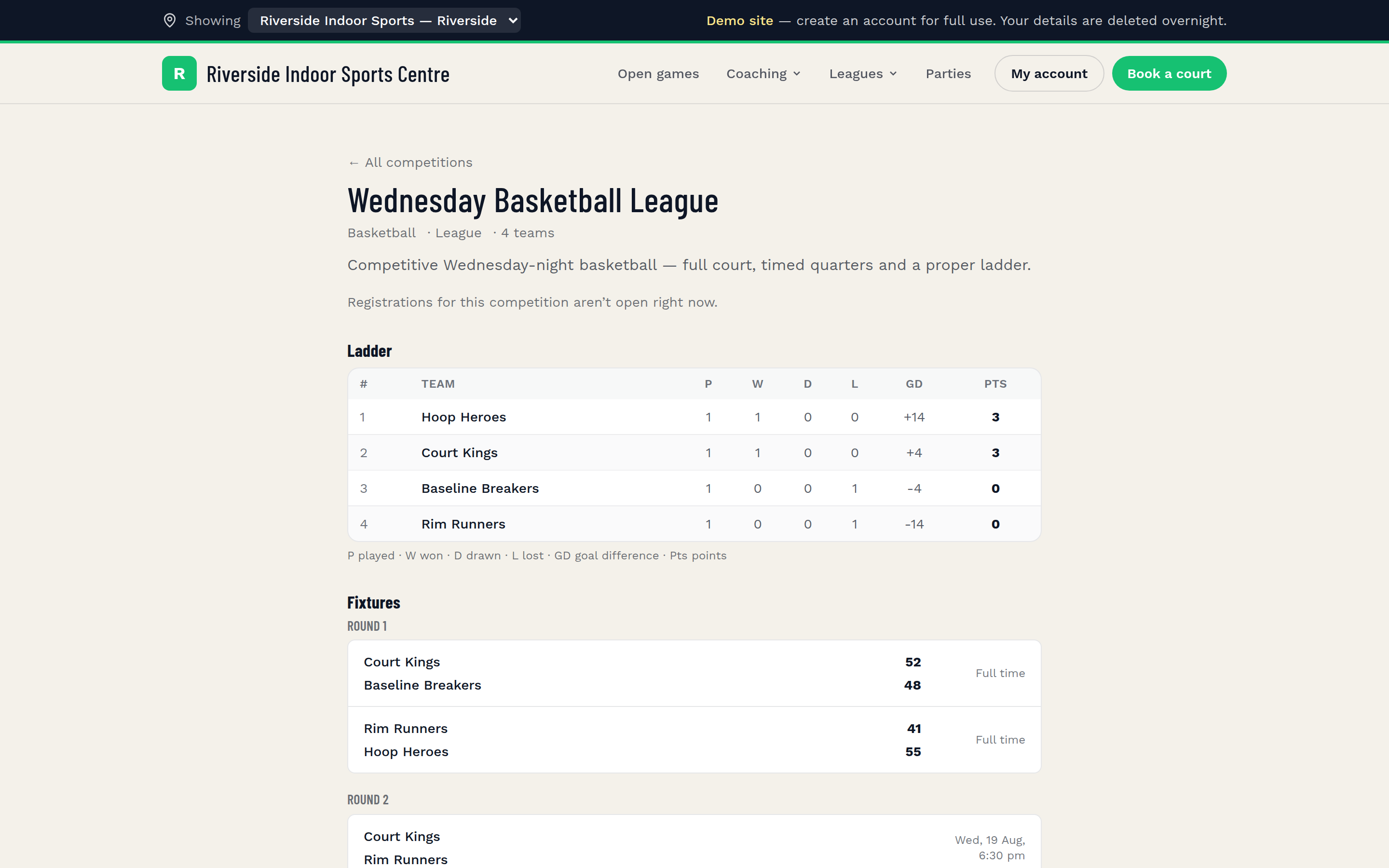
A published competition page — with the draw, results and ladder all in one place — removes that friction entirely. Teams check the page; you stop answering the same message fifteen times. When results go in after each round, the ladder updates automatically. By finals time, everyone knows their position without you having to explain it.
That's the part where competition ladders and results management saves the most time — not the setup, but the ongoing communication overhead across a twelve-round season.
The format decision is a one-time call at the start of the season. Done right, it sets up a competition that feels fair, creates genuine stakes and runs to a satisfying conclusion. Done poorly, it creates complaints you're managing right up to the grand final.
Choose the format that fits your team count, your courts and your players' expectations — then build the draw and let the games do the talking.
FAQ
How many teams do I need for pool play to make sense?
Pool play starts to make sense from around ten teams. Below that, a straight round robin usually gives a fairer result without the seeding complexity. Above ten, splitting into pools of four or five gives every team guaranteed games while keeping the total round count manageable.
What's the fairest format for a one-day tournament?
Pool play into a single-elimination bracket is the standard answer. It guarantees every team at least three or four games in the morning, then creates a finals atmosphere in the afternoon. The key is seeding the pools carefully so strong teams aren't knocked out in pool play by luck of the draw.
How do I handle byes in a knockout bracket?
Byes appear whenever your team count isn't a power of two (4, 8, 16, 32). Assign byes to the highest-seeded teams — they've earned the advantage through the regular season. Make sure the bracket is published before round one so teams with byes know in advance.
Can I run a round robin and still have a grand final?
Yes — and most seasonal comps do exactly this. Run a full round-robin regular season to determine seedings and build the ladder, then use the final two or three weeks as a single-elimination finals series. The top teams advance based on their regular-season finish. It combines the fairness of a round robin with the drama of a finals series.
What's the difference between single and double elimination?
In single elimination, one loss ends your tournament. In double elimination, you need to lose twice — there's a winners bracket and a losers bracket running in parallel. Double elimination is fairer but significantly more complex to schedule, and it requires more courts and time. For most Australian ball-sport comps, pool play is a simpler way to achieve a similar 'second chance' effect.