Court hire pricing: how to price courts and fields
A practical walk-through of court hire pricing for Australian venues — how to set a cost floor, read the local market, and build a rate card that holds up under discount pressure.
On this page
Court hire pricing starts with your cost floor
Most venues back into their prices. Someone looks at what the club down the road charges, knocks a few dollars off to seem competitive, and calls it a rate card. It works right up until a quiet winter or a rent increase, and then nobody can say with any confidence whether $38 an hour is profitable or just familiar.
Court hire pricing has to start from cost, not from guesswork or the neighbour's price list. Add up what an hour of court or field time actually costs you to deliver: a share of rent or mortgage, power and water, insurance, lighting for night sessions, cleaning, and the wages of whoever's rostered on to open up, supervise or run the desk. Divide that by the hours you realistically expect to sell in a week, not the hours the facility is technically open — a court that's booked 40% of the time carries its full fixed cost across those fewer hours, not across the full week.
That number is your floor, not your price. It's the point below which every booking is actively losing money, no matter how good it feels to fill the calendar. Once you know it, every other pricing decision — peak rates, discounts, party packages — becomes a question of how far above the floor you're sitting, rather than a guess in the dark. A surprising number of venues discover their floor sits higher than their current casual rate, particularly on courts with expensive lighting or short booking windows either side of it for changeover.
Reading the local market
Once the floor is set, the ceiling comes from the market. Call around or book a look at three or four comparable venues within a realistic travel radius — same sport, similar quality of surface and facilities, roughly the same catchment. Note their casual hourly rate, whether it changes for peak evening and weekend slots, and what's included versus charged as an extra (lights, equipment, a second court for a bigger group).
The goal isn't to match the cheapest venue in town. A venue with better courts, easier booking, undercover parking or a decent cafe attached can reasonably sit above the local average, and a bargain-basement rate often signals a facility that's cutting corners somewhere. What matters is knowing where you sit and why, so a price increase can be explained in one sentence — better surface, longer hours, easier booking — rather than defended vaguely.
Local participation data is worth a glance too. The Australian Sports Commission's AusPlay survey tracks participation by sport and state — a useful sanity check on whether you're pricing into rising demand or a shrinking pool of players before locking in a season's rates.
Casual vs recurring rates
A one-off Tuesday night booking and a team that locks in the same slot for a sixteen-week winter season are different products, even though they're using the same court. Casual hire carries more admin per booking — someone has to process the enquiry, take payment, answer the "is 7pm free" question — and it fills gaps in the calendar that would otherwise sit empty. Recurring hire is close to guaranteed revenue: predictable, low-admin once it's set up, and it locks in cash flow for the season ahead.
That trade-off is exactly why most venues price recurring hire slightly below the casual rate — not a token discount, but one that genuinely reflects the lower admin cost and the certainty of the booking. A common structure: standard casual rate for one-off bookings, a modest per-hour discount for a term or season commitment paid upfront or by regular instalment, and a slightly higher rate again for casual bookings dropped into premium evening slots at short notice, where the venue is carrying the risk of that slot not filling otherwise.
The trap to avoid is discounting recurring hire so heavily it becomes the venue's least profitable booking type. A season team locked in at a rate that barely clears the cost floor is worse than an empty slot sold to a casual booker at full price — it just takes longer to notice, because the calendar looks full the whole time.
Peak and off-peak
Demand for court and field hire isn't flat across the week, and pricing that pretends it is leaves money on the table during the busiest hours while doing nothing to fill the quietest ones. Weeknight evenings from about 5pm to 9pm and weekend mornings are peak for most sports — parents finishing work, weekend sport starting early, social competitions running their regular slot. Weekday daytime hours, particularly mid-morning through early afternoon on weekdays, are reliably the quietest.
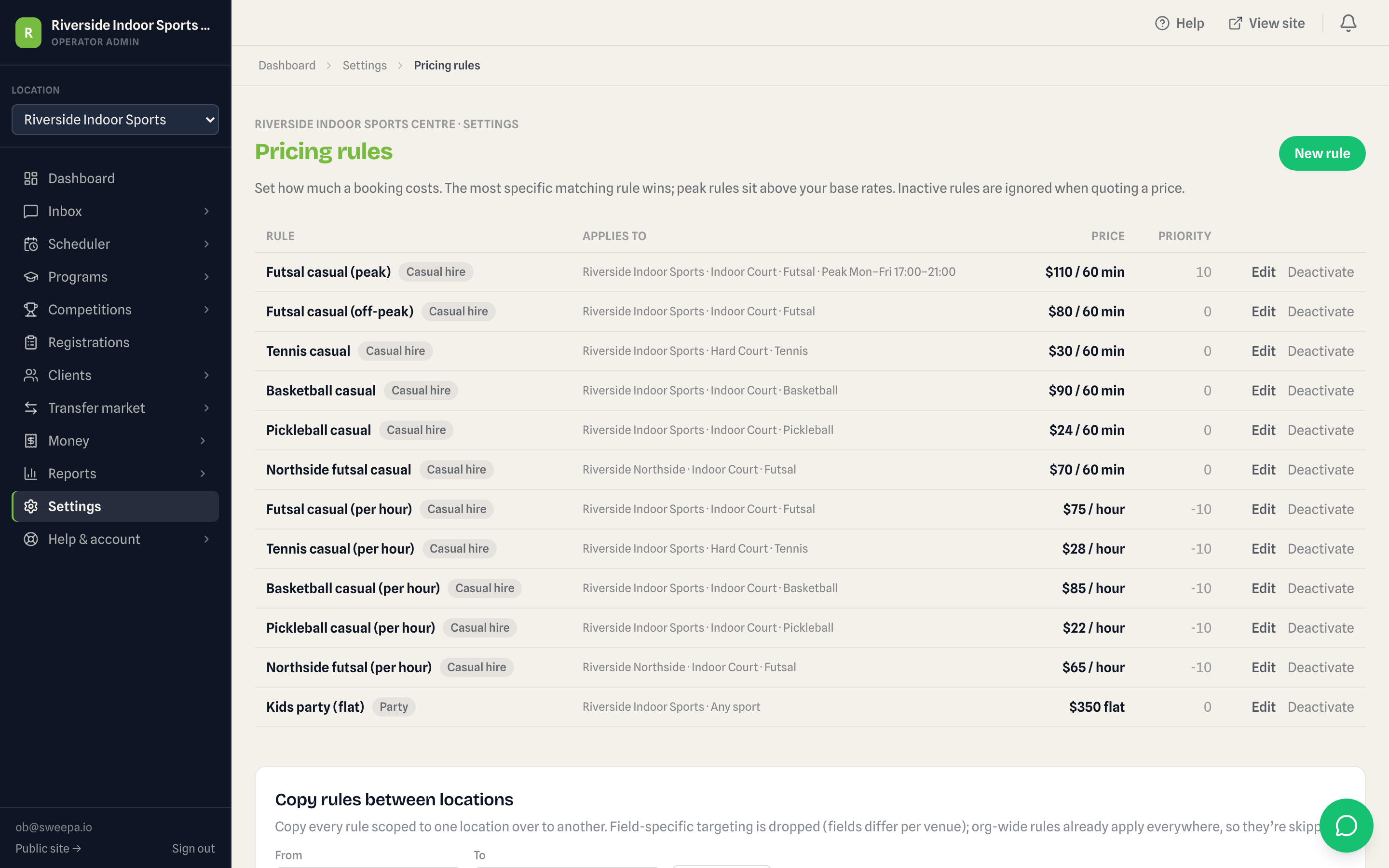
A two- or three-tier structure handles most venues well: a peak rate for the genuinely high-demand windows, a standard rate either side of it, and an off-peak rate for the hours that would otherwise sit empty. The off-peak rate doesn't need to be dramatically lower to work — even a modest discount is often enough to pull in retirees, shift workers, home-school groups or small businesses running a team session on a Wednesday afternoon, which is real revenue a flat rate card simply never captures.
Setting this up manually is where a lot of venues give up — juggling different rates by day and time slot in a spreadsheet gets error-prone fast, and staff end up defaulting to one rate because nobody can remember the exceptions. Sweepa's pricing-rules configuration lets a venue set peak, off-peak and day-of-week rates once per court, and the booking page charges the right rate automatically without anyone at the desk doing the maths.
Parties and flat rates
Birthday parties and group bookings don't fit neatly into an hourly rate card, and trying to force them into one usually undersells what's actually being delivered. A party isn't just court time — it's often a longer block with setup and pack-down either side, sometimes a party host or staff supervision, use of a function space or tables, and more wear on the facility than a straightforward casual booking.
A flat package rate solves this cleanly: one price for a fixed block of time and inclusions — say ninety minutes of court time plus thirty minutes either side for setup and pack-down, a set number of guests, and whatever's bundled in (equipment, a host, a room). Price the package against what it actually costs to deliver, including the staff time nobody remembers to count, not against a simple multiple of the hourly casual rate. Most venues find a well-built party package clears more margin than the equivalent hours sold as casual hire, precisely because it's priced as a distinct product rather than backed into from an hourly number.
Where group bookings sit outside a formal party package — a corporate team session, a school group, a one-off tournament hire — the same principle holds: price the actual block and inclusions, not a straight hourly rate stretched to fit. If parties are a meaningful part of your business rather than an occasional booking, it's worth reading how other venues structure that side of things in our guide to sports venue birthday parties.
Discounting without eroding the rate card
Discounting is tempting whenever a calendar looks patchy, and it's not wrong in every case — but an undisciplined discount habit quietly trains regular customers to expect one, and once that happens the rate card stops meaning anything. The fix isn't to never discount. It's to discount with a reason attached, every time.
Sibling and multi-booking discounts make sense because they reward genuine volume — a family booking three kids into the same program, or a team locking in a full season, is lower admin per booking and worth rewarding. Off-peak discounts make sense because they fill hours that would otherwise earn nothing. A loyalty discount for a long-standing recurring booker makes sense because it protects retention. What doesn't hold up is an ad hoc discount handed out over the phone to whoever asks persuasively enough, because that one is invisible to everyone else on the rate card and impossible to defend later when someone finds out.
The practical guardrail is to decide your discount categories in advance — which situations earn one, and by how much — and apply them consistently. A rate card with three or four clearly defined discount reasons still functions as a rate card. One that bends every time someone pushes back on the phone has effectively stopped being one.
Reviewing prices annually
A rate card set two years ago and left untouched isn't stable, it's stale. Costs move every year — power, insurance, wages, maintenance — and a court hire pricing structure that doesn't move with them slowly turns a healthy margin into a thin one without anyone deciding that on purpose.
Set a fixed point each year to review rates properly rather than letting it happen reactively when a bill arrives that's bigger than expected. Before a new season is the natural moment for most Australian venues — it lines up with when teams and regulars are already expecting some change, and it avoids the awkwardness of raising a mid-season recurring rate on a team that's already paid for the term. Revisit the cost floor first, since that's what's moved most; then check whether the local market has shifted; then look at which discount categories and off-peak windows are actually pulling their weight versus which ones have quietly become the default rate everyone gets.
A small, expected annual adjustment is far easier for regulars to absorb than a rare, large correction after years of standing still. If getting paid for that adjusted rate reliably — deposits, upfront payment, chasing outstanding balances — is the harder part of the equation, our guide on getting paid upfront for court hire covers that side in more detail. And if the rate structure itself has outgrown what a spreadsheet or paper diary can track cleanly, that's usually the point venues look at Sweepa's booking and payments features to run peak, off-peak, recurring and party pricing from one place instead of memory and sticky notes.
FAQ
How do I calculate a fair hourly rate for court or field hire?
Start from cost, not competitors. Add up the fixed and variable costs behind an hour of court time — a share of rent, power, insurance, lighting and staff wages — and divide by the hours you realistically expect to sell, not the hours you're open. That's your cost floor. From there, adjust up based on what comparable local venues charge and what makes your facility worth choosing over theirs.
Should casual hire and recurring hire be priced differently?
Generally yes. Recurring bookings carry less admin and give a venue predictable, upfront revenue, so a modest discount against the casual rate is common and defensible. The trap is discounting recurring hire so far that it barely clears the cost floor — a season booking locked in too cheaply can end up less profitable than the casual hire it replaced.
How much should off-peak rates be discounted?
Enough to genuinely shift behaviour, not so much that it undercuts the value of peak hours. Even a modest discount on quiet weekday daytime slots is often enough to attract retirees, shift workers or small groups who wouldn't otherwise book at all — which makes it pure incremental revenue on hours that were previously earning nothing.
How do I price a birthday party or group booking?
Treat it as its own product rather than a multiple of the hourly casual rate. Price the actual block of time, including setup and pack-down, plus whatever's included — a host, equipment, a function space — against what it costs you to deliver. Most venues find a well-built party package clears better margin than the same hours sold as casual court time.
When should I review my court hire pricing?
Once a year, at a fixed point rather than reactively. Before a new season works well for most Australian venues, since teams and regulars already expect some change at that point. Revisit your cost floor first, then check the local market, then review which discounts and off-peak windows are still earning their place on the rate card.
Will discounting scare away long-term customers if I stop?
Rarely, if the discounts that remain are tied to a clear reason — off-peak timing, season commitment, multi-booking volume. What erodes a rate card is ad hoc, undocumented discounting handed out inconsistently, because regulars compare notes and the whole card stops meaning anything. Consistent, reasoned discounts hold up; one-off favours don't.