How to Create Sports Fixtures Without the Spreadsheet: A Season That Survives Contact
A plain-English walkthrough of how to create sports fixtures that hold up all season: the round-robin logic, the bye maths, the washout plan, and how to publish a draw people can actually find.
On this page
Constraints first: venues, times and byes
If you've searched how to create sports fixtures because a season starts in a few weeks and the draw is still a half-built spreadsheet, start in a different place than most guides do. Don't open the round-robin template yet. Write down the constraints first — every fixture you build has to survive contact with them, and building the draw before you know them is how you end up rebuilding it twice.
Three constraints matter more than the rest. Venues: how many courts, fields or pitches do you actually have available at the same time, and are they identical, or does Court 3 have a lower ceiling that rules out anything with a high ball flight? Times: what's your real window each round — a Saturday morning comp with a hard 1pm venue handover looks very different to a midweek social league that can run into the evening — and how long does a game plus changeover actually take, not the optimistic version. Byes: how many teams are you fixturing, and does that number divide cleanly into your court and time slots, or does someone sit out every round?
Get these three down on paper before you touch a scheduling tool. A fixture draw is really just these constraints expressed as a grid. Skip this step and you'll build a mathematically elegant round-robin that has team A playing at 6pm on a field with no lights, which is a worse outcome than a slightly uglier draw that actually holds.
How to create sports fixtures with round-robin logic, in plain English
The most common format — every team plays every other team once — has a genuinely simple logic once you strip the jargon out. Picture a clock face with one team fixed at 12 o'clock and the rest of the teams sitting around the dial. Each round, the fixed team plays whoever's directly opposite it, and every other team plays the one next to it around the circle. Then, for the next round, everyone except the fixed team rotates one position around the clock — like the hands moving forward a notch — and you read off the new pairings.
Do that rotation once for every team on the dial (minus one, since the fixed team doesn't move) and you've generated a complete round-robin: every team has played every other team exactly once, and no team ever plays twice in the same round. It's the same method fixture generators use under the hood, whether that's a spreadsheet macro or Sweepa's competition and fixtures tools — the software just does the rotation for you and checks the venue and time constraints against it as it goes, instead of you doing it by hand at 10pm on a Sunday.
Two practical wrinkles worth knowing before you build a season on this logic. First, a straight round-robin gives you one match per pairing — if your season needs home-and-away fixtures, you run the whole rotation twice and flip which team is "home" the second time through. Second, the rotation gives you pairings, not venues and kickoff times — you still need to lay each round's pairings across your actual courts and time slots, which is where the venue and time constraints from the first step come back in. A draw that's mathematically correct but ignores that Court 2 is unavailable after 4pm isn't a usable fixture list, it's a maths exercise.
Odd team counts and byes: the fix nobody explains well
Most competitions don't have a neat even number of teams, and most explanations of byes gloss over what to actually do about it. Here's the practical version: if you've got an odd number of teams, add one imaginary team to the rotation to make it even, run the clock-face method exactly as above, and whichever real team is scheduled to "play" the imaginary team that round gets a bye instead. Nothing more complicated than that — the phantom team is just a placeholder that makes the maths work.
The part that actually matters is how you spread those byes. Every team should get roughly the same number of byes across the season, and — this is the bit that causes complaints — nobody should get two byes close together, and nobody should get a bye in the final round if you can help it, since a team sitting out the last regular-season round while everyone else plays their run-in feels like a raw deal even when it's mathematically fair. If your competition has finals or a ladder cutoff, check the bye distribution against that cutoff specifically: a team that's had one more bye than its rivals by the time the ladder locks has played fewer games for the same points ceiling, and someone will notice.
The other odd-number trap is uneven pools. If you're splitting a bigger competition into divisions to keep travel or skill gaps sane, an odd number in one pool and an even number in another means one division has byes every week and the other doesn't — which is fine, but only if you've decided that on purpose rather than discovered it after the draw's already been sent out.
Washouts and rescheduling: building slack into the season
A fixture list built for perfect weather doesn't survive a real season, and outdoor sports in particular need to plan for washouts before the first ball is bowled or kicked, not after the third round gets rained out. The principle that actually works is simple: build slack into the calendar up front rather than trying to find it under pressure later.
That means holding one or two bye rounds in reserve toward the end of the regular season specifically for rescheduling washed-out games, rather than scheduling wall-to-wall with no gaps. It means deciding your wet-weather call process before round one — who makes the call, by what time on game day, and through what channel — because a Saturday morning washout decision made at 7am needs to reach every team before they've left the house, not after they've already loaded the car. And it means having a clear, published rule for what happens to a washed-out game: does it get replayed in a reserve round, does it become a shared points result, or does it get dropped from the ladder entirely if there's genuinely no room left in the calendar? Whatever you choose, teams need to know the rule before it's tested on them, not after.
The other rescheduling scenario worth planning for is the individual team request — a bye week clash with a rep carnival, a forfeit that needs a makeup game. Set a cutoff (a lot of leagues use something like the halfway point of the season) after which rescheduling requests aren't accepted, purely so the back half of the draw stays stable enough for finals seeding to actually mean something.
Publishing fixtures people can actually find
A fixture list that only lives in the club committee's group chat isn't published, it's rumoured. The single biggest source of "wait, where do we play this week" messages isn't bad scheduling — it's a good draw that nobody can actually find without asking someone.
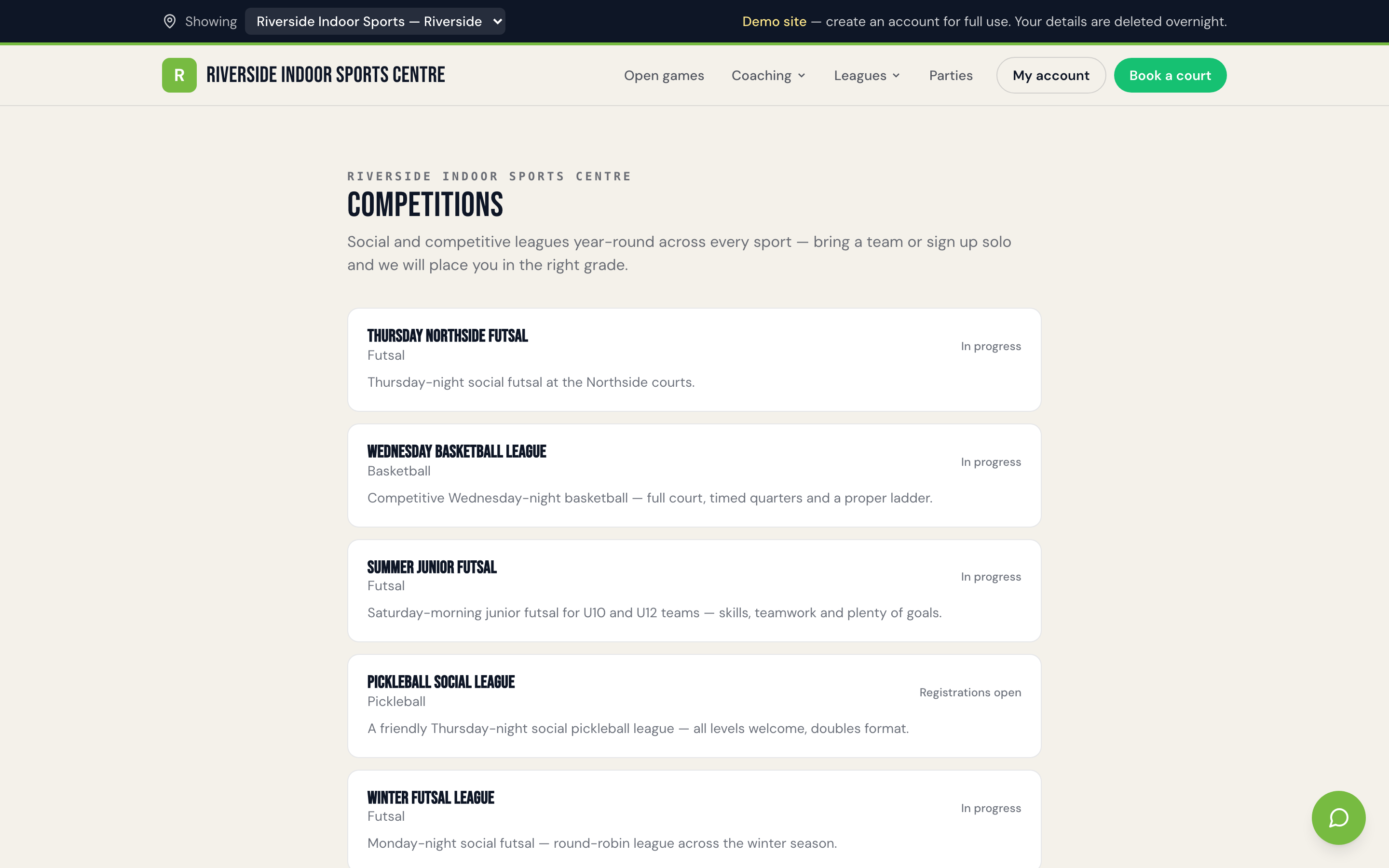
A published fixture needs to be in one place, always current, and reachable without a login or a Facebook group search. A public competition page that updates automatically when a game gets rescheduled beats a PDF that goes stale the moment the first washout hits, because the PDF version keeps circulating in old group chats long after round three's draw has changed. This is the gap Sweepa's public comp pages close — fixtures, results and the ladder live on one URL that every team, parent and umpire can bookmark, and it updates the moment you change something in the admin view rather than requiring someone to re-export and re-share a document.
Whatever tool you're using, the test is simple: can a parent who's never been to the clubrooms find next Saturday's game time and venue in under thirty seconds on their phone? If the answer's no, the fixture isn't really published yet, no matter how correct the maths behind it is. For the layer that sits right on top of this — turning the published draw into a live ladder once results start coming in — our guide to competition ladders and results covers that next step.
Making changes without chaos
Every season has changes — a forfeit, a venue double-booking discovered a week late, a team that drops out in round four. The chaos doesn't come from the change itself; it comes from a fixture existing in five places at once, so the change only gets made in one of them.
The fix is boring but it works: one source of truth, edited in one place, that everyone else reads from rather than copies from. The moment a fixture gets copied into a spreadsheet, then into a group chat as a screenshot, then printed and pinned to a noticeboard, you've created four versions that can each go stale independently, and nobody finds out which one was wrong until two teams show up expecting the same court. When a change happens in a single published source, everyone downstream sees the same update — no reconciling four copies against each other on a Thursday night.
The second habit worth building is a standing rule for who's allowed to make changes and how they get communicated. A competition with one coordinator and a clear "changes go out by Thursday 6pm" rule runs smoother than one where three committee members can independently promise a team a rescheduled game, because those three promises rarely end up compatible with each other or with the venue calendar. It doesn't need to be complicated — it just needs to be consistent, and it needs the people affected to actually see the update, which is easier when fixtures live somewhere with built-in email and SMS communications than when it depends on someone remembering to post in the right group chat.
None of this is really about the maths. The round-robin logic is the easy part once you've seen the clock-face method once. The season that survives contact is the one where the constraints were mapped before the draw was built, the byes were spread on purpose, the wet-weather rule was written down before it was needed, and the published version was the only version anyone ever had to check. If you're running a full competition rather than a single fixture list, our guide to running a sports league covers the season end to end, from entries through to grand final.
FAQ
What's the easiest way to create sports fixtures for a round-robin competition?
Use the clock-face rotation method: fix one team in place, arrange the rest around it, pair them off, then rotate everyone except the fixed team by one position each round. Repeat until every team has played every other team once. Fixture generators, including Sweepa's, run this same logic automatically and check it against your venue and time constraints as they go.
How do byes work when you have an odd number of teams?
Add one imaginary team to the rotation so the total becomes even, run the standard round-robin method, and whichever real team is scheduled against the imaginary team that round sits out instead. The key is spreading those byes evenly across the season and avoiding a bye in the final round wherever possible.
What should a wet-weather or washout policy actually cover?
Three things, decided before round one: who makes the wash-out call and by what time on game day, how teams are notified, and what happens to the result — replayed in a reserve round, shared points, or dropped if there's no room left in the calendar. Publish the rule so no one's discovering it mid-season.
How far in advance should a season's fixtures be published?
Publish the full round-robin before the season starts, not round by round, so teams can plan around bye weeks and travel early. Keep one or two reserve rounds unscheduled toward the back end for rescheduling washouts, and be clear that those slots may get used.
How do I stop teams double-booking a venue when building fixtures?
Treat venue availability as a hard constraint you map before building the draw, not something you check after. List every court or field, its available time blocks each round, and any restrictions (lighting, size, surface), then build the rotation against that grid rather than the other way around.
What's the best way to communicate a mid-season fixture change?
Change it once in a single published source — a public competition page rather than a spreadsheet, group chat and printed sheet all being edited separately — so every team, umpire and parent sees the same update at the same time. Pair that with a standing rule for who's allowed to make changes and by when.