How to run a sports league: the complete guide
Everything a volunteer committee or comp organiser needs to run a local sports league well — from choosing a format through to fixturing, fees, ladders and finals.
On this page
The real answer to how to run a sports league: start with format and season structure
Every league runs into the same first decision, whether it's five-a-side futsal on a Tuesday night or a Saturday morning netball comp with eight age groups. Before you touch a spreadsheet or send a single email, you need to lock in the shape of the season — because everything downstream (fixturing, byes, finals) inherits whatever you decide here.
The two workhorse formats are round robin and knockout, and most local leagues actually run a hybrid: a round-robin home-and-away season that seeds a finals bracket. Round robin is fairer over a season — one bad night doesn't end your comp — but it needs more rounds to settle. Straight knockout is fast and dramatic but brutal for a team that travelled across town to lose in eight minutes. If your competition has an odd number of teams, decide early how byes rotate; nothing burns goodwill faster than one team copping three byes while another gets none.
Season length is the next lever. Count backwards from your finals date (which is often fixed by venue availability or a school-term calendar) and work out how many playing rounds actually fit, allowing for at least one buffer week for wet-weather washouts. A six-week comp with no buffer week is a comp that ends in an argument about whether round four ever happened. Most social and junior leagues in Australia sit somewhere between eight and fourteen rounds plus finals — long enough to build a ladder that means something, short enough that teams don't drop off before the finish.
Divisions matter too. If you're running open-age social sport, a single division is fine. If you're running junior or representative competition, you'll usually need divisions by age or grading, and a mid-season regrading point if the gap between top and bottom gets too wide. Decide this now — regrading after round six is far messier than building it into the structure from round one.
Recruiting and registering teams
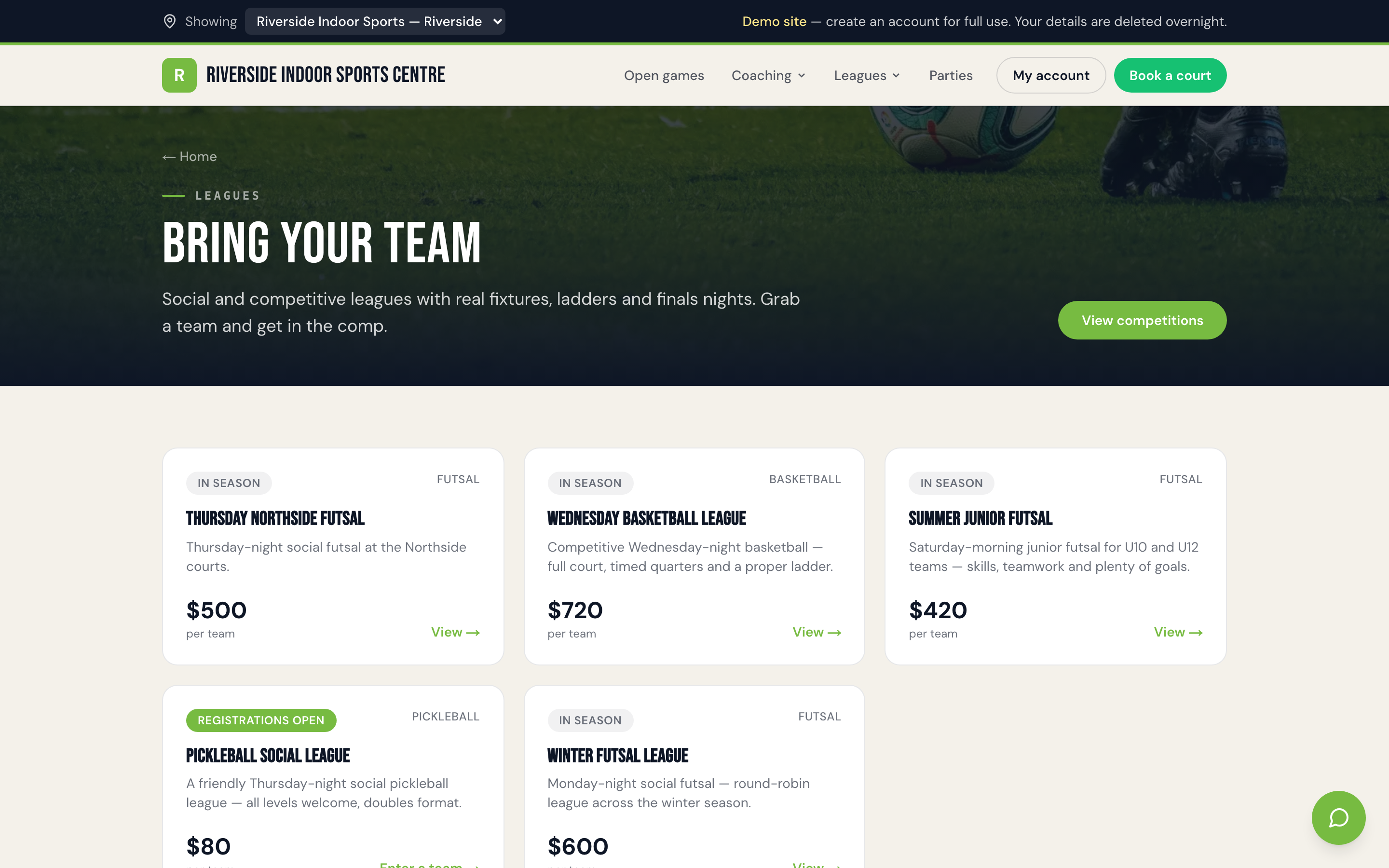
Recruitment is a funnel problem before it's a sport problem. Organising a local competition starts with getting the sign-up in front of captains and making it easy to say yes on the spot — not chasing them for a week. Team captains need to know your comp exists, know it's worth their Tuesday night, and be able to sign their whole roster up without twelve separate phone calls. The leagues that fill fastest treat registration like any other online checkout: one link, clear pricing, no back-and-forth.
Practically, that means online team registration with a public sign-up page, not a Google Form that dumps into someone's inbox to be manually entered later. Team registration should capture the captain's details, the full roster (with waivers or emergency contacts if your sport requires them), and the division they're entering — all in one pass. If you're running age-graded junior competition, this is also where waitlists earn their keep: cap a division at the number of grounds you actually have, and let overflow teams queue automatically rather than you fielding "is there room?" texts for three weeks.
A word on affiliation: if your league sits under a state or national sporting body, check that body's current requirements for team affiliation, insurance and player eligibility before you open registration — those rules change season to season and are outside the scope of what any software can advise on. Get that pointer-level check done early so it's not a scramble in week two.
Fees and payments upfront
Chasing team fees is the single most common way a volunteer committee burns out mid-season. The fix isn't a sterner reminder email — it's structuring payment so it happens before round one, not during round six.
Take payment at the point of registration. If a captain can register a team without paying, some captains will register a team without paying — not out of bad faith, usually, just because life gets busy and an unpaid rego slips down the list. Card payment (plus Apple Pay and Google Pay for the captains registering from their phone at training) built into the sign-up flow removes that gap entirely. If your league offers instalment-friendly options like Afterpay or Zip where available, that can help teams that are splitting costs among players rather than one person fronting the lot.
Set your fee structure before you open registration, not after: full-season team fee, any bond, and whether individual players can pay their share directly instead of the captain collecting cash in an envelope (this alone eliminates most of the "half my team hasn't paid me back" problem). If you invoice affiliated clubs or sponsors separately from individual teams, having invoicing that carries your own prefix and numbering makes reconciliation at season's end far less painful than chasing a folder of bank transfers with no reference. We've covered fee structuring in more depth in our guide to team registration and payments, including how to think about bonds and split payments specifically for team sport.
Fixturing without tears
Fixturing is where most volunteer-run leagues lose a weekend. Building a round robin draw by hand for ten teams across two venues, then manually checking nobody plays themselves twice or gets three home games in a row, is genuinely hours of work — and every late team change means starting large chunks of it again.
The mechanics that matter: even distribution of home and away games, ground allocation that doesn't double-book a court or field, and a clean bye rotation if your team count is odd. Build in your buffer week now rather than trying to retrofit it after a washout — shifting one week's fixtures by hand across every remaining round is exactly the kind of job that eats a Sunday afternoon.
This is one of the clearest places where the right tool earns its keep rather than a shared spreadsheet. Fixture generation that handles round robin, knockout or hybrid formats, respects ground and time availability, and lets you make a late change (a forfeit, a ground closure) without manually re-threading every following round, turns a weekend job into a twenty-minute one. We've written a full walkthrough on creating sports fixtures if you want the step-by-step on draw generation specifically.
Once the draw is set, get it in front of teams immediately and in one place — not emailed as a PDF that's out of date the moment round three gets rescheduled.
Results, ladders and public pages
This is the part players actually care about week to week: who won, where the ladder sits, and when their next game is. If your comp's "official" results live in a spreadsheet that only the competition secretary can edit, you've built a bottleneck that guarantees Sunday-night phone calls asking who won the derby.
A public competition page solves this properly. Results get entered once — by an admin, or by team managers if you allow it — and the ladder, fixtures and results all update from that single source of truth. No separate Facebook post, no "final results" PDF emailed a week later, no arguing about percentage differentials because two people were keeping their own version of the table. A public comp page also does quiet marketing work for you: it's the page a parent or player forwards to a friend, and the page a sponsor can point to and say "that's us."
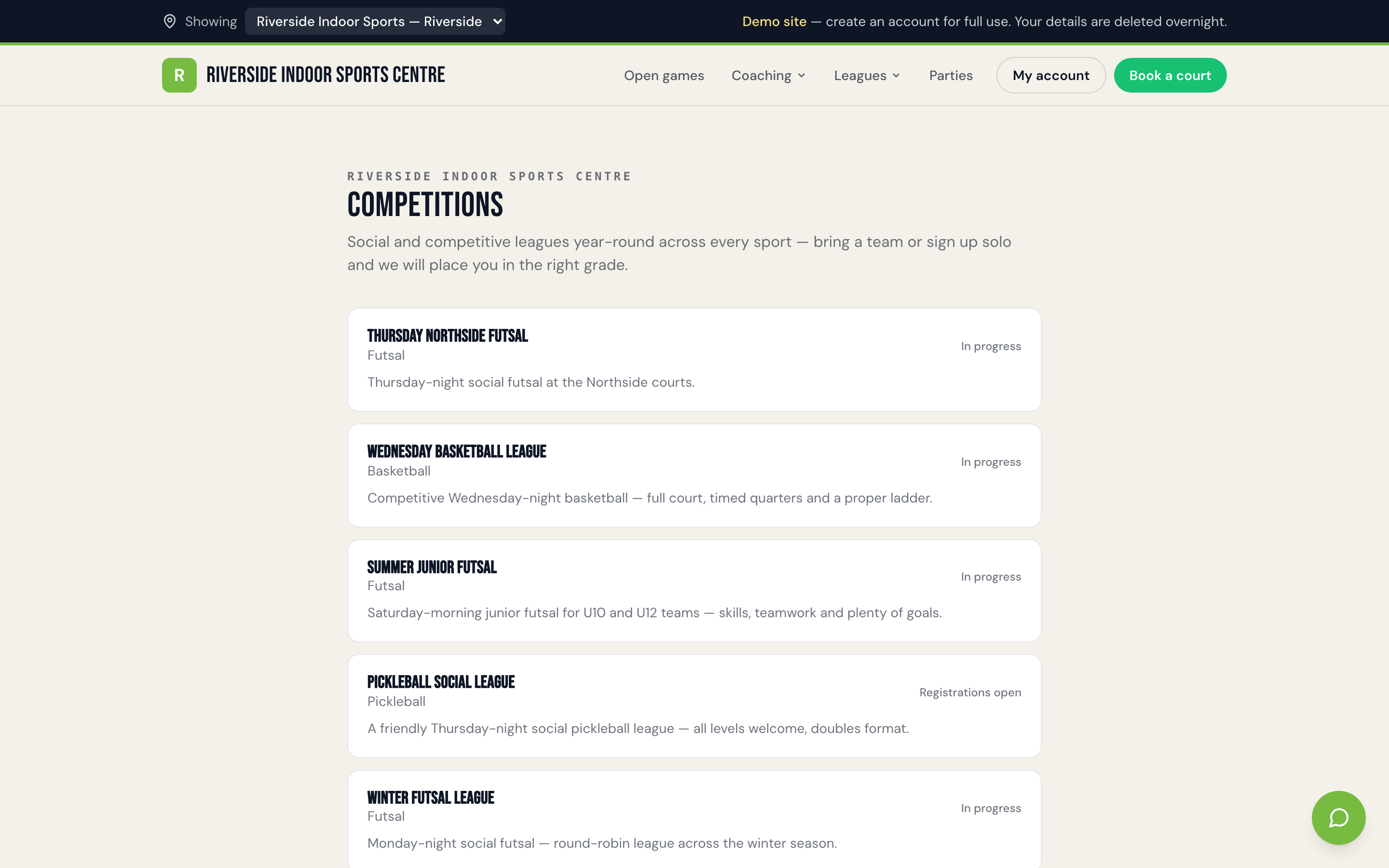
For knockout stages, a bracket view that updates as results go in matters just as much — nobody should have to ask "who do we play if we win Saturday?" The principle underneath all of this is simple: results and ladders should update automatically from what's entered, not require someone to manually recalculate percentages and re-publish a table. If your competition runs points differentials, bonus points, or head-to-head tiebreakers, the ladder logic needs to handle that without a volunteer doing it in a spreadsheet on Sunday night. See how Sweepa's competitions and public comp pages handle fixtures, ladders and results together if you want to see the mechanics in practice.
Season comms
A season lives or dies on whether teams know what's happening before it happens. Fixture changes, wet-weather calls, finals scheduling — the leagues that run smoothly are the ones where this information reaches captains without anyone chasing it down.
Wet weather is the clearest example. A genuine wet-weather call — checking ground conditions, making the decision, and notifying every affected team — needs to happen by a fixed cut-off time (commonly two hours before the first game, tighter for morning rounds) and needs to reach every captain in one shot, not via a phone tree that misses the third team down the list. Automated email and SMS to registered captains the moment a call is made removes the "did you hear?" chaos that otherwise follows a rained-out Saturday.
Beyond wash-outs, regular touchpoints matter: a reminder before round one with ground and time, a mid-season note if divisions are regrading, and a heads-up before finals with format and venue. None of this needs to be manual per-team messaging — set it up once against your fixture calendar and let it fire on schedule. A client portal where captains can check their own team's fixtures, results and any outstanding fees also cuts down the "what round are we up to" messages considerably, because the answer is sitting there whenever they want to look.
Finals
Finals format should be decided and published well before the last home-and-away round, not scrambled together once the ladder settles. The common structures — top four, top six with a double-chance system, or straight knockout from the full ladder — each reward different things, and each needs its qualification rule spelled out from round one so nobody's arguing about percentages in the last week of the season.
Practically, finals need tighter turnaround than the regular season: results have to be entered and the next round's fixture confirmed within hours, not days, because teams are often playing the following week or even the same day. This is where a public bracket or ladder that updates the moment a result is entered earns its keep — teams find out who they're playing without a phone call to the comp secretary. Confirm venues and times for finals earlier than you think you need to; grounds get booked out and grand final day is not the day to discover your usual venue is unavailable.
The wrap and next-season retention
The season doesn't really end when the trophy's handed out — it ends when you've captured what you need for next season to be easier than this one. Two things are worth doing in the week after finals, while it's fresh: note what worked and what didn't (which division needed regrading earlier, which ground was consistently double-booked, which week the wet-weather calls piled up), and reach out to every team while the season's still warm rather than waiting until pre-season scramble three months out.
Retention in local sport is mostly about removing friction, not running a big campaign. A captain who registered easily, paid without chasing, always knew the fixture, and could see a clean ladder all season is a captain who re-registers without thinking twice. A captain who spent the season chasing PDFs and phone calls is a captain who's open to trying a different comp next year. If registration for next season opens with the same sign-up link and the same smooth first step, you'll convert more of this season's teams than any reminder email will achieve on its own.
Running a local sports league well isn't about one clever trick — it's about removing the dozen small frictions that otherwise land on one volunteer's shoulders every single week. Good sports league management is mostly invisible when it's working: get the format and structure right up front, take fees before round one, make fixturing and results low-effort rather than a spreadsheet marathon, and keep comms automatic rather than manual. Do that, and a season that used to feel like a part-time job starts to feel like, well, running a league.
FAQ
What's the best format for a small local league?
For most social and community leagues, a round-robin home-and-away season is the fairest option because one bad night doesn't end a team's competition. If you want a finals series to add stakes at the end, run a round robin through the regular season and seed a small knockout bracket — top four or top six — from the final ladder.
How many teams do I need to run a competition?
There's no fixed minimum, but four teams is a practical floor for a round robin to feel like a real competition rather than three teams playing each other repeatedly. Below that, a knockout or round-based ladder against a wider regional comp often works better than trying to run a standalone league.
How do I handle byes fairly?
Decide your bye rotation before the draw is published, not after a team complains. The standard approach with an odd number of teams is a rotating bye that gives every team exactly one (or as close to equal as the round count allows), spread across the season rather than clustered early or late.
Should team fees be paid upfront or split by round?
Upfront, wherever you can manage it. Taking the full season fee at registration — either from the captain or split across individual players — removes the single biggest source of mid-season admin: chasing part-payments from teams that are three rounds deep and still haven't settled up.
What do I do when a game gets rained out?
Make the wet-weather call by a fixed cut-off time, notify every affected captain in one go — email and SMS both help here, since not everyone checks the same channel — and have a rule ready for how washed-out games get rescheduled (a dedicated buffer week works better than trying to slot make-up games into an already tight run of rounds).
Do I need public liability insurance to run a league?
In most cases yes, and if your competition sits under a state or national sporting body there's often a standard affiliation and insurance pathway through them. This is genuinely worth checking directly with your sport's governing body before the season starts, since requirements vary by sport and by state.