End of Season Sports Club Playbook: Finals, Presentation Night and Getting Teams Back
A practical end-of-season playbook for sports clubs: finals logistics, a presentation night that doesn't blow the budget, and the retention sequence that gets teams back for next season.
On this page
Finals logistics without the scramble
Winter finals are running across most of the country right now, and if you're steering any kind of end of season sports club through August and September, the calendar stops being forgiving. Finals week compresses everything the regular season spread out over months — venue bookings, results turnaround, team communications — into a run of days where a missed detail is visible to every team at once.
Lock finals venues and times well before the ladder settles, not after. Grounds get booked out for other events heading into spring, and "we'll sort it once we know who's playing" is how a grand final ends up unconfirmed the week it matters most. Publish the finals format — top four, top six with a double-chance system, straight knockout — at the start of the season so nobody's disputing percentages in the last week, and get results entered and the ladder updated within hours of the final siren, not days, because teams are often turning around for the next round within a week.
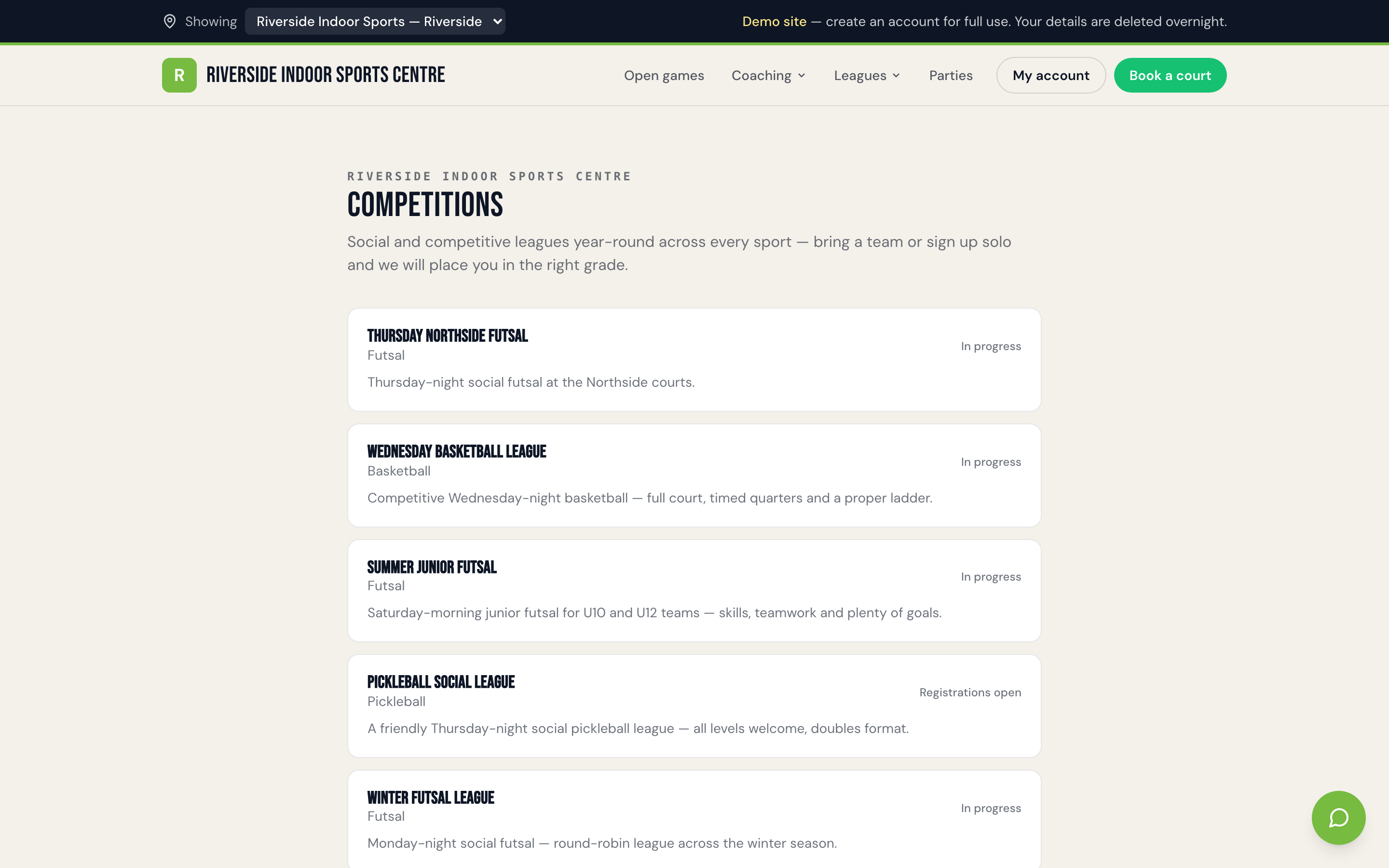
A public ladder and results page that updates the moment scores go in removes the phone-tag that otherwise follows finals day — captains checking who they're playing next without a call to the comp secretary.
A sports presentation night that doesn't eat the margin
A sports presentation night is one of the best retention tools a club has, and one of the easiest to let blow out. The pattern we see again and again with clubs and leagues we've worked with: a venue booked for the whole afternoon "just in case," a trophy order padded because nobody wants to be the club that ran short, and catering quoted per head against a number that's really a guess.
Trophy count is the easiest line item to fix. If teams registered through a proper sign-up rather than a paper list, you already know exact rosters — order to that number plus a small buffer, not a round figure that assumes a fifth of the room will turn up empty-handed. Venue hire is the next lever: a tight two-hour slot with a clear start and finish costs a fraction of an open-ended afternoon, and most families are there for the presentations and gone within ninety minutes anyway. Keep the formal part brisk — call names, hand out trophies, say thanks — and let the social part happen informally afterwards rather than programming it in.
Capturing feedback while it's fresh
The best data a season gives you arrives in the fortnight after the last game, and most clubs let it evaporate. A captain who was frustrated about ground allocation in round four remembers exactly why in the week after finals; by pre-season next year it's a vague grumble nobody can action.
A short survey — five questions, sent to every registered captain or parent contact while the season's still top of mind — beats a chat at presentation night, because presentation night is loud, social, and not where people give you the honest version. Ask what worked, what didn't, whether the fixture and comms cadence felt right, and whether they'd register again. Keep it short enough to finish standing at the bar. The point isn't a formal report — it's catching the two or three things genuinely worth fixing before next season's structure gets locked in, while the people who noticed them still remember the detail.
Early-bird rego for next season
The fortnight right after finals is the highest-intent moment of the entire year for next season's registration, and most clubs let it close unused. A team that just finished a season they enjoyed is far more likely to commit again this week than three months later, once pre-season admin has piled up and a rival comp has caught their eye.
An early-bird rego window — open for a couple of weeks, at a genuinely lower price than the season's eventual full fee — gives captains a reason to commit now rather than "get to it later." It also gives you real signal months out: how many of this season's teams are coming back, which divisions are filling, and where you need to actively recruit rather than assume the numbers will show up. Structuring team fees and early-bird pricing properly is worth doing right the first time — our guide to team registration and payments covers how to set that up without creating a reconciliation headache later.
Announcing next season's dates
Pair the early-bird window with a firm next-season date, even a provisional one. "Round one kicks off [date], early-bird rego closes [date]" gives captains something concrete to hold a season around — block out the calendar, confirm the roster's still keen, tell the club committee it's locked in. A vague "see you next year" doesn't do any of that work.
If your dates genuinely aren't locked yet — venue availability, term dates, or a governing body's fixture calendar all outside your control — say so honestly and give a target window instead of a guess dressed up as a date. Captains forgive "we're confirming venue by [date]" far more than they forgive a published date that later moves.
The retention email sequence
Off-season player retention isn't a single big campaign — it's a short, deliberate sequence sent while there's still a reason for someone to open the email. A sequence that actually works usually looks like three touches, not one.
A thank-you and feedback ask within a few days of the final siren — genuine thanks, plus the short survey from earlier in this playbook, sent while the season's still fresh enough that people bother replying. A next-season announcement two to three weeks later — dates, any format changes, and the early-bird window opening — timed to land while the season's still warm rather than after it's faded. And an early-bird reminder in the final days before that window closes, for anyone who opened the first email and didn't act — a short, specific nudge, not a repeat of the full pitch.
None of this needs to be a marketing automation platform. It's templated email and SMS sent to the list you already have from this season's registrations, scheduled against your own calendar rather than fired off ad hoc when someone remembers. Sweepa's built-in email and SMS communications handle exactly this kind of scheduled sequence — the timing above is a template, not a feature list, so adjust it to suit your own club and sport.
Your own post-mortem: the end of season sports club checklist
Before the committee scatters for the off-season, run your own post-mortem while the detail is still sharp. What broke this season — a venue that was consistently double-booked, a division that needed regrading earlier, a wet-weather call that went out too late? What worked well enough to repeat exactly as-is? And what's the one structural change worth making before next season, rather than three small ones that won't move the needle?
Write it down somewhere the next committee — or next-season you — will actually find it, not in a group chat that scrolls away by October. An end of season sports club that captures this properly turns every season into a slightly easier version of the last one. The clubs that feel like they're starting from scratch every March are usually the ones that skipped this step, not the ones that had a harder season. If you're building out the rest of your competition around this — fixtures, ladders, finals structure — our full guide to running a sports league covers the season end to end.
FAQ
When should we send presentation night invites and trophy confirmations?
Send the invite as soon as your finals date is locked, ideally three to four weeks out, so families can plan around it. Confirm final trophy numbers against actual registered rosters roughly a week before ordering — that's late enough to reflect any last-minute team changes but early enough to avoid a rush order fee.
How do we run a presentation night without blowing the season's budget?
Cap the venue hire to a tight window (two hours is usually plenty for the formal part), order trophies against actual registered rosters rather than a padded round number, and keep catering simple. If a bigger, longer event genuinely works for your club and community, that's a legitimate call — just cost it out against what it actually returns rather than assuming it has to look the same every year.
When should early-bird registration open for next season?
As close to finals as you can manage — the fortnight right after the season ends is when interest and goodwill are highest. Waiting until pre-season means competing with a fresher memory of a rival comp and a captain's attention split across a dozen other things.
What should a post-season feedback survey actually ask?
Keep it to around five questions: what worked, what didn't, whether the fixture and communications cadence felt right, whether they'd register again, and one open question for anything else. Send it within a week or two of the season ending, while specific detail is still fresh rather than faded into a general impression.
How many emails should an off-season retention sequence actually include?
Three is usually enough: a thank-you and feedback ask within days of the season ending, a next-season announcement with dates and the early-bird window a few weeks later, and a short reminder before that window closes. More than that starts to feel like noise rather than a useful nudge.