The Sports Program Waitlist Playbook: Trials and Sibling Discounts That Convert
A full program isn't a finished one. Here's how to run a sports program waitlist that actually converts, plus the trial-session and sibling discount details that keep the roster filling itself.
On this page
Full isn't finished: what a sports program waitlist is actually for
Full is a good problem. It's also an incomplete one. A lot of coaching programs treat "sold out" as the finish line — the term sheet closes, the coordinator moves on to rostering coaches, and the families who missed out get a shrug or, worse, silence. That's where a program leaks its best future revenue.
A sports program waitlist isn't a consolation list. It's the next intake sitting right there, already interested, already motivated enough to sign up for something that wasn't available. Treat it as a pipeline and it behaves like one: spots open from cancellations, payment failures, and late withdrawals more often than most coordinators expect, and a waitlist that's actually managed — not just a spreadsheet tab nobody opens — fills those spots in hours instead of weeks.
The mechanics matter here. A waitlist needs to capture the same information a registration would (child's age or grade, session preference, any relevant medical or access notes) so that when a spot frees up, you're not starting the conversation from scratch. It needs an order — first in, first offered, no exceptions, because nothing burns trust with parents faster than a perception that the coach's mate's kid jumped the queue. And it needs a deadline attached to every offer, because an open-ended "let me know if you're still keen" just recreates the queue you were trying to clear.
Waitlists that convert: keep the list warm, not shelved
The difference between a waitlist that fills programs and one that's dead weight is contact frequency. A family that joins a waitlist in week one of term and hears nothing until week six has usually found another program, another sport, or simply stopped expecting to hear from you. Warm waitlists get touched on a rhythm — not spammed, just kept in the loop.
A practical cadence: confirm the waitlist position immediately (automated, not a manual email you write between coaching sessions), send a short update if the program is genuinely tracking full for the rest of term, and reach out proactively the moment a spot opens rather than waiting for the family to check in. Speed matters more than most coordinators assume — the first family to respond to an opening is very often the only one who needs to, because everyone else has already moved on by the time you'd have gotten to them on a manual list.
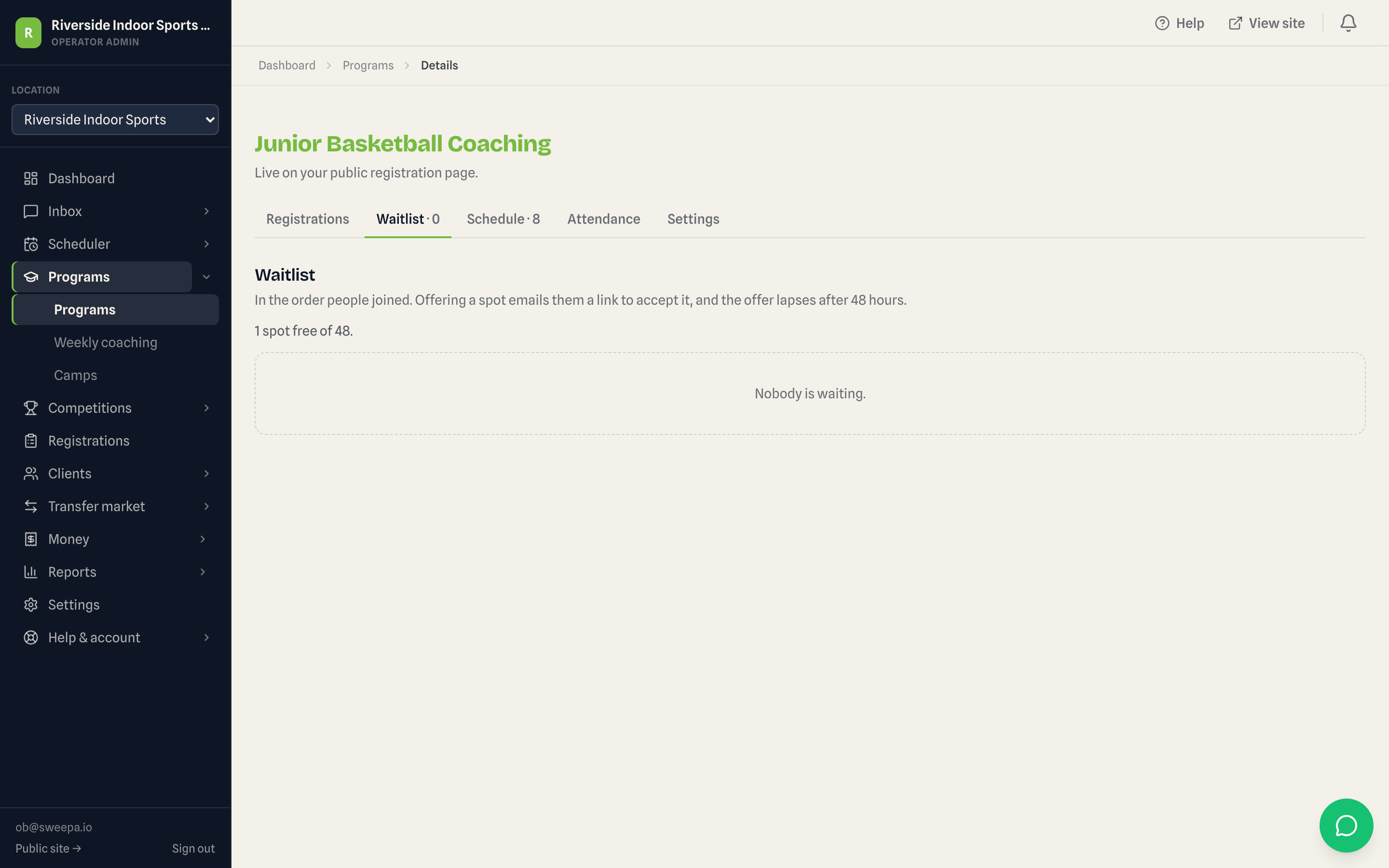
This is also where automated tools earn their keep. Chasing waitlist replies by hand across email and text is exactly the kind of admin that eats a Tuesday evening. Sweepa's registration and waitlist tools hold the queue in order, send the position confirmation and the opening offer automatically, and roll the spot to the next family if the offer lapses — so the list keeps moving even when nobody's sitting at a laptop managing it.
Running trial sessions well
Trials solve a different problem to waitlists: they're for the family who hasn't committed yet, not the one who's already tried to and missed out. Sports trial sessions are how a lot of programs — futsal clinics, swim squads, junior basketball — convert curiosity into a paying registration, but only if the trial is run with the same care as a real session.
A few things separate a trial that converts from one that's just a free hit-out. Cap the number of trial spots per session so the regulars don't feel swamped and the trialling kids get genuine coach attention — nobody signs up after standing at the back of a session that was really a normal training night with extra bodies. Collect the same registration details you'd collect for a full sign-up (guardian contact, any medical notes, age group) rather than a scrap of paper, because that trial record should convert into a registration with one click, not a re-entry from scratch. And follow up within a day or two while the session is still fresh, with a clear next step — "here's how to lock in the spot for next week" beats a vague "let us know if you're interested."
The trade-off worth being honest about: trials cost coaching time and court or field space that isn't generating fee revenue that week. They're worth it when they're converting a reasonable share of attendees into full registrations. If a program's trial sessions are consistently full of families who never come back, that's a signal to look at the trial format itself — session length, coach-to-player ratio, or whether the sport suits a one-off taste at all — rather than just running more of them.
Designing a sibling discount policy you won't regret
A sibling discount policy is one of those things that feels simple until the second family with three kids across two programs asks how it actually applies. Get the policy vague or verbal, and you'll spend more admin time relitigating it case by case than you'd have spent just writing it down properly.
Decide, in writing, before you offer it to anyone: does the discount apply per additional sibling, or does it cap out after the second child? Does it apply across different programs (an older sibling in the representative squad, a younger one in the come-and-try group) or only within the same program? Is it a flat dollar amount off each additional registration or a percentage — percentage scales better across programs with different price points, but a flat amount is easier for parents to do the mental maths on at sign-up.
A common structure we see work well for coaching programs: full price for the first child, a modest percentage off the second, and a slightly larger percentage off the third and any further siblings — enough to feel like real recognition of a multi-kid family's commitment without eroding program margin on the family that was always going to enrol regardless of the discount. Whatever the shape, the policy needs to be visible at the point of registration, not something a parent has to email in and ask about — and it needs to apply automatically at checkout so nobody's manually adjusting invoices during the busiest sign-up week of term.
Sibling discounts are also where families quietly test your fairness. If the policy exists but isn't applied consistently — one coordinator honours it, another forgets, a third negotiates a better rate for a persistent parent — that inconsistency travels through the parent group faster than almost anything else a program does wrong.
The comms templates that do the work
Waitlists, trials and discounts all live or die on the same thing: whether the right message goes out at the right moment without a human having to remember to send it. A handful of templates cover most of the ground.
Waitlist confirmation, sent the moment someone joins: confirms their position in the queue, sets expectations on timing ("spots typically open as term progresses"), and states plainly that being on the list isn't a guarantee. Spot offered, sent the instant a place frees up: states the deadline to accept (24–48 hours is standard practice for most coaching programs), and what happens if it lapses — straight to the next family, no chasing. Trial follow-up, sent within a day of the session: thanks the family for coming, names one specific thing the coach noticed (this is where the trial actually converts — generic follow-ups read as automated even when they aren't), and gives a clear, single next step to register. Sibling discount applied, sent at registration: confirms the discount was applied and to which registrations, so there's a written record if it's ever questioned later in the term.
None of these need to be long. A parent scanning a message on their phone between school pickup and training drop-off wants the answer in the first line, not buried in the third paragraph. Templates also mean the wording doesn't drift between whoever's on comms duty that week — useful when a program runs across multiple coaches or a small admin team. If you haven't yet nailed down the broader registration flow these templates sit inside, our guide to sports program registration covers the sign-up sequence end to end, and if trials are feeding into a school holiday intake specifically, running school holiday sports camps covers the seasonal version of the same problem.
Measuring what's actually converting
None of this is worth tuning without knowing what's working. Three things are worth tracking every term, even in a rough spreadsheet if that's all you've got: what share of the waitlist actually converts to a paid registration once offered a spot, what share of trial attendees sign up for the full program, and how the sibling discount is affecting overall program revenue versus just being a cost.
Waitlist conversion tells you whether your list is genuinely warm or whether people are parking themselves on multiple programs and taking whichever comes free first — if conversion is low, the fix is usually speed (faster offers, shorter deadlines) rather than a bigger list. Trial conversion tells you whether the trial session itself is doing its job — a well-run trial for the right sport should convert a solid share of attendees, and if it isn't, look at the session experience before assuming the sport just isn't for those families. And sibling discount tracking, even informally, protects the policy from itself: it's easy to keep discounting generously term after term without ever checking whether it's still doing what it was designed to do, which is retain multi-kid families who'd otherwise have to choose which child gets to play.
The programs that get the most out of waitlists, trials and sibling discounts aren't running anything exotic — they're just consistent. The list moves fast, the trial gets treated like a real session, the discount is written down and applied the same way every time, and the messages go out without anyone having to remember to send them. That consistency, more than any single tactic, is what actually fills the roster.
FAQ
How long should families stay on a sports program waitlist before we clear it?
Clear it at the end of the enrolment window it was attached to — typically the end of that term or season — rather than letting it roll indefinitely. If a family hasn't converted by the time the next term's sign-up opens, invite them to join the new list rather than assuming the old entry still reflects their interest or their child's availability.
Should a spot on the waitlist be first-come, first-served or prioritised somehow?
First in, first offered is the safest default and the easiest to explain if a parent ever questions it. Some programs prioritise returning families or siblings of current participants, which is a reasonable policy choice — but whatever the rule is, write it down and apply it the same way every time, because an inconsistent queue is worse for trust than a strict one.
How many trial sessions should a new participant get before deciding?
One well-run trial session is usually enough for a family to decide, and offering more than one without charge starts to look like free coaching rather than a taste of the program. If a sport genuinely needs a longer look — a technical one like swimming squad, say — a short, clearly bounded trial period (two sessions, not open-ended) is more honest than an unlimited free trial.
Do sibling discounts need to apply the same way across every program we run?
No — it's reasonable to scope a sibling discount to registrations within the same program or the same term, rather than across your entire operation, particularly if you run programs at very different price points. What matters is that the scope is written down and visible before someone registers, not decided case by case when a parent asks.
What's a reasonable deadline for accepting an offered waitlist spot?
24 to 48 hours is standard for most coaching programs — long enough for a family to check the school and work calendar, short enough that the spot doesn't sit unfilled while they think it over. Shorter deadlines suit programs with high demand and a long waitlist behind the offer; a little more breathing room is fine for programs where the waitlist is short and the next family is unlikely to be lost to a competing option in the meantime.
Should trial sessions be free, or is it fair to charge a small fee?
Both approaches work and the right one depends on the program. A free trial lowers the barrier to showing up, which suits programs still building numbers. A small paid trial fee — often credited toward the first term if the family enrols — filters for genuinely interested families and covers the coaching time and facility cost of running it. Neither is required; it's a judgement call based on demand.