School holiday sports camps: planning, pricing and selling out
A practical playbook for school holiday sports camps — picking the right weeks, pricing and staffing them properly, and turning a good camp week into next term's enrolments.

On this page
Why school holiday sports camps anchor the calendar
Ask any coaching program or venue operator what pays the bills between terms and the answer is almost always the same: camps. School holiday sports camps fill the gap when term programs pause, court and field hire dips, and casual bookings alone won't cover the wages of the coaches you want to keep on through the year. Done well, one strong camp week can out-earn a slow fortnight of term coaching and fill weekday hours that would otherwise sit empty. This is our practical rundown of how to run a holiday camp end to end — the windows to plan around, program design, pricing, staffing, and the comms that keep parents calm and coming back.
Camps also do something a Tuesday-night session can't: they're a five-day audition. A parent who wasn't sure about committing to a ten-week term will happily try one week of holiday camp. If the coaching is good, the kid has fun, and sign-up wasn't a headache, that family becomes a term enrolment. Get the camp right and you've built your own pipeline.
The AU holiday windows
Australian school calendars give you four real windows a year, though not every one suits every sport or program: the April break around Easter, the June/July mid-year break, the September/October spring break, and the long December/January summer break. Each has a different profile. The spring break lands in good weather and ahead of summer trials, so it's strong for multi-sport and skills camps. The summer break is the longest and the most competitive — every venue, club and school is running something, so what makes your camp different matters more than how many weeks you offer. Winter suits indoor sports and futsal-style programs when outdoor fields are wet or booked solid for club finals.
State school terms shift by a week or two year to year and between states, so don't build a camp calendar off memory or last year's dates. Check your state education department's published term dates before you lock in weeks, and set registration around the actual gazetted dates rather than a rough guess.
Program design by age group
A single "come and play" camp works for a handful of kids. Once you're running at scale, age banding is what keeps parents booking and coaches sane. A common structure we see working:
- 5–7s: shorter days or half-day options, high adult attention, fundamental movement and games over structured drills, plenty of variety to hold attention.
- 8–11s: full days, sport-specific skill blocks in the morning, small-sided games and challenges in the afternoon, a simple medal or "camp cup" moment on the last day.
- 12+: more autonomy, genuine skill progression, and — where the coaching depth supports it — a conversation about pathway or representative squads.
Mixing multi-sport days with single-sport specialisation days inside the same week serves both the family after a fun holiday activity and the family chasing serious development. Keep group sizes honest. Oversized groups are the fastest way to turn a well-marketed camp into a one-star review, no matter how good the coaching content is.
Pricing, early-bird and sibling discounts
Price camps by the week where you can, not by the day — it simplifies the decision for parents and protects your margin against half-filled single days. Layer in:
- Early-bird pricing that closes two to three weeks out, not the night before. The point is to pull bookings forward so you know your numbers early enough to staff properly, not to squeeze a few extra dollars at the end.
- Sibling discounts for the second and subsequent child in the same week — often the difference between a family booking one kid or three.
- Multi-week discounts for families booking more than one holiday block, which also locks in revenue further out.
Resist the urge to discount too hard, too often. A camp that's always "on sale" trains parents to wait for the next discount instead of booking early, which defeats the entire point of early-bird pricing in the first place.
Registration parents actually finish
Holiday camp registration is where good camps get lost. A parent booking at 9pm on their phone, juggling two kids' school holidays and half-remembered dietary notes, will abandon a form that's too long or asks for the same information twice. The registration flow that converts is short, mobile-first, and asks for what you actually need on day one — emergency contact, medical or allergy notes, which week and which child — not a full profile interrogation before they've even paid.
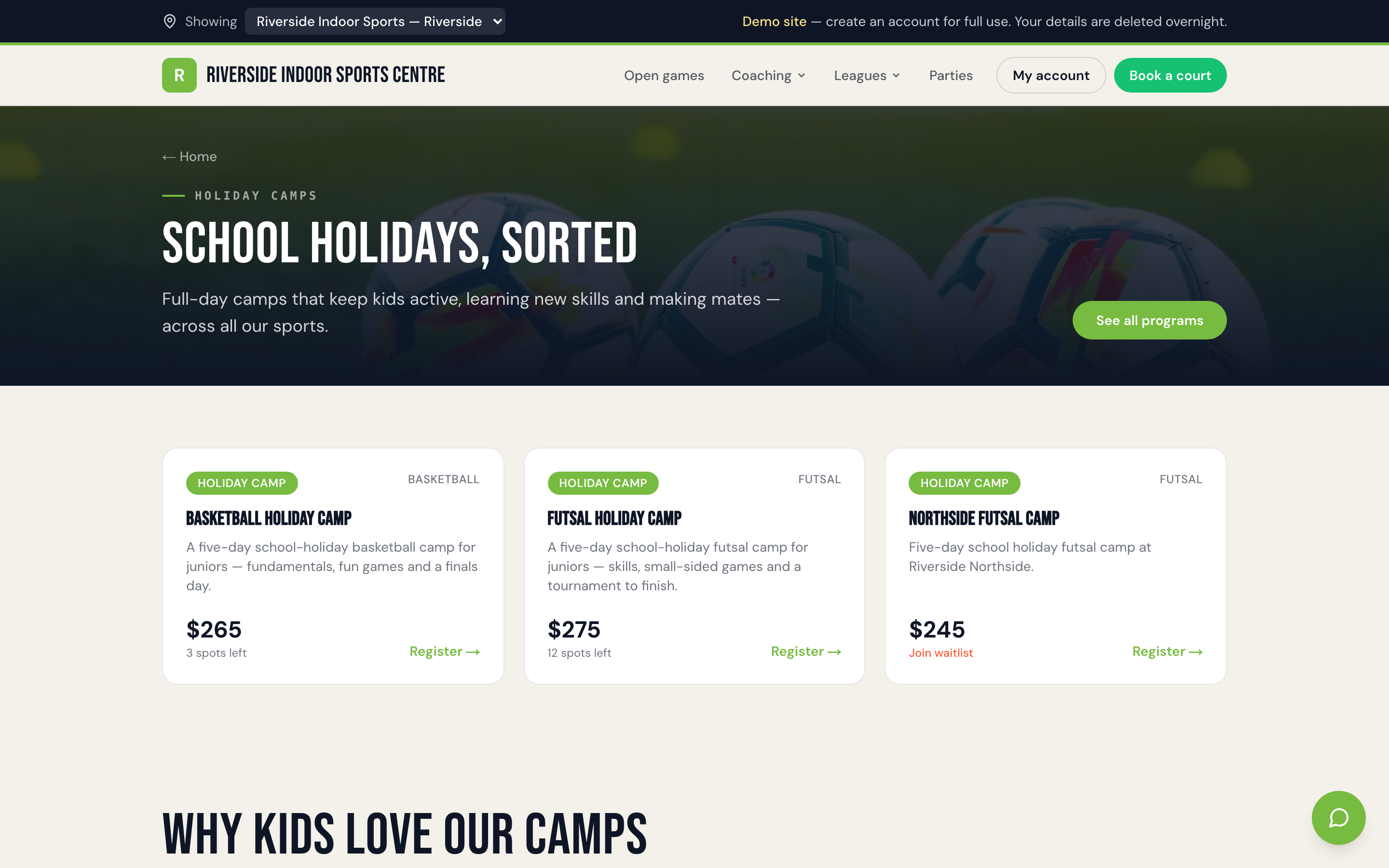
Waitlists matter more for camps than almost anything else you run. Popular weeks — the first week of the summer break, the week before a state final — will sell out, and a visible "join waitlist" option captures demand you'd otherwise lose to a phone call nobody returns. When a spot frees up, the family that's already given you their details should be the easiest booking you make all week.
If you're building a camp program from scratch rather than adding one to an existing offering, it's worth reading our broader guide on how to start a sports coaching business in Australia, which covers the structural decisions — insurance, entity setup, pricing philosophy — that camps sit on top of.
Staffing and ratios
Camps live or die on staffing, and this is one area where cutting corners shows immediately. Coach-to-child ratios should be set by age group and activity type, and tighter than you think you need — a ratio that works for a term session with parents in the car park doesn't automatically work for a full day of holiday camp, where you're also responsible for lunch, sun protection and toileting for younger kids.
This is genuinely regulated territory in most states. Required ratios, first aid coverage and Working With Children Check requirements vary and change, so check current requirements with your state's sport or community services regulator before finalising numbers, rather than working off what you did last year. Build in one float staff member per day who isn't locked into a group, so a sick call or a bathroom run doesn't leave a group short.
Comms before day one
The week before camp starts is when parent anxiety peaks — what to bring, what time is drop-off, is there a canteen, what happens if it rains. A short, well-timed pre-camp email or SMS covering drop-off and pick-up times, what to pack, weather contingency and your on-the-day contact number heads off most of the questions that would otherwise land in your inbox or, worse, at the gate on the first morning. Send it two or three days out, not two weeks, close enough that parents actually read and remember it.
On the day, a simple check-in and check-out process for guardians matters more at camp than at a regular session, because it's often a different adult doing pickup on different days. A messy sign-out process at 3:30pm on a Friday, with forty kids and half as many parents trying to leave the car park at once, is the kind of thing families remember — for the wrong reasons.
Converting campers into term enrolments
The real value of a camp week often isn't the camp fee — it's the term enrolment that follows. A camper who had a great week is your warmest possible lead for a term program, and that conversion window is short. Have a clear next step ready before the last day: a term program flyer in the end-of-camp pack, a coach who name-drops the Tuesday squad to a promising ten-year-old, a discount code valid only if used within a week or two of camp finishing.
Track which camps convert into term sign-ups and which don't. A camp that's fun but doesn't feed your term programs is still worth running for the revenue and the exposure, but a camp that consistently converts is worth protecting and expanding — more weeks, bigger groups, better coaches — because it's doing double duty as both a holiday program and your best-performing marketing channel.
Running registration, waitlists, sibling discounts and payments through Sweepa's program management features means the whole camp, from the first early-bird sign-up to the last day's pickup, runs through one system instead of a spreadsheet, a group chat and a bank statement you're trying to reconcile by hand.
FAQ
How far in advance should we open holiday camp registration?
Aim to open registration four to six weeks before the camp week itself, with early-bird pricing closing two to three weeks out. That gives families time to plan around work and other holiday commitments while still giving you a solid numbers picture early enough to confirm staffing and lock in coaches.
What age groups work best for school holiday sports camps?
Most camps split into roughly three bands: 5–7s with shorter or half-day formats and high adult attention, 8–11s with full days mixing skill blocks and games, and 12+ with more structured development and, where the coaching depth allows, a pathway conversation. Splitting by age keeps content appropriate and groups manageable.
What coach-to-child ratio do we need for a holiday camp?
Ratios are typically set by age group and activity type and vary by state, so check current requirements with your state's sport or community services regulator rather than relying on last year's numbers. Whatever the minimum, plan tighter for a full day of camp than for a term session, since camp adds meal times, sun protection and toileting for younger age groups.
Should we run half-day or full-day camps?
Half-day camps suit the youngest age groups and families who want a taster rather than full-day care, and they're a lower-commitment entry point for a first-time camper. Full-day camps suit 8s and up, work better for double-income families needing genuine holiday coverage, and generally price better per hour of coaching delivered.
How do we stop parents dropping out of registration halfway through?
Keep the form short and mobile-first, and only ask upfront for what you genuinely need on day one — emergency contact, medical or allergy notes, and which week and child. Anything that can wait until closer to the camp date, like a detailed activity preference survey, should wait. A long form at 9pm on a parent's phone is where holiday camp registration usually stalls.
How do we turn campers into term program sign-ups?
Have the next step ready before the camp finishes rather than following up cold afterwards — a flyer in the end-of-camp pack, a coach mentioning the term squad directly to a promising kid, or a short-window discount code for signing up within a week or two of camp ending. The conversion window closes fast once the holidays end and families move on to the next thing.