Coaching attendance tracking: knowing who showed up, and why it matters
A proper roll does more than tick a box — it's how you know who's on site, how you run a fair make-up policy, and how you spot a family drifting away before they cancel. Here's what a workable coaching attendance system actually needs.

On this page
The duty-of-care case for coaching attendance tracking
Picture a Tuesday afternoon squad session. Eight kids on the court, one coach, a bag of balls, forty-five minutes on the clock. A parent messages at 5:40pm asking why their daughter wasn't dropped home — she wasn't at training, she was at a friend's house, and nobody at the venue ever knew she hadn't turned up. That's not a hypothetical. It's the exact scenario that coaching attendance tracking exists to prevent.
Knowing who is physically present, and who was expected but didn't show, is one of the more unglamorous parts of running a program — right up until the afternoon it's the only thing that matters. A roll isn't there to look official. It's there so that at 5:40pm you can answer, in seconds, whether a child arrived, when, and who signed them in.
To be clear about where the line sits: this is a practical operational and accountability tool, not a compliance product. Working With Children Checks, mandatory reporting obligations and state-based child-safety regulations are a separate, serious body of rules, and they differ by state and by activity type. If you're setting up a coaching program, that's a conversation for your state's sport and recreation department or your governing body — not something a piece of software can tick off for you. What attendance tracking gives you is the record that sits underneath good duty-of-care practice: who was there, when, and who marked it.
The paper-roll problem
Most coaching programs start with a clipboard. A laminated sheet, a whiteboard marker that's always half-dry, a coach trying to tick eight names while also setting up cones and fielding a parent question about next week's bye. It works, sort of, for one class on one afternoon.
It stops working the moment you're running six age groups across three time slots with four coaches, some of whom cover for each other. The roll sheet goes home in someone's bag. It gets filled in from memory after the session, which means "present" quietly becomes "probably present." Nobody can pull last month's attendance for a family that's disputing an invoice, because the sheets are in a folder in someone's car. Sports program roll marking on paper is fine at a handful of sessions a week — it falls over as soon as it needs to be searchable, shareable, or trusted after the fact.
The deeper issue isn't the paper. It's that a paper roll only exists in one place, at one point in time, in one coach's handwriting. Nobody else in the business can see it until someone manually chases it down.
What minimum viable coaching attendance tracking looks like
You don't need anything elaborate. A workable system for class attendance for sport needs to do four things well, and not much else.
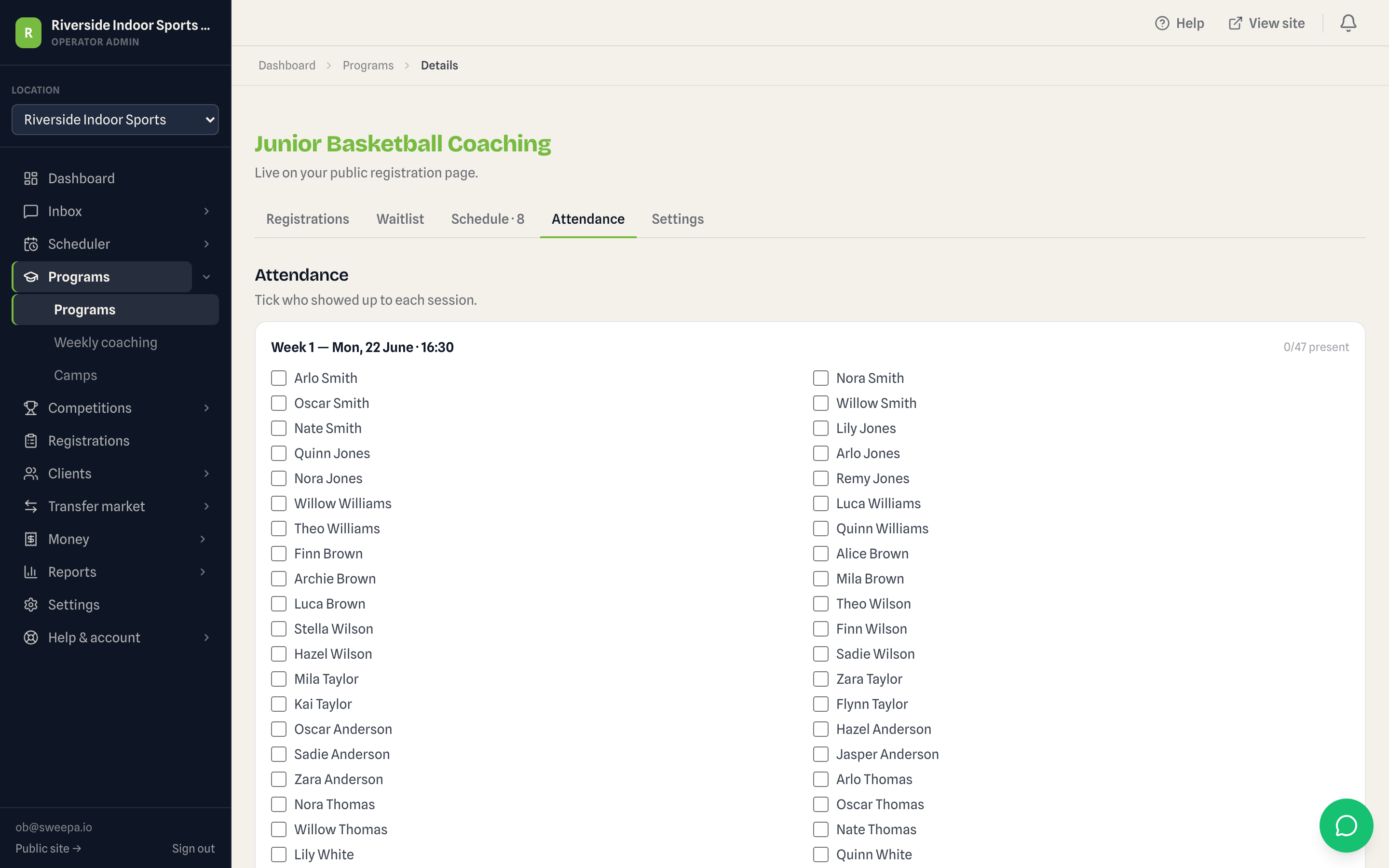
First, it has to be fast enough for a coach to use pitch-side, one-handed, between drills — not a form they fill in back at the office. Second, every mark needs a timestamp and a name attached to who marked it, so it's an actual record rather than a vibe. Third, the record has to be visible to whoever needs it afterwards — an admin fielding a query, a duty manager checking who was on site during an incident — without anyone having to physically hunt down a coach. Fourth, it needs to be pullable later: a term's worth of attendance for one participant, or one session's roll for everyone in it, on request.
That's the job Sweepa's registration and attendance tools are built around — tapping present, absent or late against a session roster, synced straight back to the admin side, so the record exists the moment the coach marks it rather than whenever the clipboard resurfaces. It sits alongside the rest of our program registration and management features, so attendance isn't a separate system bolted onto the side of your bookings.
Make-up and catch-up policy
Families will ask for make-ups. A kid misses week four with a cold, and a fortnight later a parent wants to know if there's a catch-up spot in another group. Whether you say yes is a business decision — but you can't make that decision fairly, or defend it later, without an accurate record of who actually missed what.
A clear make-up policy, applied consistently, depends entirely on attendance data being trustworthy. If session four's roll was filled in from memory a week later, you genuinely don't know whether a child missed one week or three — and you end up either over-promising catch-ups you can't fit, or under-delivering on a policy you can't actually verify. Set the policy in plain terms up front — how many make-ups per term, how they're booked, whether they carry over — and let the attendance record do the arbitrating when a parent asks whether their child really has only missed the one session.
Attendance as an early churn signal
Here's the pattern-based case for treating attendance as more than a safety record: it's usually your earliest warning that a family is about to leave.
A participant who's attended every week for a term, then starts missing every third session, is telling you something before they tell you anything. Maybe it's a scheduling clash, maybe interest is fading, maybe a sibling's activity now competes for the same afternoon. Venues and coaching programs we've worked with typically only notice this kind of drift when it's too late — the parent doesn't re-enrol next term, and by then there's no window left to have the conversation. A visible attendance trend, checked every couple of weeks rather than only at term's end, turns that into something you can act on while the family is still enrolled.
This matters more in coaching than in a lot of other sport contexts, because a coaching business's revenue is built on re-enrolment, not one-off transactions. If you're still working out the shape of that business — pricing, term structure, how many coaches a given roster actually supports — it's worth reading our guide to starting a sports coaching business in Australia, which covers retention alongside the operational basics.
Talking to parents with the data
Attendance data is also just useful, day to day, in the ordinary business of talking to parents. How many sessions has my son missed this term is a question you should be able to answer in seconds, not by scrolling back through a group chat. So is a request for a partial refund after missing three weeks while travelling — a question that's straightforward to answer fairly when you have the record, and genuinely difficult to answer fairly when you don't.
The same goes for the softer version of that conversation: a coach who mentions, in passing at pickup, that a normally reliable kid has missed the last two Tuesdays. That's worth a proper check-in call, not a guess based on memory. Handled well, attendance becomes one input into a broader communications habit rather than a one-off admin task — something we go into in more detail in our piece on parent communications for sports programs, covering what to send, when, and through which channel.
None of this needs to be complicated. It needs to be consistent — marked every session, by the person actually running it, in a place everyone who needs it can see.
FAQ
Is attendance tracking the same as a Working With Children Check or child-safety compliance?
No. Attendance tracking is an operational record of who was present at a session and when — it's useful for duty-of-care and accountability, but it isn't a substitute for WWCC checks, mandatory reporting training or state-based child-safety regulations. Those requirements differ by state and by activity type, so check with your state's sport and recreation department or your sport's governing body for what actually applies to your program.
How often should coaches mark the roll?
At the start of every session, ideally before the warm-up finishes. Marking attendance from memory after the fact — even an hour later — quietly turns an accurate record into a guess, which defeats the point when you need to check it later.
What should we do if a participant's attendance starts dropping?
Treat a change in pattern — not just a single absence — as a prompt for a quick, low-pressure check-in with the family. Attendance that goes from weekly to fortnightly is often the first sign a family is drifting toward not re-enrolling, and it's much easier to address while they're still in the program.
Do we need a formal make-up class policy?
It doesn't need to be elaborate, but it should be written down and applied consistently — how many make-ups are allowed per term, how families book them, and whether they roll over. Consistency is much easier when your attendance record is accurate, since it's what you'll point to when a parent asks about a specific missed week.
Can attendance data help with refund or credit disputes?
Yes — a reliable attendance record is usually the quickest way to resolve a dispute fairly, because it settles the factual question (how many sessions were actually missed) before you get into the policy question (what the family is entitled to as a result).