Summer Holiday Camp Marketing: A Four-Week Launch Plan for the Term 4 Window
A week-by-week summer holiday camp marketing plan that runs inside Term 4. It covers when to open, when to close the early bird, where sibling offers fit, and what to do with the stragglers.
On this page
It's the second week of December. Your January camp is half full, and every parent you ask says they'll 'sort the holidays after Christmas'. That's the usual result of summer holiday camp marketing that starts too late. The fix is a four-week sequence that runs inside Term 4, while families are still in routine and still reading their email.
This post gives you that sequence week by week. It covers when to open, when to close the early bird, where sibling offers go, and what to do with the late bookers. It assumes you already know what you're running and roughly what it costs. If you don't yet, start with our guide to planning, pricing and selling out school holiday camps.
Why summer holiday camp marketing is won in Term 4
Term 4 is the last stretch of the year when families live in a predictable weekly rhythm. Kids are at school and at training. Parents are checking the school app and their inbox.
December breaks that rhythm. Concerts, presentation nights, end-of-year breakups, Christmas shopping and travel all land on top of each other. Your camp email becomes one of forty.
Working parents also tend to plan holiday care in one sitting. They work out their leave, then fill the gaps. If your camp isn't open and clearly priced when they sit down to do that, they book whoever is. For January, that sitting usually happens well before school finishes.
The sequence runs four weeks for a reason. Shorter than that, and you don't get enough touches to catch busy parents. Longer, and the early-bird deadline stops feeling like a deadline.
Map the four weeks onto your state's term dates. Term 4 timing differs a little between states, so check your education department's calendar. The goal is to close the early bird with a week or two of term still to go. That keeps your deadline clear of the end-of-year pile-up.
What to have ready before week one
The sequence only works if nothing changes once it starts. Lock these in first:
- Dates, times and age groups. Set them per day and per week, with a capacity for each. Parents book days, not abstract 'camps'.
- Four price points. Set the full price, the early-bird price, the sibling discount, and an early-bird closing date and time. 'End of November' is vague. 'Sunday 30 November, 8pm' is a deadline.
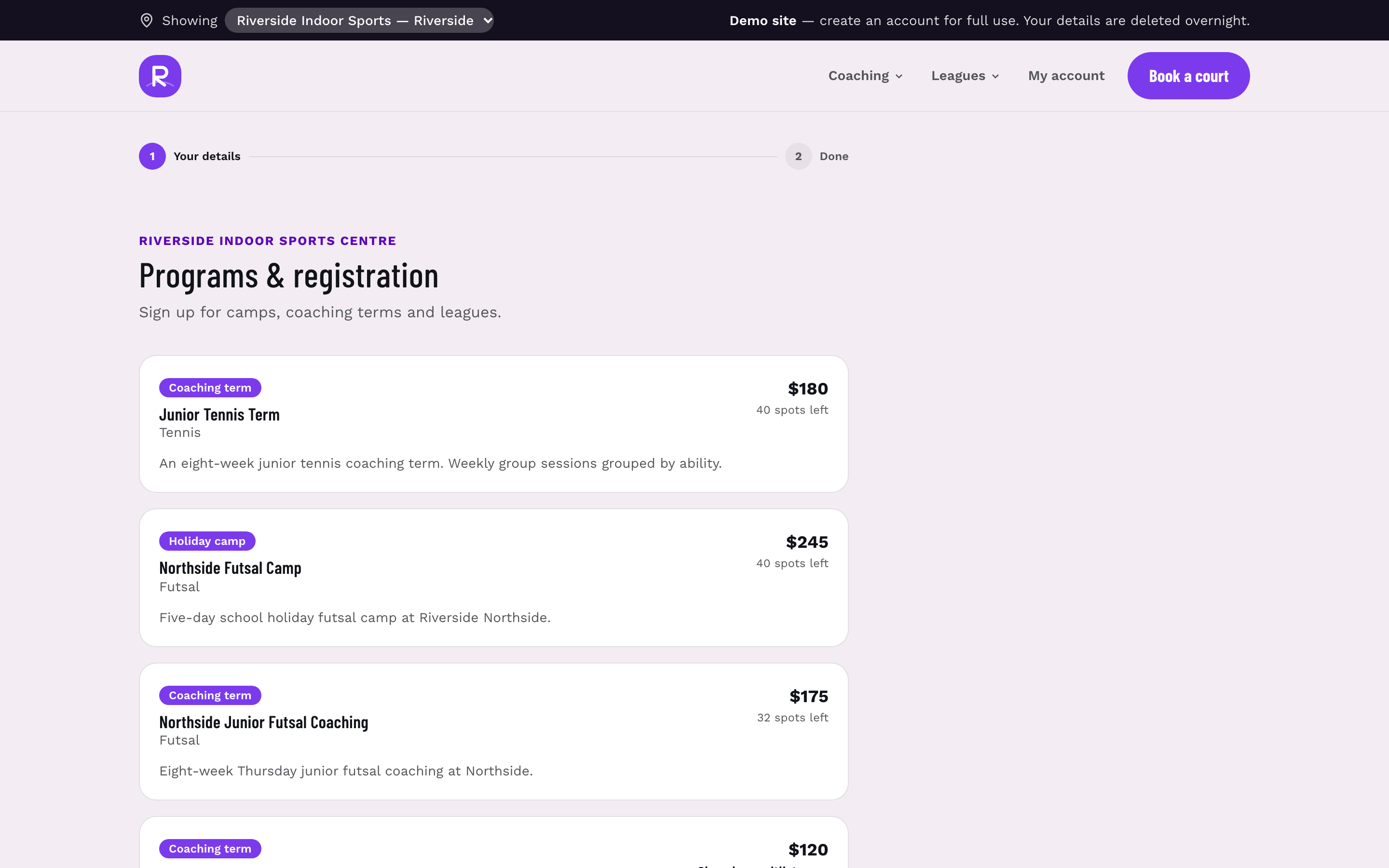
- A registration page that works on a phone. A parent should finish it in a few minutes, standing at the school gate. Test it yourself on mobile before you send anything. Our program and camp registration page shows what this can look like when sessions, sibling discounts and waitlists live in one flow.
- Waitlists switched on for every day and age group. A full Tuesday should capture a name, not lose one.
- All your messages drafted now. Write every email and SMS for the four weeks in one sitting. You won't have time in week three.
- A clean contact list. Include past campers, current term-program families and anyone who enquired this year.
- Written refund and transfer terms. The first question after 'how much' is 'what if we go away?'
Weeks one and two: existing families first, then everyone
Week one is priority access. Send it only to returning camp families and current term-program families. Give them a head start of three to five days before you go public.
This isn't just a nice gesture. These are the parents most likely to book, and a camp that's already filling looks better when you open it up. Send one email and one short SMS. Include the dates, what's new this year, the early-bird deadline, and the link. Ask your coaches to mention it at the end of every session that week.
Week two opens to everyone. Now use your local channels:
- School newsletters. Lots of schools run community notices, but their deadlines can be a week or more ahead, so ask early.
- Your socials and your venue noticeboard.
- Local community groups and partner clubs.
- A QR code at the front desk that goes straight to registration.
We cover the low-cost local options in more detail in how to promote a sports venue locally.
In every message, repeat the early-bird closing date. Repetition feels boring to you. It's the first time most parents notice it.
By the end of week two, look at bookings by day, not just in total. If Monday to Wednesday are filling and Thursday is empty, your week-three messages should push Thursday.
Weeks three and four: sibling offers and the early-bird close
Week three leads with siblings and friends. By now, parents with two or three kids are doing the maths. Make the sibling offer the headline of this week's message.
The discount should apply automatically at checkout. Avoid codes. Parents forget codes, then email you to ask for a refund of the difference. That's an hour of admin you don't need in November.
Pair it with a 'bring a mate' nudge. Kids want to go to camp with a friend, and parents book faster when their child is asking. Give families a simple shareable link and suggest they coordinate days with each other. Our waitlist and sibling discount playbook goes further on structuring the offer so it converts without eating your margin.
Week four is deadline week. Plan three touches:
- Start of the week: 'Early bird closes Sunday at 8pm.'
- Forty-eight hours out: list the days that are nearly full.
- Morning of close: one short SMS with the link.
Then close it on time. Don't extend. An extension teaches every family on your list that next year's deadline is soft. If you want the reasoning, read what a deadline actually does to registrations. After close, full price carries on, and full days send people to the waitlist.
Worked example: one camp week through the sequence
Here's an illustration of the shape to aim for. The numbers aren't data, just a way to see the pace.
Assumptions: one four-day camp week in mid-January, 40 places a day, an existing list of past campers and term-program families, and an early bird that closes at the end of week four.
| Stage | What you send | Places filled per day (illustrative) |
|---|---|---|
| Week 1: priority access | Email and SMS to existing families; coaches mention it at sessions | 14 |
| Week 2: public launch | School newsletters, socials, noticeboard, desk QR code | 22 |
| Week 3: siblings and friends | Sibling offer headline, shareable link | 30 |
| Week 4: early-bird close | Three deadline reminders | 37 |
| December to January | One reminder after term ends, one in early January | 40, waitlist open |
The use of a table like this is the checkpoint, not the final number. Write down your own target shape before week one. If you're well behind it after week two, you still have two weeks to act. You could push a quieter day, add a single-day option or get coaches talking it up.
If you only notice the gap in December, your options shrink to discounting.
What the last early-bird weekend looks like at the desk
Here's a setup we see a lot. It's the last Saturday before the early bird closes. The morning term program finishes, and four parents arrive at the desk at once.
One wants to know if the early bird is still on. One is booking for two kids and wants to know the sibling price. One asks which day their son's mate is booked into. One just wants the link again.
If the answer to any of that is 'I'll check and call you', you've probably lost them until after the weekend, and the deadline will have passed.
Set the desk up to answer on the spot:
- Put the QR code to registration on the counter, not just the noticeboard.
- Make sure staff know the sibling discount applies automatically, so there's nothing to explain.
- Keep a whiteboard showing which days still have spots.
- Have the coach announce the closing time at the end of the session.
For the 'which day is his mate in' question, don't share other families' bookings. Suggest the parents text each other, then book the same day.
Common mistakes, and a launch checklist
The mistakes we see most often are easy to avoid once you know them:
- Starting in December. You're competing with everything else in the calendar.
- One big announcement, then silence. Most parents need several touches before they act.
- Extending the early bird. It works once and costs you every year after.
- Sibling discounts as codes. They create admin and disappointed parents.
- Tracking totals, not days. A camp can look 'nearly full' while Thursday sits empty.
- No waitlist. A full day without a waitlist is demand you can't see.
For message wording that parents actually open, see emails and SMS that get read.
Your checklist:
- Check your state's Term 4 dates and pick your four weeks.
- Set the early-bird closing date and time.
- Lock days, age groups and capacity per day.
- Test registration on a phone, including the sibling discount.
- Switch on waitlists.
- Draft every message for all four weeks.
- Write down your target bookings per day for the end of each week.
- Brief coaches and desk staff on dates, prices and the deadline.
If you'd rather registrations, sibling discounts, waitlists and email and SMS reminders sat in one system, that's the job Sweepa does for coaching programs. You can see the plans and the 30-day free trial on our pricing page.
On Monday, put your four send dates in the calendar and pick the exact minute the early bird closes. Everything else follows from those two decisions.
FAQ
When should I start marketing January holiday camps?
Start inside Term 4, ideally so a four-week sequence finishes with a week or two of term still to go. Families are still in their school routine and reading emails then. Once December hits, end-of-year events and Christmas compete for every parent's attention. Check your state's term dates and count back from the last week of school.
How long should an early-bird offer for holiday camps run?
About four weeks from the first priority-access message works well. Shorter, and you don't get enough reminders to reach busy parents. Longer, and the deadline stops feeling urgent. Set a specific closing date and time, and don't extend it.
Should sibling discounts apply automatically or with a code?
Automatically, wherever your registration system allows it. Parents forget codes or enter them wrong, then contact you for a partial refund, which creates admin at your busiest time. An automatic discount also makes the offer easy for desk staff to explain.
Should returning families get early access to holiday camp bookings?
Giving returning camp families and current term-program families a three-to-five-day head start is a sensible default. They're the most likely to book, so you start with momentum. A camp that's already filling also looks more appealing when it opens to the public.
What should I do if some camp days aren't filling?
Check bookings by day at the end of each week rather than looking at the total. If a day is lagging, make it the focus of your next message, offer a single-day option, or ask coaches to mention it at sessions. Catching it by the end of week two leaves you time to fix it without discounting.
What happens after the early-bird deadline closes?
Keep registrations open at full price and let full days fill their waitlists. Send one reminder after term ends and one in early January for families who plan late. Don't reopen the early-bird price, or families will expect the same next year.