Summer Competition Planning: A Week-by-Week Run Sheet from Registration to Round One
Summer competition planning works best backwards. Pick your first fixture night, then count back through team lists, draw release, grading, registration close and venue bookings so nothing lands in the same week.

On this page
It's a Thursday in late September. A captain leans on the desk and asks when the summer draw is coming out, and you realise you haven't confirmed which courts you've actually got on Tuesday nights. That's the moment most summer competition planning goes wrong: not because anyone's lazy, but because the season was planned forwards from "let's open rego" instead of backwards from the first whistle.
This post gives you a run sheet that works the other way. Pick your round one date, count back ten weeks, and every job (venue bookings, registration close, grading, draw release, team lists) gets its own slot. By the end you'll have a timeline you can copy into your calendar on Monday.
Start summer competition planning from round one and count backwards
Round one is the only date that can't move without someone noticing. Teams have told their players. Players have told their partners. Once it's published, shifting it costs you goodwill and usually a few teams.
So fix it first, then work back. Before you count anything, check three things:
- School holidays. In most states, the Term 3 break lands in late September and early October. That's right in the middle of a typical summer rego window. Families and social players are away, replies slow down, and captains go quiet. Plan for a flat fortnight.
- Public holidays. Several states have a Labour Day or King's Birthday Monday in early October, and Victoria has Melbourne Cup Day in November. Check your state government's public holiday list and mark every one that touches your comp night.
- The Christmas break. Most summer comps stop for two or three weeks over Christmas and New Year. Decide now how many rounds you'll fit before the break and how many after, because that number shapes your division sizes later.
If you run outdoors, add one more: daylight saving starts on the first Sunday in October in the states that observe it. Your late timeslot might be playable in daylight from round one, or it might not be, depending on where your start date falls.
With those marked, write "R1" on your calendar and count back ten weeks. Call that week minus ten. Everything below hangs off it.
Weeks 10 to 8: lock venue availability first
You can't sell a comp you don't have courts for. Before a single rego form goes live, confirm:
- Which nights and how many courts or fields. If you hire from a council or a school, get it in writing. Verbal "should be fine" holds are how you end up with four divisions and three courts.
- Timeslots per night. Say you have three courts on a Tuesday, with games every 50 minutes from 6pm to 10pm. That's four slots per court, twelve games a night, which is 24 team-slots. That's your ceiling for that night.
- Blackout dates. School carnivals, venue maintenance, a booked tournament. Get them now, not after the draw is out.
- Changeover time. If your games run back-to-back, factor in the gap for teams to clear. Ten minutes between games is common for indoor courts, and skipping it is how 9pm games start at 9:15.
The output of this phase is one number per night: the maximum number of teams you can take. Everything in registration should be capped against it.
Weeks 8 to 4: run registration to a hard close
Open rego around eight weeks out. That gives returning teams time to sort themselves through the school holidays and new teams time to find you.
What matters here:
- Publish the close date on day one. Not "rego closing soon". A date. If you're running an early-bird rate, put that deadline a fortnight before the close; our post on what an early-bird deadline does to registrations covers how to set it.
- Ask for what grading needs. Last season's division, a self-assessed grade, preferred timeslot. If you don't ask now, you'll be ringing captains in week minus three.
- Take payment or a deposit at rego. A team that has paid is a team that turns up. If you're still invoicing after the draw, you're building your draw on guesses. There's more on that in getting team fees paid before round one.
- Watch each night against its cap. When Tuesday hits its ceiling, close Tuesday and point new teams at Wednesday.
Close rego four weeks before round one. Not three. You need the extra week for the late teams who'll ask anyway.
Weeks 4 to 2: grade the teams, then build and release the draw
This is the busiest fortnight in the run sheet, and the one that most often slips.
Week minus four: grade. With rego closed, you know your team count per night. Sort teams into divisions using last season's results and what they told you at rego. Aim for even division sizes that suit the rounds you planned around Christmas. Our guide to grading teams into divisions fairly walks through a method that holds up when the first complaint arrives.
Week minus three: build the draw. Feed in your nights, courts, timeslots and blackout dates from week minus ten. Check that no team plays the late slot every week and that byes are spread fairly. If you're still doing this in a spreadsheet, budget a full day and a second pair of eyes.
Week minus two: release the draw. Publish it somewhere every player can find it, not just in an email to captains. Most of the "what time are we on?" messages you'll get in round one come from players whose captain never forwarded anything.
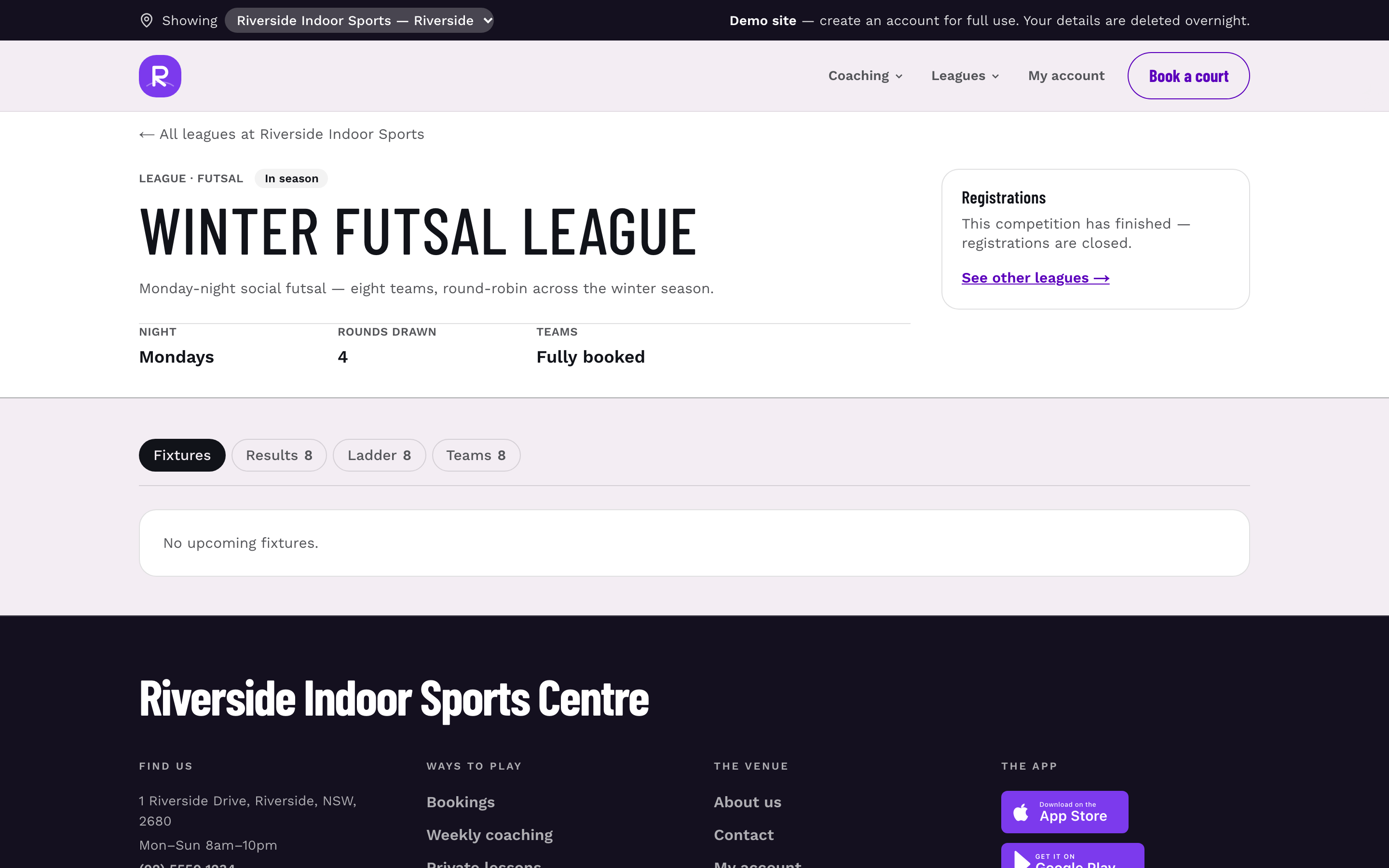
This is where software earns its keep. In Sweepa, fixtures are generated from your league and competition management setup and published to a public comp page with the ladder alongside, so the draw players check on the night is the same one you built.
Weeks 2 to 0: team lists, payments and the first night
With the draw out, the last fortnight is about people and money.
- Team lists. Chase captains for full player names. You need them for results, for any player eligibility rules in finals, and for contacting players directly if the captain goes missing.
- Outstanding fees. Anyone not paid by week minus one gets a direct message with a clear deadline. If they're not paid by round one, decide in advance whether they play.
- Rules and conduct. Send the comp rules, forfeit policy and wet-weather approach once, in one message, before round one. If you run outdoors, link your wet-weather policy so nobody hears it for the first time at 5pm on a stormy Tuesday.
- Officials. Confirm umpires or referees for every round-one game.
Round one week itself should be quiet admin-wise. If you're still editing the draw on the Monday, something upstream ran late.
The summer competition planning run sheet at a glance
Here's the whole timeline in one table. The assumption: one comp night, round one on a Tuesday, a three-week Christmas break.
| Week | Job | Output |
|---|---|---|
| −10 | Mark round one, school holidays, public holidays, Christmas break | Fixed R1 date and season length |
| −10 to −8 | Confirm courts, timeslots, blackout dates | Team cap per night |
| −8 | Open rego with close date published | Live rego form, early-bird deadline set |
| −6 | Early-bird deadline | Read on demand, close full nights |
| −4 | Close rego | Final team count per night |
| −4 | Grade teams | Divisions set |
| −3 | Build the draw | Draft fixtures checked |
| −2 | Release the draw publicly | Published draw, captains notified |
| −2 to −1 | Chase team lists and unpaid fees | Full lists, fees cleared |
| −1 | Send rules, conduct and wet-weather info; confirm officials | One clear pre-season message |
| 0 | Round one | Results entered same night |
Print it, stick it behind the desk, and move the dates to suit your night.
What the last week before round one actually looks like
A setup we see a lot: the draw went out on time, everyone's happy, and then on the Wednesday before round one a team withdraws. Their captain's moved interstate. Now one division has an odd number of teams and every round has a bye that wasn't there before.
You have three options. Pull in a team from the waitlist if you kept one. Leave the bye in and tell the division clearly. Or redraw the division, which means re-sending times to every team in it and fielding the questions that follow.
The venues that handle this calmly are the ones that kept a short waitlist after rego closed and held one spare timeslot per night. The ones that struggle are redrawing on a Friday afternoon with the phone ringing.
The other one that shows up every season: a captain at the desk on round-one night saying they never got the draw. They did. It went to their old email. Which is why the draw needs to live somewhere public, and why texts beat emails in the final week.
Mistakes that push round one back, and what to do this Monday
The mistakes we see most often:
- Opening rego before courts are confirmed. You end up selling places you can't host.
- Soft close dates. "Rego closes Friday, but message us if you're late" means grading happens in week minus two and the draw comes out days before round one.
- Ignoring the school holidays. Rego goes quiet, the organiser panics and extends the close date, and every downstream step gets compressed.
- Publishing the draw only to captains. Half your players never see it.
- Taking fees after the draw. You draw teams who then don't pay, and you're chasing money during the season.
If you want the deeper version of the fixtures step, our guide to creating sports fixtures without the spreadsheet covers byes, timeslot fairness and changes mid-season.
For this Monday: open your calendar, mark round one, then mark week minus ten, week minus four and week minus two. Those three dates are the spine of the season. If week minus ten has already passed, start with venue availability today, and if you want to see how the rest of the run sheet looks with rego, payments and the draw in one place, the full feature list is a good start.
FAQ
How far ahead should I start summer competition planning?
Start about ten weeks before your first fixture night. That gives you two weeks to confirm venues, four weeks of registration, and four weeks for grading, the draw and team lists. If you hire courts from a council or school, start earlier, because their booking cycles can be slower than yours.
When should registration close for a summer comp?
Close registration four weeks before round one. That leaves a week to grade teams, a week to build and check the draw, and two weeks between draw release and the first game. Closing any later usually means the draw comes out in the final week and teams don't have time to sort their players.
How early should the draw be released before round one?
Aim for two weeks. That gives captains time to tell their players, lets teams flag clashes while you can still fix them, and leaves a buffer for late withdrawals. Publish it somewhere every player can see, not just in an email to captains.
What do I do if a team withdraws after the draw is out?
You can bring in a team from a waitlist, leave a bye in that division, or redraw the division. Bringing in a waitlisted team causes the least disruption, which is why it's worth keeping a short waitlist after registration closes. Whatever you choose, tell every team in that division in one clear message.
Should summer comps break over Christmas?
Most summer comps take a two to three week break over Christmas and New Year, because attendance drops and many venues reduce hours. Decide the break before you open registration so you can tell teams how many rounds they get on each side of it. That number also helps you set division sizes during grading.