Sports Venue Birthday Parties: How to Run Them Profitably
A practical playbook for running sports venue birthday parties that actually turn a profit — packages, flat-rate pricing, deposits, the day-of run sheet, and the upsells and follow-up that bring families back.
On this page
Sports venue birthday parties as a revenue anchor
Saturday afternoons are where a lot of venues leave money on the table. The morning is full of junior sport, the evening picks up with adult competition, and the hours in between often sit half-empty. Sports venue birthday parties are one of the most reliable ways to fill that gap — done well, a single two-hour party slot can out-earn three hours of casual court hire. It's also one of several ways to fill off-peak hours at your venue, and one of the easiest to sell yourself, since parents are actively looking for somewhere to book.
The economics work differently to normal hire. A parent booking a party isn't comparing your court rate to the venue down the road — they're comparing your $300–450 package to a soft-play centre or a trampoline park. Priced as a package rather than an hourly rate, it feels like good value to the parent and lands well above your standard yield per hour for you.
Before you open parties for booking, get three things sorted: a public liability and child-safety policy that covers unsupervised minors on site (check with your insurer or your state sport and recreation body for what applies to your venue type), a staffing model for who runs bump-in, hosting and bump-out, and a clear view of which spaces you can block out for parties without cannibalising your regular bookings.
Designing party packages that book themselves
Rather than quoting every party individually, build two or three fixed packages so parents can self-serve online. A simple structure that works across most venue types:
- Court or space only — the birthday family books your space and brings their own catering and entertainment.
- Standard package — space plus a staff host, a basic equipment set (balls, bibs, cones for a mini tournament), and a party room for cake and presents.
- Premium package — everything in Standard plus a themed activity block (a round robin, an obstacle course, a skills clinic) run by one of your coaches.
Build packages around what you already have — courts, coaches and a function space — rather than props and decorations you'd need to source and store. A futsal venue running a "mini World Cup" round robin, or a swim school running a pool party with a lifeguard and a shallow-end games session, are using the same three-tier structure with content that fits their facility.
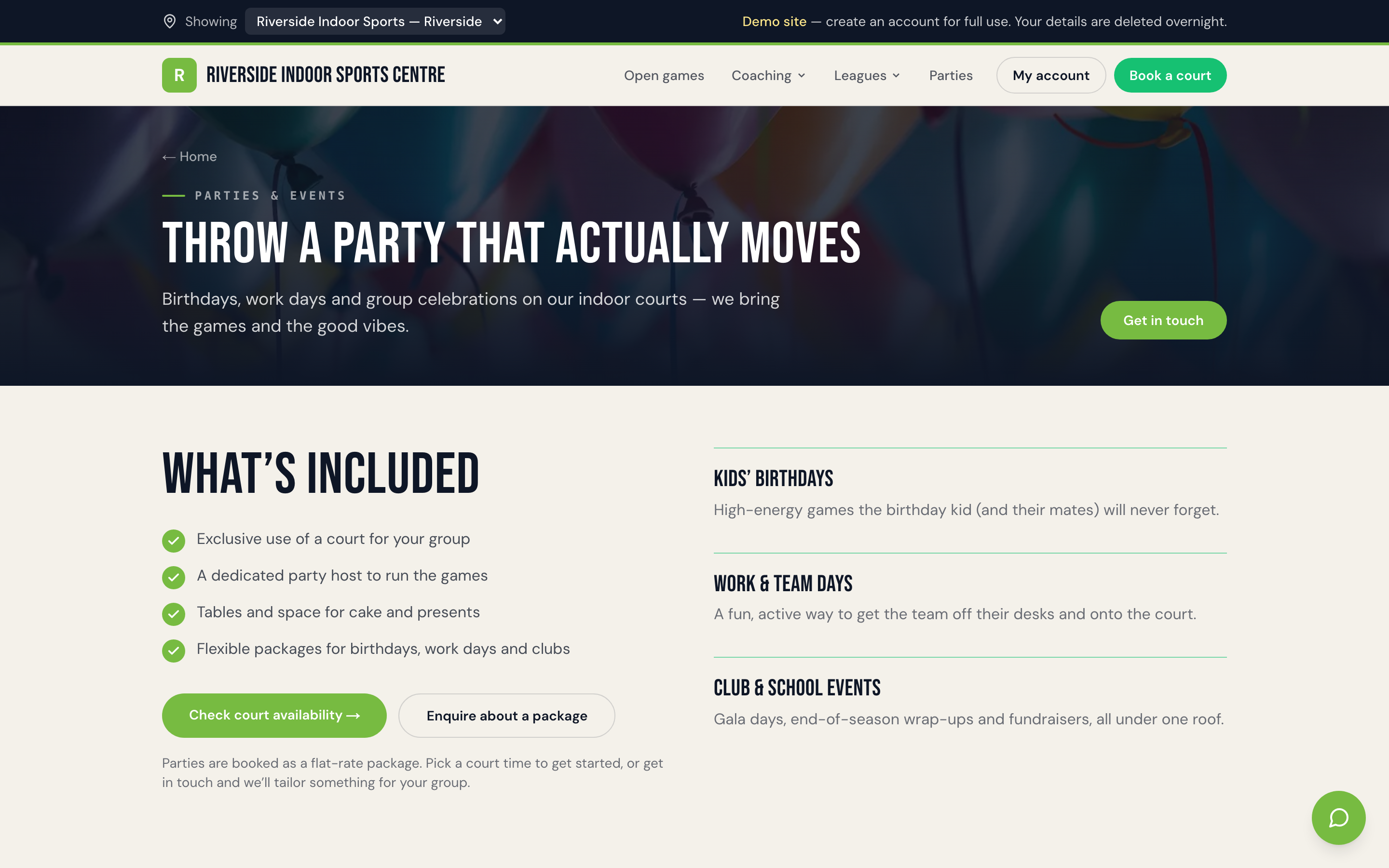
List each package with a clear capacity ("up to 12 kids"), a fixed duration, and exactly what's included, so a parent can compare and book without needing to call and ask. That clarity is what actually gets a party booked online instead of turning into a string of back-and-forth phone calls.
Pricing party packages, including whole-booking flat rates
Two pricing models work for parties: per-head and flat rate. Per-head pricing ("$25 per child, minimum 10") scales with attendance but makes the total unpredictable for the parent, and for your rostering — you don't know final numbers until days out. A flat rate for the whole booking — one price for the space, the time block and the inclusions, regardless of whether nine or fourteen kids show up — is usually the better fit, because you're really selling a block of your facility and your staff's time, not a headcount.
This is also where a facility with multiple courts or fields has an edge: you can price a flat rate across a booking that spans more than one space — say, one court for the sports activity and the function room for food and cake — as a single package rather than juggling separate line-item bookings. Set that up once as a package in Sweepa's booking and payments features and it's available online at a fixed price every time, without re-quoting each parent's slightly different request.
Whichever model you use, set your price against your true cost: staff hours, the opportunity cost of the slot versus casual hire, and cleaning time afterwards. A package that reads as premium pricing to a parent still needs to clear a decent margin once the labour is costed properly.
Bookings and deposits
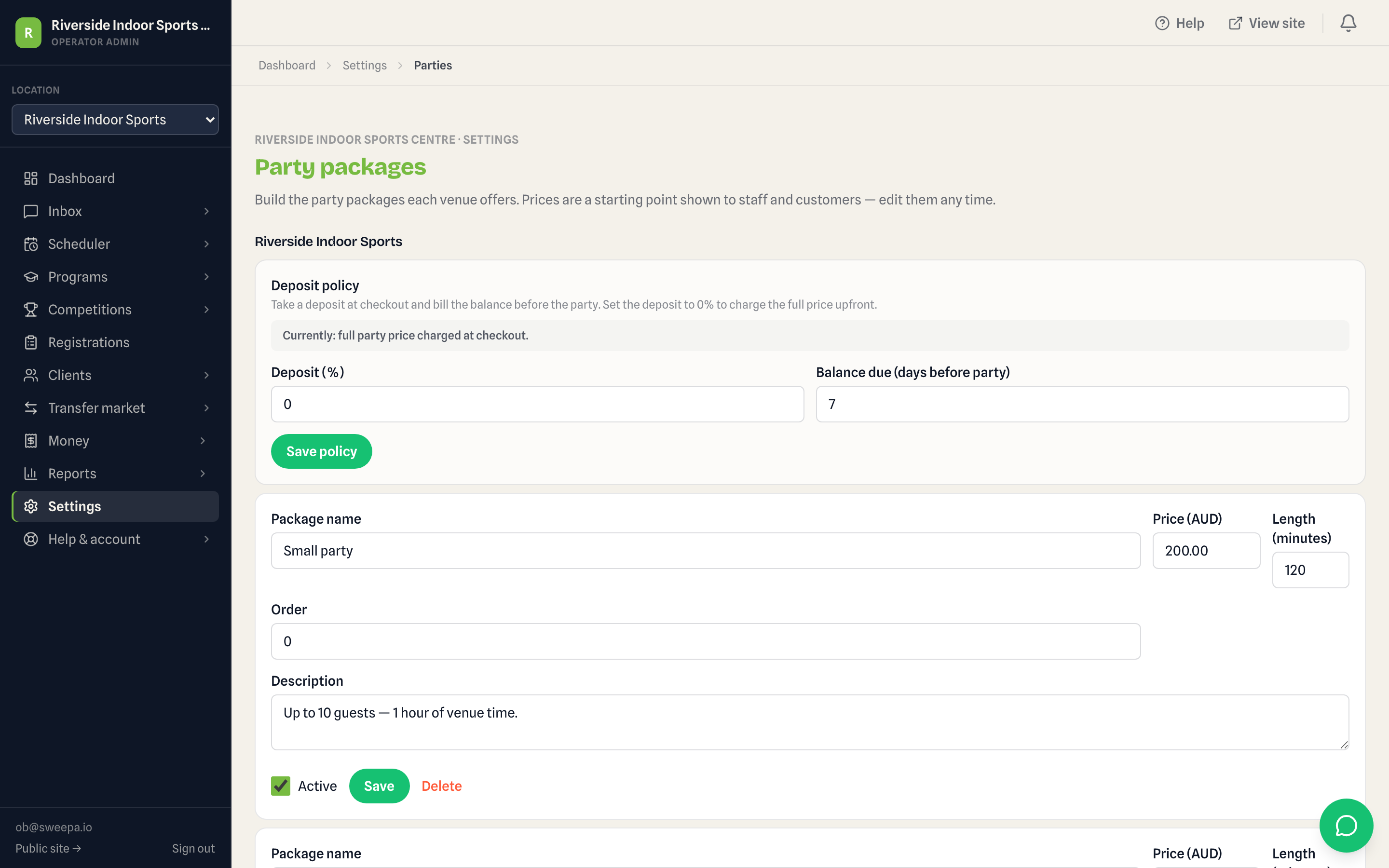
Publish your packages on your venue's booking page and let parents book and pay online, the same way they'd book a casual court. That single change removes most of the phone tag that makes parties feel like more admin than they're worth — no back-and-forth on dates, no manually blocking out a court in a paper diary and hoping nobody double-books it.
Take payment — or a deposit — at the time of booking rather than on the day. A parent who has already paid is a parent who shows up, and it protects you against a last-minute cancellation eating a Saturday slot that could have gone to another family. With Stripe-native payments built into the booking flow, you can take a deposit or the full package price at checkout, and send an automatic confirmation and reminder by email or SMS so the parent isn't hunting for the details three weeks later.
Set a cancellation and reschedule policy up front — how many days' notice, what's refundable — and put it on the booking page itself, not just in a follow-up email. It's much easier to hold a parent to a policy they saw and agreed to than one you're explaining after the fact.
The day-of run sheet
Parties tend to fail operationally, not commercially — the package sells fine, but the changeover on the day is where things go wrong. Build a simple run sheet for every party slot and put it in the hands of whoever's hosting:
- Arrival — who greets the family, and where they wait if the space isn't clear yet.
- Setup — equipment list, court markings, party room layout, done five to ten minutes before start.
- The block — activity sequence in fixed chunks (a ten-minute warm-up game, forty minutes of main activity, a ten-minute drinks break, remainder free play).
- Cake and food — your policy on candles and confetti or glitter (usually banned — it's a nightmare on sports flooring), and who manages timing.
- Bump-out — a reset checklist so the space is genuinely ready for the next booking, not just "good enough."
- Handover — a minimum fifteen-minute buffer between parties. Sports flooring shows every dropped drink and stray sock, and a rushed changeover is how a good 2pm party turns into a rushed 4pm one.
A run sheet also means any staff member can host a party, not just the one person who's "good at parties." Print it, laminate it, keep it at the front desk — the point is that it's boringly repeatable, not that it's clever.
Upsells that don't feel grubby
The line between a good upsell and a grubby one is whether it's offered before the parent has to ask. Put two or three genuinely useful add-ons on the booking page itself: extra time in 15 or 30-minute blocks, an extra coach for a bigger group, food or drink packages if you run a canteen, or a photo pack for a skills-based activity.
A two-court venue we've worked with found that simply listing extensions and extra coaches as tickable options on the booking page — rather than something a parent had to ask for on the phone — lifted how often families added them, with no hard sell in sight.
What doesn't work: pushing add-ons once the parent's already paid, or making the base package deliberately thin so everyone "needs" the upsell. Price the standard package to be genuinely good value on its own — upsells are for families who want more, not families who feel short-changed without them.
The parent follow-up
The party doesn't end when the family walks out the door. A short follow-up — a thank-you message, a couple of photos, and an invitation to book a return visit or a term of coaching — costs five minutes and is the highest-leverage marketing you'll do all week. Parents who've just had a good experience are primed to become term-program families or repeat bookers; that follow-up is what converts the goodwill into a second booking.
Automate the mechanical part — a thank-you sent by email or SMS a day or two later — so it happens every time, not just when someone remembers. Keep the tone personal even if templated; nobody wants "Dear Valued Customer" after their kid's ninth birthday party.
Common mistakes to avoid
A few patterns show up again and again in venues that struggle to make parties work:
- No fixed packages. Quoting every party individually makes every party a negotiation.
- Pricing per hour instead of per package. Parents think in "what does the whole thing cost," not court rates.
- No deposit. Unpaid bookings get no-showed or cancelled at the last minute far more often than paid ones.
- No buffer between parties. Back-to-back bookings with no reset time is how a good 2pm party turns into a rushed one two hours later.
- Treating it as a one-off, not a system. Venues that do well run parties the same way every time — same packages, same run sheet, same follow-up.
Checklist: running a profitable party program
- Fixed packages with clear inclusions, capacity and duration
- Flat-rate pricing for the whole booking, costed against real staff time
- Online booking and payment (or deposit) at time of booking
- A written cancellation and reschedule policy on the booking page
- A standard run sheet covering arrival, setup, the activity block, cake and bump-out
- A genuine buffer between back-to-back party slots
- Two or three upsells offered up front, not pushed after payment
- An automated thank-you and rebooking nudge after the party
FAQ
How long should a birthday party slot run at a sports venue?
Most venues land on 90 minutes to two hours, split roughly into arrival and warm-up, the main activity block, and food and cake, with a buffer built in afterwards for reset before the next booking.
Should I charge per child or a flat rate for parties?
A flat rate for the whole booking is usually simpler and more profitable than per-head pricing — you're selling a block of space and staff time, not a headcount, and it makes the total predictable for the parent too.
Do I need a deposit for party bookings?
Taking a deposit or full payment at the time of booking significantly cuts no-shows and last-minute cancellations, and it protects a Saturday slot that could otherwise have gone to another family.
What insurance or child-safety checks do I need to run parties?
Requirements vary by state and venue type, so check with your insurer and your state's sport and recreation body for what applies to unsupervised minors on your site before you start selling parties.
Can I run parties alongside regular bookings on the same day?
Yes, as long as you block out the space clearly in your booking system and leave a genuine buffer between the party and whatever's booked before and after it — a rushed changeover is the most common way parties go wrong operationally.