Late Team Entry Sports League Policy: Byes, Draw Changes and Fairness
A written policy, a one-minute decision tree and a worked pricing example for late teams. Say yes or no quickly, and stay fair to every team that paid on time.
On this page
A late team entry sports league policy is the thing most organisers wish they'd written the week before the draw went out. It's Tuesday night, round one is Thursday, and a captain is at the desk with six mates, a team name and a story about how they missed the email. Say yes on the spot and you might break a balanced draw, hand someone a bye they didn't expect and annoy the teams who paid on time. Say no without a reason and you lose a team that genuinely wanted to play.
This post gives you a written policy, a decision tree you can apply in under a minute, and a pricing method for late teams that stays fair to everyone who paid up front.
Write your late team entry sports league policy before you need it
The worst time to decide is when the late team is standing in front of you. You'll be generous because they're friendly, or strict because you're tired, and either way the next late team gets a different answer. That inconsistency is what teams complain about, more than the decision itself.
A policy settles four things in advance:
- Windows. When late entries are accepted, and the hard cut-off after which they aren't.
- Fees. What a late team pays, and when it has to be paid.
- Draw rules. What you're allowed to change in the fixture, and what's locked.
- Ladder rules. How missed rounds count for the late team.
Publish it on your rego page and in the confirmation email. When it's written down beforehand, saying no becomes "that's the policy" rather than a personal call. If you already have a sports venue refund policy you can actually enforce, put this next to it. Same tone, same place.
The three windows that decide almost everything
Most late-entry questions get answered by one fact: where are you in the season?
Window 1: rego closed, draw not published. This is the cheap window. Nothing has been announced and nobody has planned around a fixture. A late team here is close to free to accept, as long as the division has room and the team pays before you publish.
Window 2: draw published, round one not played. Teams have seen their fixture and some have told their players. You can still add a team, but only in ways that don't move fixtures for teams already in. Usually that means filling a bye.
Window 3: season under way. Results exist and the ladder exists. Every change now touches something people check each week. Accept only into an existing bye slot, only up to your cut-off round, and only with ladder rules already decided.
Pick a cut-off and write it as a round number, not a vague "early in the season". In a ten-round season, many organisers stop at the end of round two or three. After that, the late team has missed too much for the ladder to mean much. Whatever you pick, apply it every time.
A decision tree for every late team
Run each request through these questions in order. Stop at the first "no".
- Are we before the cut-off round? No: offer the waitlist for next season, or a fill-in list.
- Is there a division this team fits? No: offer the closest division or the waitlist. Don't move paid-up teams to make room.
- Can they be added without moving anyone else's fixture? No: decline, or hold them until a second late team turns up so you can add a pair.
- Will they pay in full now? No: they're not in.
Here's the same logic as a table you can stick on the wall behind the desk.
| Situation | Action | Draw change | Fee |
|---|---|---|---|
| Draw not published, room in division | Accept | Build them into the draw | Full fee + late fee |
| Draw published, division has a bye | Accept into the bye slot | Only the bye becomes a game | Full fee + late fee |
| Draw published, even number of teams | Hold for a second late team, or decline | None unless a pair forms | — |
| After round one, bye slot exists, before cut-off | Accept | Bye slots from now on become games | Pro-rata + late fee |
| Past the cut-off round | Decline | None | Offer the waitlist |
| Division full or wrong grade | Offer another division or the waitlist | None | — |
Grading matters too. A late team should be graded with the same method as everyone else, and our guide to grading teams into divisions fairly covers how. The rule here is simple: the late team fits into the existing structure. The structure doesn't bend for them.
How to price a late entry without punishing paid-up teams
Fairness runs both ways. Teams that paid on time shouldn't subsidise a late team, and the late team shouldn't pay for games it was never going to play.
A pro-rata fee plus a flat late fee handles both. Here's a worked example. Assume a ten-round season, a $700 team fee and a $50 late fee, with a cut-off after round two. These are illustrative numbers, not a recommendation.
| Joins | Rounds remaining | Pro-rata ($70/round) | Late fee | Total |
|---|---|---|---|---|
| Before round one | 10 | $700 | $50 | $750 |
| After round one | 9 | $630 | $50 | $680 |
| After round two | 8 | $560 | $50 | $610 |
| After round three | — | Not accepted | — | — |
Three things make this work. The late fee is flat and published, so it doesn't feel like a penalty you made up on the night. Pro-rata only starts once games have been played, so before round one everyone pays the full fee. And payment is due at entry, not "before your first game", because a late team that hasn't paid by Thursday is a forfeit waiting to happen. Our post on getting team registration payments in before round one goes further on collecting fees up front.
If finals are part of the fee, say so in the policy. A late team still has a shot at finals, so some organisers don't pro-rate that component at all.
Byes, odd numbers and draw changes: what to touch and what to leave alone
Adding a team changes the maths of the draw. Here's how it usually plays out.
Odd number of teams. Someone has a bye every round. A late team that fills the bye slot is good news for everyone: no more byes, more games. This is the easiest late entry to say yes to.
Even number of teams. Adding one makes it odd and creates a bye where there wasn't one. That's a draw change for teams already paid up, who now lose a game they expected. Avoid it. Wait for a second late team, or decline.
Bye points. Decide in advance whether byes earn points. If your comp awards points for a bye, filling the bye mid-season changes what other teams can earn. Write the rule down before round one.
Missed rounds for the late team. There are two common approaches. Record the missed rounds as byes for the late team, using the same points rule as other byes, or rank the ladder by points per game played. Either works. Changing method mid-season doesn't.
A trick worth using: if late teams are normal at your venue, build the draw with a placeholder team in odd-numbered divisions. The placeholder's games read as byes until a real team claims the slot. Our guide on creating sports fixtures that survive contact covers building draws that can absorb changes like this.
What you shouldn't do after round one is regenerate the whole draw. Even if the new one is better balanced, teams have arranged work, childcare and lifts around the old one.
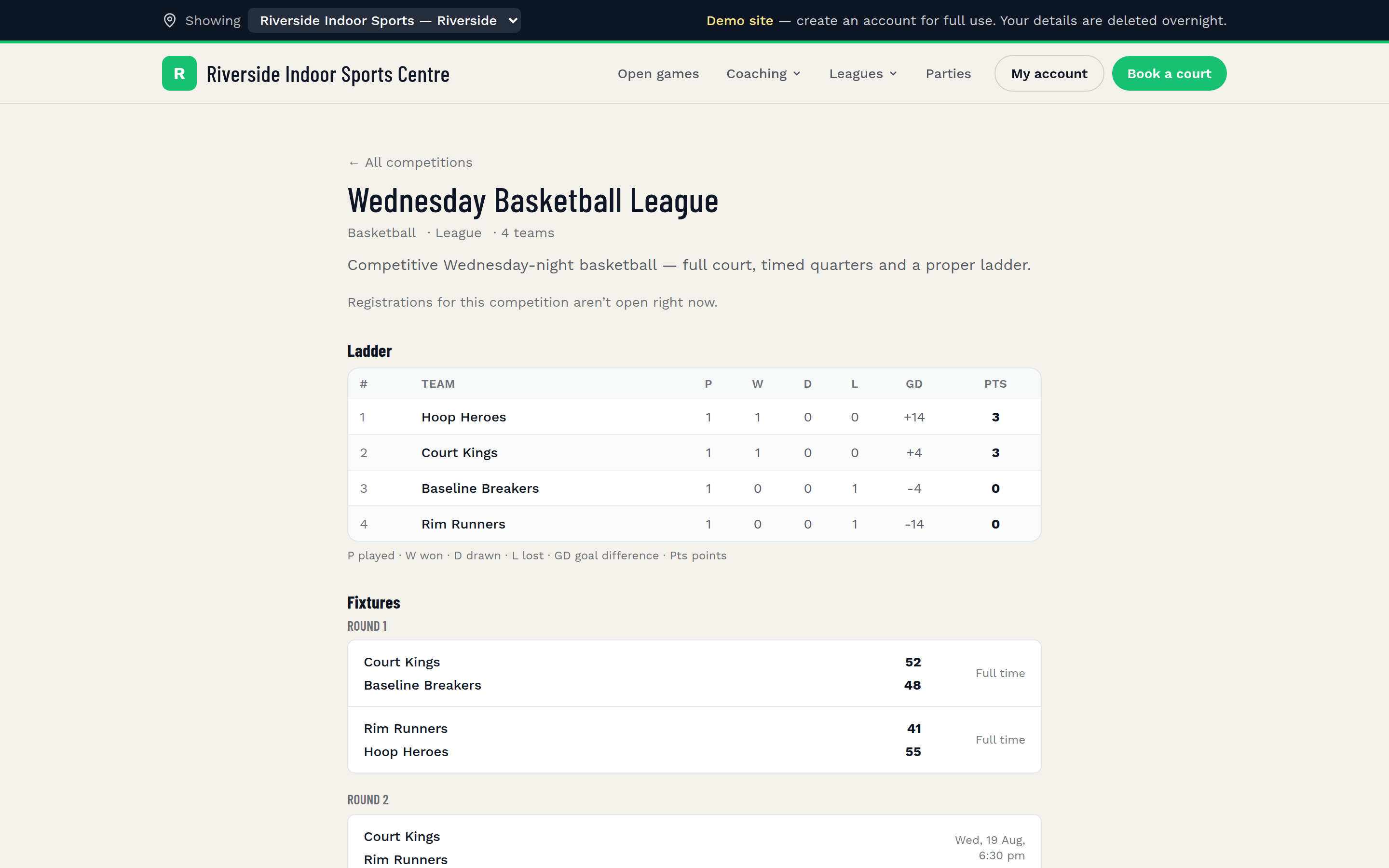
This is where keeping fixtures, ladders and the public comp page in one place helps. With Sweepa's competition management, the draw players look up is the draw you edited, so a slotted-in team appears without a separate round of spreadsheet uploads and group messages.
What it actually looks like at the desk
A setup we see a lot: a weeknight social comp, two courts, eight or nine teams per division. The draw goes out on a Monday. By Wednesday there's a message from someone who thought rego was open until the first game. Then a second team turns up on Thursday night, in person, bibs on, ready to play.
Without a policy, the organiser does a mental shuffle mid-session. Maybe if the 7.40 game swaps with the 8.20 and the new team goes on court two. They promise an answer by the weekend. By then three captains have heard about it and want to know why their fixture might change.
With a policy, it's a two-minute conversation. "We're past the draw, so you can come in if there's a bye. There's one in Division 2. It's the full fee plus the late fee, paid now, and you start this round." Or: "Division 1 has no bye, so I'll put you on the waitlist and call you if a second team comes in." Either answer is friendly, quick, and the same one the next team will get.
Common mistakes that cost you the paid-up teams
- Taking a late team on a promise to pay. Paid-up teams notice when someone plays three rounds without paying.
- Moving an existing team to another division to make room. That team paid for the division they're in.
- Adding to an even division mid-season. You've just handed everyone a bye they didn't sign up for.
- Inventing the ladder rule after the fact. Decide how missed rounds count after results exist and someone will say you picked the rule that suited a particular team.
- Different answers for different captains. The friendly regular gets in past the cut-off, the stranger doesn't. Word gets around fast in a social comp.
Your late-entry policy checklist for Monday
Before next season's rego opens, settle these and put them on the rego page:
- [ ] Cut-off round for late entries, written as a round number
- [ ] Late fee amount, flat and published
- [ ] Pro-rata rule for teams joining after round one
- [ ] Payment due at entry, no exceptions
- [ ] Rule for even divisions: hold for a pair or decline
- [ ] Whether byes earn points
- [ ] How missed rounds count on the ladder
- [ ] "No full redraw after round one" written down
- [ ] A waitlist for next season, so a "no" still keeps the team's details
If you're setting this up in a new system, the Sweepa features page shows registrations, waitlists, payments and competitions together. Start with the cut-off round. It's the one decision that makes every other one easier.
FAQ
Should a sports league accept late team entries at all?
Usually yes, as long as it happens inside written rules. A late team that fills a bye slot gives everyone more games, so it can improve the season. The problems come from accepting late teams in ways that move fixtures or change the ladder for teams who already paid. A published cut-off round and decision tree let you say yes when it helps and no when it doesn't.
How much should a late team pay to join a league?
A common approach is a pro-rata fee for the rounds remaining plus a flat, published late fee. Before round one, the late team pays the full fee plus the late fee, because no games have been missed. After that, the fee drops by the per-round amount for each round already played. Whatever numbers you choose, publish them before rego opens and require payment at entry.
What happens to the ladder when a team joins mid-season?
Decide this before the season starts. One option is to record the late team's missed rounds as byes using the same points rule as other byes. Another is to rank the ladder by points per game played, so teams with fewer games aren't disadvantaged. Either is defensible, but switching methods once results exist will cause complaints.
Can I add a late team to a division with an even number of teams?
You can, but it creates a bye every round that didn't exist before, which means paid-up teams lose games they expected. Most organisers either decline or hold the request until a second late team arrives, so the pair can be added without creating a bye. If you must add one team, be upfront with the division about the change before you publish it.
Should I redraw the whole fixture when a late team joins?
Not after round one. Teams have already planned work, childcare and transport around the published draw, and a full redraw undoes all of that. Instead, slot the late team into an existing bye or placeholder position so only those games change. Before the draw is published, building them in from scratch is fine.
When should the cut-off for late team entries be?
Set it as a specific round number rather than a vague phrase like early in the season. In a ten-round season, many organisers stop accepting teams after round two or three, because beyond that the late team has missed too much for the ladder to be meaningful. Pick a round that suits your comp length and apply it to every team, regulars included.