How to Price Sports Coaching Programs and Camps
A practical walk-through of how to price sports coaching programs and camps — from a true cost-per-session floor to term pricing, camp weeks, discounts and raising prices without losing families.

On this page
How to price sports coaching starts with the honest cost per session
How to price sports coaching is the first real business decision most operators make, and it's also the one they're most likely to get by copying someone else's homework. Ask five coaching operators how they landed on their price and four will tell you they started with a look at what the program down the road charges — which tells you nothing about that program's costs, coach pay, or whether it's actually clearing a margin.
The honest starting point is your own cost per session, not someone else's rate card. Add up what it genuinely costs to deliver one session: your coaching time, paid at a rate that reflects real qualification and preparation rather than pocket money; venue or court hire; a share of insurance for the season; equipment wear and replacement; and a fair slice of whatever it cost to market and fill the group in the first place. Divide that total by the number of kids you expect in the session — not the number you'd need in a perfect world — and you've got a genuine cost per student.
That figure is a floor, not a price. Everything charged above it is margin, and margin is what makes a coaching program a business rather than a well-organised way to break even on your own time. It's a common discovery, once operators run this properly, that a program assumed to be doing fine was barely covering its own costs once coaching hours were counted honestly.
If you haven't settled the structural side of the business yet — entity, insurance, venue arrangements — that groundwork sits underneath every pricing decision here, and it's worth locking down first; our guide to starting a sports coaching business in Australia covers it properly.
Positioning against the local market
Once the floor is set, look outward. Find three or four genuinely comparable programs — same sport, similar age band, similar session length and coach-to-player ratio — within a realistic catchment for your venue, and note their term price, what's bundled in (a shirt, equipment, a photo day), and whether they charge per term or per session.
The goal isn't to match the cheapest option nearby. A program with better-qualified coaches, a proper venue, and consistent, professional communication with parents can reasonably sit above the local average — and often should, because a bargain price is frequently a sign that something else is being cut to make the numbers work: smaller coach ratios, less prep time, thinner insurance cover. What actually matters is being able to explain your price in one sentence — smaller groups, more experienced coaches, a better facility. "That's just what we charge" is a weak answer to a parent doing the maths at their own kitchen table; a specific reason holds up far better.
Comparing like for like matters more than comparing broadly. A 45-minute clinic with twelve kids and one coach is a different product from a 90-minute session with eight kids and two coaches — pricing them the same because they're both "under-9s football" is comparing a hatchback to a ute and wondering why the numbers don't line up.
Per-term vs per-session pricing
Term pricing — one flat fee for a fixed run of weeks — is the standard model for good reason. It gives you predictable revenue you can actually plan a season around, it cuts the admin of chasing payment session by session, and it commits a family to showing up rather than deciding week to week whether coaching beats a sleep-in. For most standalone term programs, term pricing should be the default, not an option buried under a per-session rate.
Per-session or drop-in pricing still has a place, but it's a different product and should be priced like one. A casual visitor trying a session before committing to a full term, a family filling in around another sport's schedule, or someone genuinely unable to commit to sixteen straight weeks — all legitimate reasons to offer a single-session rate. Price it above the effective per-session cost of the term rate, not below it. If a ten-week term works out to $18 a session but a casual drop-in costs $15, you've built an incentive to never commit, which quietly undermines the term pricing you want families choosing.
A hybrid works well for a lot of programs: a term price as the headline offer, a modestly higher casual rate for one-off sessions, and a free or low-cost trial session as the entry point rather than a discounted ongoing option. Decide the structure before registration opens — retrofitting a per-session option onto a program that's only ever sold terms is a harder conversation with existing families than building it in from week one.
Camp pricing: day vs week
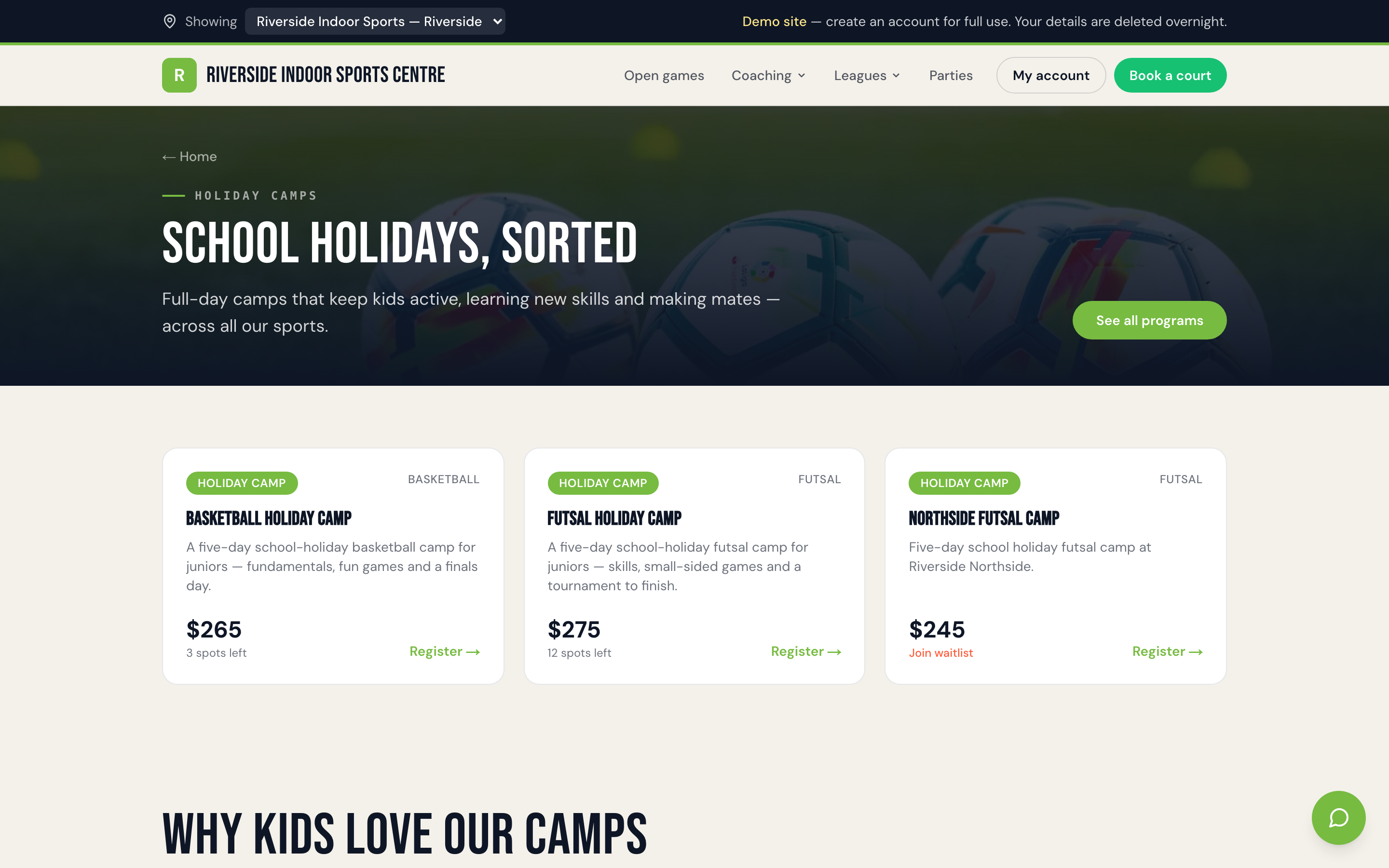
Holiday camps are a different pricing problem from term coaching, because the commitment window is days, not months, and competition for the same week is fierce — every venue, club and school in the area is running something across the same school holidays. Price camps by the week wherever the format allows it, not by the day. A weekly rate simplifies the decision for a parent booking online at 9pm, and it protects your margin against a roster of half-filled single days that are individually cheaper to deliver but collectively worse to staff.
A day rate still earns its place for families who can't commit to a full week — but price it noticeably higher per day than the weekly rate divided evenly, the same logic as per-session versus per-term. A five-day week at a strong weekly rate should always beat five individually-booked days on revenue per camper, because scattered single-day bookings carry more risk and admin for the operator, not less.
Early-bird pricing that closes two to three weeks before the camp week — not the night before — is one of the highest-leverage levers available, because it pulls bookings forward far enough that staffing and ratios can be locked in against real numbers rather than a hopeful guess. Our full playbook on running school holiday sports camps covers program design and staffing alongside the pricing side.
Discounts without killing margin
Sibling discounts, early-bird pricing and multi-term loyalty rates are all normal and, done properly, don't damage your margin — because each is tied to a real, defensible reason. A second sibling enrolling is genuinely lower marginal admin cost per family. An early-bird booking gives you certainty weeks ahead of a term or camp starting. A family re-enrolling for a fourth straight term is retention worth rewarding, because winning a brand-new family almost always costs more than keeping one you already have.
What erodes a pricing structure is the discount with no reason attached — the one handed out over the phone because a parent pushed back, or because a group booking sounded big enough to warrant "a bit off." Those discounts are invisible to everyone else paying full price, and they're the first thing that unravels once two families compare notes at pickup.
The practical guardrail is the same one that works for court and field hire: decide your discount categories in advance — which situations earn one, and by how much — and hold the line consistently. A handful of clearly defined discounts still reads as a genuine offer. Discounting every time someone asks has quietly become a different, lower headline price, just one nobody wrote down.
This is also where the admin catches most operators out. Tracking who's eligible for a sibling discount, who's inside an early-bird window, and who's on a loyalty rate across dozens of families in a spreadsheet gets error-prone fast. Sweepa's registration and payments features apply discount rules automatically at registration, so the right family gets the right price without anyone doing the maths by hand.
Raising prices without losing families
Prices that never move aren't stable, they're stale — coach pay, venue hire and insurance all creep upward every year, and a program that holds its price rigid for three years straight isn't being generous, it's quietly eroding its own margin without anyone deciding that on purpose.
Timing matters more than the size of the increase. Raise prices between terms, never mid-term on families who've already paid for the weeks remaining. Give existing families more notice than new enrolments need — a few weeks' heads-up before the next term's registration opens is enough for most families to absorb a modest, expected increase without feeling ambushed.
Explain the increase in one honest sentence rather than burying it in an email nobody reads. "Coaching qualifications, venue hire and insurance have all gone up this year, so term fees are increasing" lands far better than silence followed by a bigger number on the invoice. Families rarely leave over a small, explained increase — they leave over a surprise one.
A small annual adjustment is easier to absorb than a rare, large correction after years of standing still. Set a fixed point each year — before the season's first term, typically — to review the number properly, working back from the same cost-per-session exercise that set your price in the first place.
Payment and refund policy basics
Collecting payment at the point of registration, rather than chasing it once the term has started, solves most of the cash-flow stress that comes with running a coaching program. A family that pays upfront for the term is also more likely to actually show up, because there's a commitment keeping them engaged rather than a session-by-session decision to bother turning up. Sweepa takes payment natively through Stripe at registration — card, Apple Pay, Google Pay, and Afterpay or Zip where you've enabled them — so the fee is settled before the first session, not tracked down afterwards.
A written cancellation and refund policy matters just as much as the price itself, and it needs to exist before registration opens, not get improvised the first time a parent asks for their money back mid-term. At minimum it should cover: what happens if the program cancels a session (weather, coach illness); what a family is entitled to if they withdraw early, and by when; and whether missed sessions carry a make-up option or a credit rather than an automatic refund.
The legal detail behind refund obligations — what's required under Australian Consumer Law versus what's simply good practice — is worth getting right rather than guessing at, and it sits outside what a blog post can responsibly advise on. The ACCC publishes plain-language guidance on refunds and consumer guarantees, a sensible starting point before finalising your own policy. What matters for pricing purposes is simpler: publish the policy, keep it visible at registration, and apply it consistently — a policy nobody can find is the same as not having one.
FAQ
How do I work out my true cost per coaching session?
Add up everything it costs to deliver one session — your own coaching time paid at a fair rate, venue or court hire, a share of seasonal insurance, equipment wear, and a slice of whatever it cost to market and fill the group. Divide that total by the number of kids you realistically expect, not a full house. That number is your cost floor, not your price — everything charged above it is margin.
Should I charge per term or per session?
Term pricing should be the default for most standalone coaching programs — it gives predictable revenue and cuts session-by-session admin. Per-session or drop-in pricing still has a place for trial visitors or families who genuinely can't commit to a full term, but it should be priced above the effective per-session cost of the term rate, not below it, so it never becomes cheaper to stay casual than to commit.
Should holiday camps be priced by the day or the week?
Price by the week wherever the format allows it — it's simpler for parents to book and protects your margin against a roster of half-filled single days. Keep a day rate available for families who can't commit to a full week, but price it noticeably higher per day than the weekly rate divided evenly, since scattered single-day bookings carry more admin and risk, not less.
How big should sibling and early-bird discounts be?
There's no universal figure — what matters is that every discount is tied to a genuine reason, such as lower marginal admin for a second sibling or the certainty an early booking gives you weeks out. Decide your discount categories in advance and apply them consistently. Discounts with no reason attached, handed out ad hoc over the phone, are what actually erode a pricing structure over time.
When's the right time to raise coaching program prices?
Between terms, never mid-term on families who've already paid for the weeks remaining. Give existing families a few weeks' notice before the next term's registration opens, and explain the increase in one honest sentence rather than letting it arrive as a silent bigger number on the invoice. A small, expected annual adjustment is far easier to absorb than a rare, large correction after years of standing still.
What should a coaching program's refund policy actually cover?
At minimum: what happens if the program cancels a session, what a family is entitled to if they withdraw early and by when, and whether missed sessions get a make-up option or credit rather than an automatic refund. The specific legal obligations behind refunds sit under Australian Consumer Law, so check the ACCC's guidance or your state's consumer affairs body when finalising the exact wording rather than guessing.