How to start a sports coaching business in Australia
A practical, pointer-level guide to how to start a sports coaching business in Australia — choosing your model, sorting the paperwork, finding venue space, pricing from day one and winning your first term of customers.
On this page
How to start a sports coaching business: choosing your model
Before you touch a whiteboard or price a single session, decide what kind of coaching business you're actually building — because "start a sports coaching business" covers at least four different jobs wearing the same tracksuit. You might run standalone term programs, hiring a court or oval by the hour and selling registrations directly to families. You might operate inside an existing venue, coaching casual clinics on their courts under a hire arrangement. You might build toward school holiday camps as your main product, with terms as the steady income between camp spikes. Or you might aim at a franchise-style model, running a program others could eventually license or replicate in other suburbs.
Each model changes almost everything downstream — how you price, where you find space, what insurance you need, and how you market. A standalone term program lives or dies on registrations and retention across a school term. A venue partnership shifts some of the facility risk onto someone else but usually caps your upside with a hire fee. Holiday camps are a different beast again: intense, short bursts of demand around school holidays, with a marketing cycle that starts weeks before the calendar, not days.
Most coaches we've spoken with start smaller than they plan to. A one-sport, one-age-group, one-venue offer — say, under-8s football skills on Tuesday afternoons at a local oval — is a genuinely good place to begin, even if the long-term vision is a multi-sport academy across three suburbs. It's not a lack of ambition; it's a way to test pricing, retention and your own appetite for the admin side before you're juggling five programs at once. You can always add a second age group or a second night once the first is running smoothly. Trying to launch the full vision in week one usually just means five half-full sessions instead of one full one.
The paperwork
The paperwork is the least exciting part of starting a coaching business, and also the part you genuinely can't skip. Three things sit at the core of it, and all three deserve more care than a blog post can responsibly give you — so treat this section as a map of what to check, not a substitute for checking it.
First, your business structure and an Australian Business Number (ABN). Most coaching businesses start as a sole trader, though some coaches structure as a company for liability or tax reasons — which is right for you depends on your circumstances, so it's worth a conversation with an accountant or business adviser rather than guessing. You can register for an ABN and confirm what registration you need directly through the Australian Business Register.
Second, insurance — specifically public liability cover, and if you'll ever employ or subcontract other coaches, workers' compensation too. Coaching involves kids, physical activity and shared facilities, all of which carry genuine risk, and most venues won't let you book space without proof of cover. Get quotes from a few insurers who specifically cover sports coaching, ask what's excluded, and confirm the cover matches what the venue itself requires — some councils and facilities specify minimum coverage amounts. Business.gov.au has a general starting point on the types of business insurance to consider.
Third, a Working with Children Check (or your state's equivalent scheme) for you and anyone you engage to coach. Every state and territory in Australia runs its own scheme, with its own name, application process and reciprocity rules — some checks are recognised across state lines, others aren't, so if you coach in more than one state, check that specifically. Search for your state or territory's official Working with Children Check authority to find the current process, and build the lead time into your launch plan — approvals aren't always instant.
None of this is legal or tax advice, and it shouldn't be treated as such — it's a pointer to where the real answers live. Get your structure, insurance and clearances sorted with the appropriate professional or official body before you take your first booking, not after.
Finding space and venues
Space is usually the first real constraint a new coaching business runs into, and it comes in three broad flavours. Council-owned courts and ovals are often the cheapest option and the easiest entry point, but bookings can be competitive, seasonal allocations get locked in early, and you're generally at the mercy of a council's booking calendar rather than your own. School facilities — gyms, halls, ovals — are a strong option for after-hours and holiday programs, though you'll usually be negotiating directly with a school and working around their calendar, not yours. Private venues — indoor centres, futsal courts, multi-sport complexes — tend to be the most flexible and best-presented option, but you're paying a commercial hire rate, so your pricing needs to absorb it from day one.
A pattern worth knowing: venues actively want programs like yours filling their off-peak hours. Weekday mornings, early afternoons and school-holiday daytimes are dead time for most facilities, and a coaching program that reliably books the same slot week after week is genuinely valuable to an operator trying to lift utilisation outside the Saturday rush. That gives you more negotiating room than you might expect — a lower hire rate, a longer-term booking, sometimes a revenue-share instead of a flat fee, especially once you can show a venue you'll show up consistently rather than book-and-cancel.
Whichever option you land on, get the booking terms in writing before you start selling registrations to families. What happens if the venue double-books your slot? What's the cancellation notice period, both ways? Who's responsible if a session is rained out — you, or the venue? A verbal handshake works right up until the first Saturday it doesn't.
Pricing from day one
Set your pricing before your first registration opens, not after you see who signs up — retrofitting a price once families are used to a number is a genuinely painful conversation to have twice. Work backwards from your real costs: venue hire per session, your own time (paid properly, not as an afterthought), insurance, any equipment, and a margin that actually makes the business worth running rather than a break-even hobby.
Term-based pricing — a flat fee for a set number of weeks — is the standard model for a reason: it gives you predictable income and gives families a clear commitment, and it's much easier to plan a season around than collecting session-by-session. Most coaching businesses layer in a handful of standard adjustments: sibling discounts for families enrolling more than one child, an early-bird rate for registrations locked in before the term starts, and a clear, fair policy for missed sessions — full refunds for every absence are rarely sustainable, but a reasonable make-up or credit policy builds trust. We've written a full breakdown of how to think through these levers in our guide to pricing coaching programs, worth reading properly before you lock in your first term's numbers.
Resist the urge to price purely against whatever the coaching business down the road charges. Your costs, your venue, your qualifications and your program structure are all different from theirs — pricing to match a competitor whose economics you don't actually know is a common way new coaching businesses quietly lose money in year one.
Winning your first twenty customers
The first twenty families are the hardest twenty you'll ever sign — after that, word of mouth starts doing real work for you. Start close to home: your own network, local school noticeboards and newsletters (many will list community sport programs for free or a small fee), and any existing club or association you're already connected to. A free trial session is one of the most effective tools a new program has — it removes the risk of committing to a full term for something a family has never seen, and if the session is genuinely good, it does more convincing than any flyer.
Sibling and friend discounts do double duty here: they lower the cost of entry for a second child, and they turn every enrolled family into a quiet recruiter for their kid's mates. A pattern we see often with new coaching businesses: the first term fills mostly through direct outreach and trial sessions, and by the second or third term, referrals from existing families start carrying more of the load than any single marketing channel.
Don't discount the venue itself as a channel. A facility that already has foot traffic — casual hirers, other program parents waiting courtside — is a genuine audience if you're allowed to put a sign up or get a mention in the venue's own communications. If you're coaching inside someone else's facility, ask.
Registrations and payments that scale
However you sign up your first twenty families — a paper form, a shared spreadsheet, a group chat — it will not survive contact with sixty. Somewhere between one program and three or four, most coaches hit the same wall: registrations scattered across text messages and cash-in-hand payments, no waitlist when a popular session fills, sibling discounts applied inconsistently because nobody's tracking who's already enrolled, and no real record of who actually turned up each week.
This is the point where dedicated registration software starts paying for itself rather than being an unnecessary expense. A platform like Sweepa handles registrations, waitlists, sibling discounts and attendance for coaching programs, camps and terms in one place, with Stripe-native payments (card, Apple Pay, Google Pay, and Afterpay or Zip where you've enabled them) taken at the point of registration instead of chased afterwards. Families register and pay online through your own branded site, staff can see attendance and payment status from a phone at the venue, and a waitlist fills automatically the moment a spot opens up instead of you fielding "any spots left?" texts one at a time.
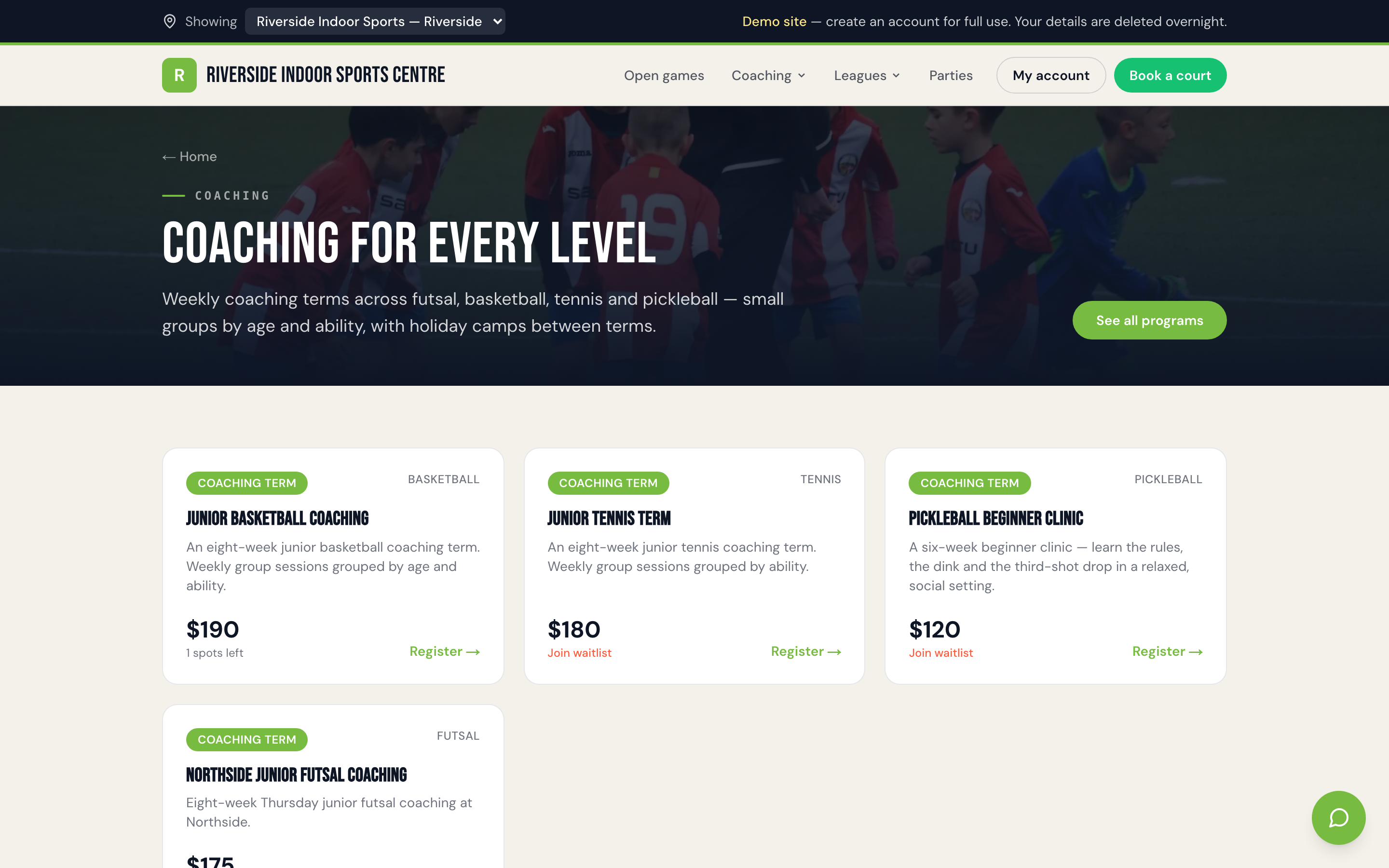
If you're weighing up whether you're at that point yet, our features overview covers what registration and payment tooling actually includes, so you can compare it honestly against what a spreadsheet and a bank transfer request are really costing you in admin hours.
Building a term rhythm
A coaching business, more than most small businesses, runs on the Australian school calendar rather than the regular calendar — four terms, four sets of school holidays, and a rhythm that repeats with enough regularity that you can plan around it once you've run it once. Registrations typically need to open two to three weeks before a term starts, giving families time to commit and you time to gauge numbers before committing to venue hire. Mid-term is about consistency — the same session, same standard, week after week, plus keeping an eye on attendance so you notice a pattern, not just a one-off, before a family quietly drifts away. The last week or two of term is when re-enrolment for the next term should already be open, ideally with an incentive for locking in early, because a gap between terms is exactly when families drift to something else.
School holidays themselves are their own product, not a gap in your calendar — camps and clinics can genuinely outperform your term revenue if you plan for them properly rather than treating them as an afterthought once term four winds down. We've covered running that side of the business properly in our guide to school holiday sports camps, which is worth reading alongside this one if camps are part of your plan from the start rather than something you'll "figure out later."
None of the paperwork in the section above will win you a premiership, and no amount of clever pricing replaces a genuinely good session on the day. But get the structure, the space, the pricing and the rhythm right early, and the coaching itself — the part you actually got into this for — gets to be the easy bit.
FAQ
Do I need a company structure before I coach my first session?
Not necessarily. Most coaching businesses start as sole traders and only move to a company structure later, if at all — it depends on your liability exposure, income and personal circumstances. This is genuinely worth a short conversation with an accountant or business adviser rather than guessing, especially once you're taking on other coaches.
How much does public liability insurance cost for a coaching business?
It varies by insurer, sport, and how many students and coaches you cover, so there's no single reliable figure to quote here. Get quotes from a few insurers who specifically cover sports coaching, and check what the venues you plan to use actually require — some set a minimum coverage amount as a condition of booking.
Can I run a coaching business without owning or leasing a permanent venue?
Yes — most new coaching businesses start this way, hiring council courts, school facilities or private venues by the session or term rather than committing to a lease. It keeps upfront costs low while you prove out demand, though it does mean negotiating booking terms and cancellation policies with each venue directly.
What's the difference between a term program and a holiday camp business model?
A term program runs weekly across a school term and relies on steady registrations and retention over several weeks. A holiday camp is a short, intense burst — usually a few days during school holidays — that needs its own marketing push weeks in advance rather than relying on term-time momentum. Many coaching businesses eventually run both, using terms for steady income and camps to boost holiday-period revenue.
Do I need a Working with Children Check in every state I coach in?
Each Australian state and territory runs its own Working with Children Check scheme, and reciprocity between states varies — some checks are recognised elsewhere, others aren't. If you plan to coach across state lines, check directly with each state or territory's official authority rather than assuming one check covers you everywhere.
How many students do I need before a coaching program is worth running?
There's no universal number — it depends on your venue hire cost, your own pricing, and how you value your time. A useful exercise is to work out your break-even enrolment for a single session (venue hire plus your paid time, divided by your price per student) before you commit to a venue, so you know exactly what a "full enough" session looks like for your own numbers.