Do You Need a Sports Venue Website?
If your booking flow lives on Instagram and your last update was a footy carnival two years ago, it might be time for a proper sports venue website — here's what it actually needs to do.

On this page
Where customers actually find you
A prospective court hirer doesn't start their search at your front counter. They start on their phone, usually at night, usually after a mate's WhatsApp message says "let's book that place for Saturday." They'll search your venue's name, or something close to it, and land wherever Google sends them — which is often an Instagram profile with a bio link, a Facebook page nobody's updated since a footy carnival two years ago, or, if you're lucky, a proper sports venue website that actually answers their question. If the first thing they hit doesn't tell them clearly whether you're open, what it costs and how to book, they don't dig for the answer. They try the next venue down the list.
Social media is genuinely useful for reach — it's where people discover you exist. It's a poor substitute for a home base. A caption can't show live court availability. A DM thread isn't a booking record. And an Instagram bio link that goes to a generic contact form makes a hirer do the work your site should be doing for you: proving you're a real, running, bookable operation. A sports facility website doesn't replace your socials — it's where the traffic from socials, Google searches and word of mouth all land and actually convert into a booking.
The three jobs your sports venue website must do
Strip away the design opinions and every sports venue website only has three real jobs. Get these right and the rest is polish; get them wrong and no amount of polish saves it.
First, answer the basic questions fast: what sports or spaces do you offer, where are you, what are your hours, and roughly what does it cost. A visitor should be able to answer all four in under fifteen seconds without scrolling past a hero banner three times. Second, let people take the actual action they came for — book a court, register for a term of coaching, enter a team in a competition — without bouncing off to a separate app, a PDF form, or a phone call during business hours. Third, look like a real, current operation. A site with last season's fixtures still pinned to the homepage, or a "call us" button as the only path to book, quietly tells visitors the venue isn't quite on top of things — even if that's not true on the ground.
Most venue websites fail on job two. They're brochures: nice photos, a mission statement, a phone number. The booking itself happens somewhere else entirely, or nowhere online at all. If you're still working out what a booking flow needs to cover before you connect it to your site, our guide on running a sports facility without drowning in admin covers the operational side that a good website is really just the front door to.
Branding that looks like yours
Your venue has a look, even if you've never written it down — the colours on your polos, the mark on your court signage, the tone you use in the group chat with regulars. A website that doesn't match any of that reads as generic, and generic reads as "could be any venue," which is the opposite of what you want when someone's deciding between you and the courts down the road.
This doesn't require a design agency. It requires consistency: your actual logo, your actual colours, your actual photos of your actual courts — not stock images of a generic gym that could be anywhere. A venue we've worked with had spent real money on branded singlets and court signage but was still sending bookers to a beige, off-the-shelf scheduling page with none of it reflected. The fix wasn't a rebrand. It was making the booking experience wear the same colours as everything else the venue already had.
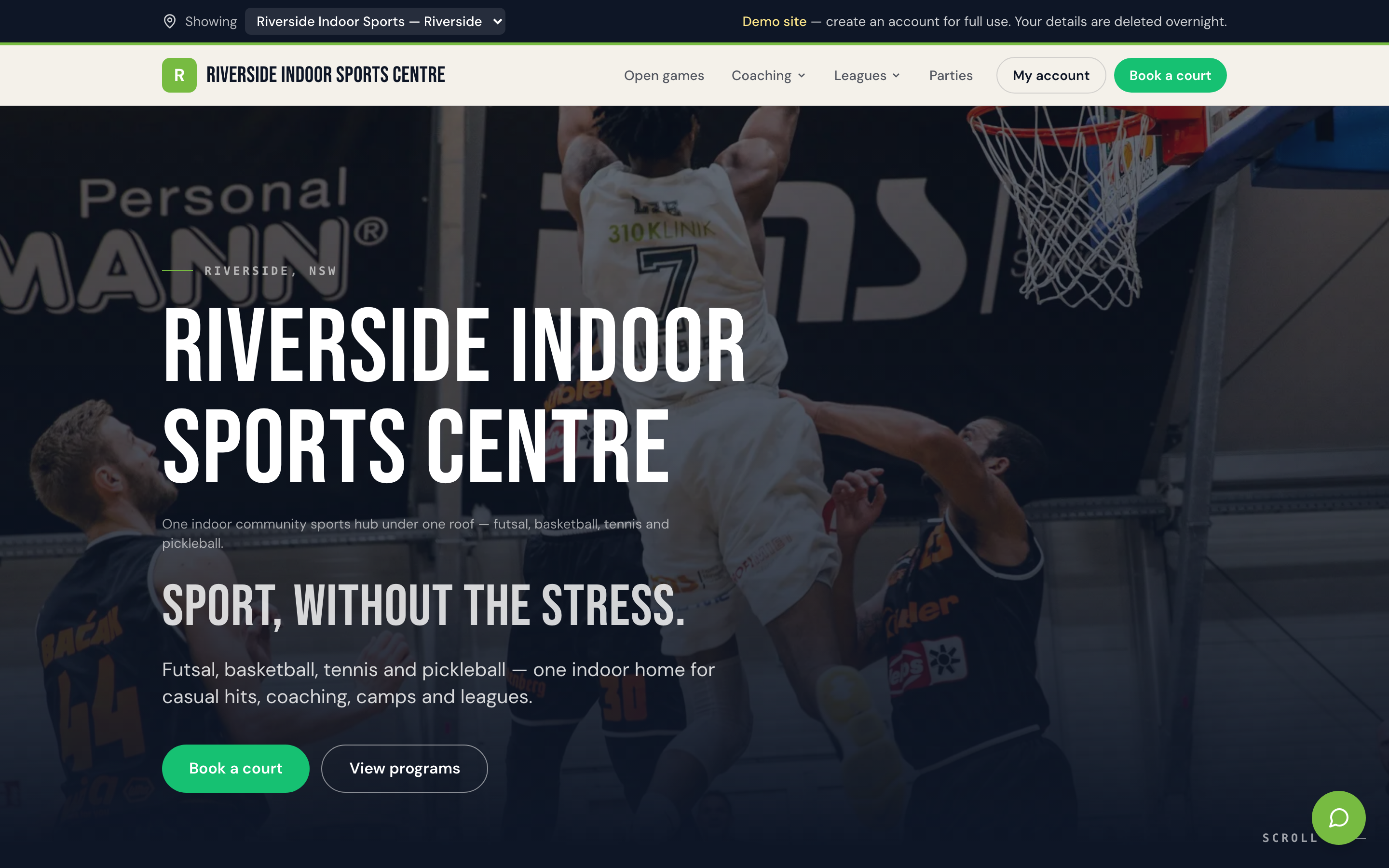
Section-based sites vs page-builder homework
Here's where a lot of venues stall out before they start. The DIY route usually means a drag-and-drop website builder — dragging boxes around a blank canvas, picking fonts, fighting with mobile layouts that break the moment you resize a photo. It's a real skill, and it takes real time most operators don't have between opening the gates and closing out the till.
Sweepa's tenant website tooling takes a different approach: section-based configuration, not a blank-canvas builder. You choose from purpose-built sections — a hero, a booking call-to-action, a programs list, a comp ladder, a contact block — and fill in your details, your photos and your colours. There's no canvas to design from scratch and no layout to accidentally break on mobile, because the sections are already built to work. What you're doing is closer to filling in a well-designed form than laying out a page pixel by pixel. It's a genuine trade-off worth naming plainly: you get less raw creative freedom than a full page builder, in exchange for a site that looks right the first time and doesn't need a redesign every time you add a new offering.
Custom domains, simply
Out of the box, your branded site lives at your own address on the sweepa.io platform — something like riverside.sweepa.io — live from the moment your site is set up, with no separate hosting to buy or configure. For most venues starting out, that's genuinely enough: it's fast, it's yours, and it works.
If you'd rather your existing domain — yourvenue.com.au — point straight at your Sweepa site, that's supported too. It's a DNS change your domain registrar can usually make in a few minutes once you've got the right details from your site settings, not a project that needs a developer on retainer. Either way, the booking flow, the branding and the content are exactly the same underneath — the domain is just the door people walk through.
SEO basics for local venues
Nobody needs to become an SEO specialist to get found locally, but a handful of basics genuinely move the needle for a sports facility website. Keep your venue name, address and phone number identical everywhere — your site, your Google Business Profile, your socials — because inconsistency there quietly confuses search engines about which listing is actually you. Make sure each major offering has its own clear page or section: courts and casual hire, coaching and camps, leagues and competitions. A search for "netball court hire" near your suburb should have something specific to land on, not just a generic homepage.
Write your page titles and descriptions the way a person would actually search, not the way you'd describe yourself internally — "indoor futsal courts, [suburb]" beats "welcome to our facility." And don't underrate speed and mobile: most local searches happen on a phone, standing at a training session or scrolling on the couch, and a site that's slow to load or awkward to tap through loses people before they ever see your booking button. None of this replaces a genuinely good booking website for venue visitors — it just makes sure people looking for one nearby actually find yours.
Keeping it maintained without a web guy
The reason most venue websites go stale isn't laziness — it's friction. If updating the homepage means emailing a developer and waiting a week, most operators simply stop bothering, and the site quietly drifts out of date while the venue itself keeps changing underneath it.
A section-based site is built so the operator does the updating, not a contractor. New term dates, a change to opening hours, a fresh set of photos after the courts got resurfaced — these are edits you make yourself, in minutes, from the same admin you already use to manage bookings. There's no separate login, no separate skill set, and nothing to break by accident because you're editing content inside sections, not rewriting code.
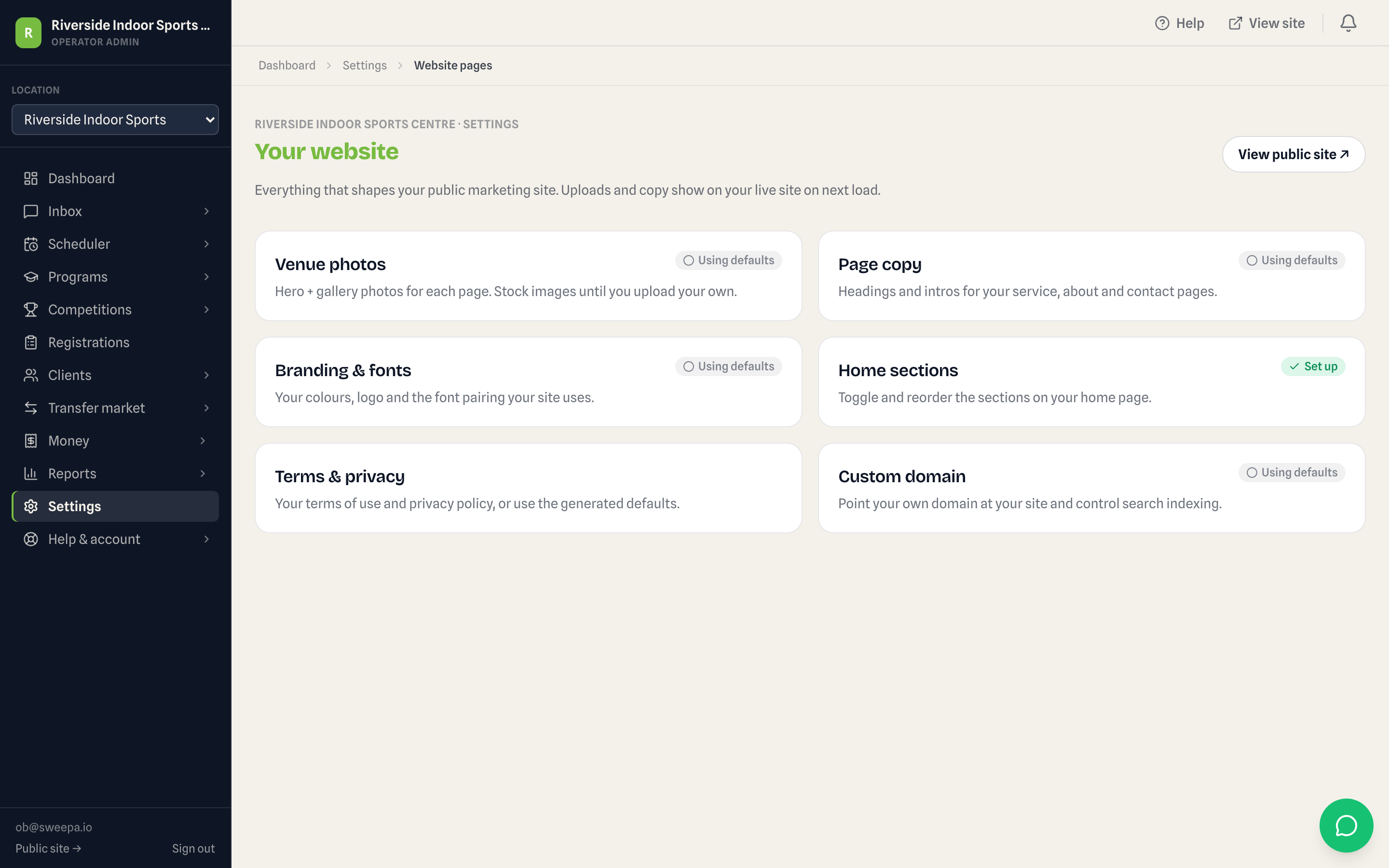
That's really the test worth applying to any sports venue website: not whether it looked great on launch day, but whether it'll still be accurate in six months without anyone having to remember to fix it. A site that's easy enough to keep current is worth more than one that was expensive to build once and impossible to touch again.
FAQ
Do I need a dedicated website if I already post bookings on Instagram or Facebook?
Social media is great for reach and discovery, but it's a poor place to actually take a booking or show live availability. Most venues get the best result using both: social posts that point people to a proper sports venue website where they can see real availability, book and pay in one place.
Can I use my own domain name for my sports venue website?
Yes. Your site is live at a branded address on the sweepa.io platform from day one, and you can point your own domain — like yourvenue.com.au — at it with a simple DNS change through your domain registrar, no developer required.
Is Sweepa's website tool a drag-and-drop builder?
No — it's section-based configuration rather than a blank-canvas, drag-and-drop builder. You choose from purpose-built sections (hero, booking call-to-action, programs, ladder, contact) and fill in your own details, photos and colours, so the layout works correctly without needing design skills.
How long does it take to set up a sports facility website?
Because the site is configured from ready-made sections rather than built from scratch, most venues can have a live, branded site up in days once their account is provisioned — not the weeks a custom-built or agency site typically takes.
Do I need a developer to keep the website updated?
No. Updates — new term dates, changed opening hours, fresh photos — are made by the operator directly in the same admin used to manage bookings, without touching code or briefing a contractor.
Will my sports venue website work properly on mobile?
Yes. Since the site is built from pre-designed sections rather than a freeform canvas, pages are structured to display correctly on phones and tablets without the manual resizing and layout-breaking that can happen with generic page builders.