Hot Weather Sport Cancellation Policy: A Summer Heat Plan for Outdoor Courts and Fields
A practical hot weather sport cancellation policy for outdoor courts, fields and summer camps. It covers tiered triggers, a fixed call time, time shifts, shade and water rules, and copy-ready SMS scripts.
On this page
It's 6.30am on a January Saturday. The forecast says 41, and your phone already has three messages asking "are we still on?" Without a written hot weather sport cancellation policy, each message becomes its own negotiation. You end up making the same call six different ways before lunch.
This guide gives you a policy you can write in an afternoon, with tiered triggers, a fixed decision time, shade and water rules, and the exact messages to send. It's written for outdoor court and field operators and for coaching programs running summer camps. Indoor venues without air-conditioning will find most of it applies too.
What a hot weather sport cancellation policy needs to cover
A heat policy isn't one rule. It's five decisions you make in advance, so nobody has to make them at 7am with a sunburnt parent at the desk.
- Triggers: what conditions move you from "normal" to "modified" to "cancelled".
- Decision time: when you make the call, and who makes it.
- Time shifts: what you move, where you move it, and what happens to people who can't make the new time.
- Provisions: shade, water and break rules for sessions that go ahead.
- Communication: who gets told, by which channel, and with which words.
Gather three things before you write any of it:
- Your sport's heat guidance. Get it from your governing body or state association. Many competitions require you to follow it.
- Your state's guidance for juniors. If you run junior programs, check your state's advice on sun protection and heat for children.
- A list of everything that runs outdoors. Include every booking type and program between November and March.
We won't tell you what temperature to cancel at. That's a health call, and it varies by sport and by state. Use your governing body and the Bureau of Meteorology forecast for your suburb. We can give you the structure that turns their numbers into an operating rule.
Step 1: Set tiered heat triggers
The most common failure we see is a single line: "Games will be cancelled in extreme heat." Nobody knows what extreme means, so everybody argues.
Use tiers instead. Each tier has a trigger, a set of actions, and a money outcome decided in advance.
| Tier | Trigger (fill from your sport's guidance) | What happens | Money outcome |
|---|---|---|---|
| Normal | Forecast below your "modify" threshold | Run as booked; standard water and shade | None |
| Modified | Forecast at or above your "modify" threshold | Extra drinks breaks, shortened halves, rolling subs, shade mandatory | None, the session runs |
| Shifted | Forecast above "modify" during the hottest window | Afternoon sessions moved to early morning or evening | Booking moved; credit if they can't make the new time |
| Cancelled | Forecast at or above your "cancel" threshold, or an official heat warning | Session off | Credit or refund per your refund policy |
Two rules make this table work.
- Use a published forecast for a named location. Never trigger on "it feels hot".
- Put the money outcome in the same row. Then the person making the call never has to decide refunds on the fly.
If you haven't settled credits versus refunds yet, our guide to designing a sports venue refund policy you can enforce covers it.
Step 2: Fix the call time and plan your time shifts
Pick a decision time and publish it. A pattern that works has three parts:
- Check the forecast the evening before.
- Make a provisional call by a set time that night.
- Confirm or upgrade it at a fixed time in the morning.
Never reverse a cancellation once it's sent. People have made other plans, and the reversal costs more trust than the session earns.
Name one person who makes the call each day, plus a backup. Rosters change over the summer holidays, so put the names in the policy document, not in someone's head.
Time shifts are where you keep revenue. Plan them before the season, not on the day:
- Map your hot window. For most outdoor venues it runs from the middle of the day through late afternoon. Mark which bookings and programs sit inside it.
- Hold your shift slots. Decide which early-morning and evening slots you can open on hot days. If you have lights, evening is usually the easiest place to move a block.
- Set the move order. Move juniors and camps first, then social comps, then casual hire. Recurring hirers get the first offer of a new slot.
- Decide the fallback. Anyone who can't make the new time gets a credit. Say so up front.
Here's a worked example with illustrative numbers. Say a four-court venue has a fully booked 3pm–5pm block of casual hire at $60 an hour per court, and the forecast hits your cancel tier.
| Option | What happens | Credits issued | Play kept |
|---|---|---|---|
| Cancel the block | 4 courts × 2 hours × $60 credited | $480 | $0 |
| Shift to 7pm–9pm, half accept | Two courts' worth of hirers take the new slot | $240 | $240 |
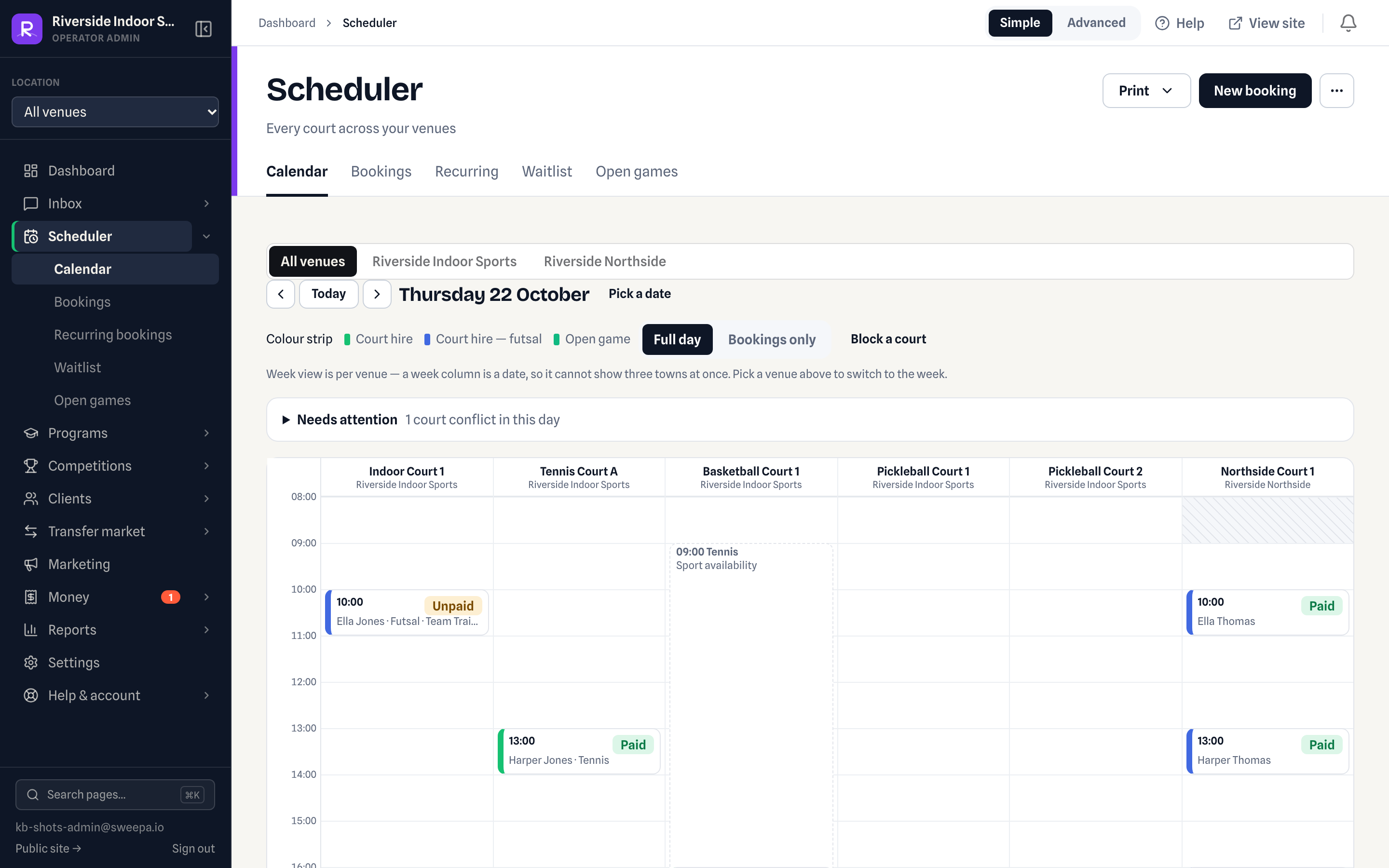
Your numbers will differ, but a planned shift slot can save part of the day. Moving a block is far easier when you can see who's affected and which evening courts are free in one view. That's what court and field booking software should give you.
Step 3: Shade, water and break rules for sessions that run
Most hot days won't reach your cancel tier. They'll sit in "modified", and that's where provisions matter. Write these as rules, not suggestions.
- Shade. Every court or field in use has shade within a short walk for benches and spectators. If you rely on portable gazebos, list how many you have, where they're stored, and who sets them up before the first session.
- Water. Have a working tap or refill station for each playing area, and check it before opening. Ask players to bring their own bottle, and put that in the confirmation message.
- Breaks. Set fixed drinks breaks for modified sessions, such as at the midpoint of each half. Don't leave it to the referee or coach.
- Format changes. Use shorter halves, rolling subs or reduced-numbers games. Decide which apply to which competitions in advance.
- Staff. Your staff spend longer in the heat than any player. Rotate outdoor duties and schedule their breaks. Check your employer obligations with your state's work health and safety regulator.
Coaching programs and holiday camps carry more risk because you have kids on site all day. Build hot-day sessions into the camp plan:
- Skills work before lunch.
- Indoor or shaded activities through the middle of the day.
- Games late in the day.
Brief every coach on the signs of heat illness, using guidance from an official source. Know who on site holds a current first aid qualification.
Step 4: Communication scripts for hot days
The message matters as much as the decision. Write scripts now, so whoever's on shift sends the same words.
- SMS is for anything that changes today. It's the channel people actually see on a Saturday morning.
- Email is for the policy itself and for changes later in the week.
- Your website should show the current status, so the "are we on?" crowd can check without calling.
Our guide to sports parent communication that actually gets read goes further on channels and timing.
Modified (SMS):
[Venue]: Hot day today. All sessions are ON with extra drinks breaks and shortened halves. Bring a full water bottle and a hat. Shade is set up courtside.
Shifted (SMS):
[Venue]: Due to forecast heat, your [time] booking on [date] has moved to [new time]. Can't make it? Call us or use your portal and we'll credit your account in full.
Cancelled (SMS):
[Venue]: All outdoor sessions after [time] today are CANCELLED due to forecast heat. Your booking will be credited, no action needed. Full heat policy: [link].
Camp parents (SMS, morning of):
[Program]: Hot day forecast. Camp runs as normal, with indoor and shaded activities through the middle of the day. Please pack a named water bottle, hat and sunscreen.
Keep each message short and put the action first. Always say what happens to their money. That one line stops more desk arguments than anything else.
With Sweepa, your bookings, registrations, email and SMS sit in one system, so the people you message are the people actually booked in. If you already run a wet-weather policy parents actually accept, reuse its structure and change the trigger.
What a hot Saturday looks like on the floor
Here's a setup we see a lot: an outdoor venue with junior comps in the morning, social adult games through the afternoon and casual hire into the evening.
The evening before. The duty manager checks the forecast. They send a provisional message: "Modified tomorrow, check for updates by 7am."
7am. The forecast has firmed up. Junior games run as modified, and the 1pm–5pm adult block shifts to the evening. Messages go out by 7.15am.
8am. The gazebos are up, the taps are checked and the cooler at the desk is stocked. Referees have been briefed on drinks breaks.
Mid-morning. The first parent arrives at the desk asking whether the afternoon's on. The staff member points to the message and the website notice. There's no negotiation, because the rule is written down and nobody on shift has the authority to bend it.
Every decision was made back in October.
Common mistakes and your heat plan checklist
These are the mistakes we see most:
- Vague triggers. "Extreme heat" is an argument, not a rule.
- Deciding refunds on the day. Put the money outcome in the tier table.
- Forgetting staff. Your duty of care covers your team as well as your players.
- Relying on one channel. A 7am email won't be read before the 8am game.
Before your first summer round, tick off:
- [ ] Governing body heat guidance saved and referenced in your policy
- [ ] Tier table written with triggers, actions and money outcomes
- [ ] Decision times and decision-makers named for each day
- [ ] Shift slots identified and held
- [ ] Shade, water and break rules listed, with who sets up what
- [ ] Four SMS scripts saved where shift staff can reach them
- [ ] Policy published on your website and sent with summer registrations
If your camps take summer registrations, put the heat policy inside the registration flow so parents accept it before they pay. See how program and camp registration handles that. With all seven items done, your first 40-degree Saturday becomes a few messages sent before breakfast.
FAQ
What should a hot weather sport cancellation policy include?
It should set tiered triggers (normal, modified, shifted, cancelled) tied to a published forecast for your location. It should also fix a decision time and name a decision-maker. Add shade, water and break rules for sessions that still run, plus pre-written messages that say what happens to people's money at each tier.
What temperature should outdoor sport be cancelled at?
There isn't one number that suits every sport or state, so take your thresholds from your sport's governing body or state association heat guidance. Base the call on the Bureau of Meteorology forecast for your suburb rather than how hot it feels on the day. If you run junior programs, also check your state's guidance for children.
Should hot weather cancellations get a refund or a credit?
Either can work, as long as you decide it in advance and publish it in the policy. Many venues credit cancelled or unaccepted shifted bookings to the customer's account, and refund only when a credit can't reasonably be used. Put the money outcome in your tier table so nobody decides it on the day.
When should I make the call on a hot day?
Pick a fixed time and publish it, such as a provisional call the evening before and a confirmation at a set time in the morning. Name one person who makes the call each day, with a backup. Once you've sent a cancellation, don't reverse it, because people will already have made other plans.
How do I tell players and parents about a heat cancellation?
Use SMS for same-day changes, because it's the message people see first on a weekend morning. Follow it up on your website and in an email for anything later in the week. Keep messages short, lead with the action, and always say what happens to the booking or registration fee.
How should holiday camps adjust for very hot days?
Plan hot-day timetables before the camp starts. Put skills work early, indoor or shaded activities in the middle of the day, and games late. Ask parents to pack water, a hat and sunscreen, brief coaches on heat illness signs from an official source, and make sure someone on site holds a current first aid qualification.