How to Chase Unpaid Team Fees Without Burning Bridges
A three-step reminder sequence, with copy-ready email and SMS wording, for team managers who still haven't paid before round one. Firm enough to work, friendly enough to keep the team.
On this page
It's the Wednesday before round one. The draw is published, the umpires are rostered, and three teams still haven't paid. If you've ever had to chase unpaid team fees the week a season starts, you know the trap: push too hard and you lose a team you need for an even draw, go too soft and you're still chasing in round six.
This post gives you a three-step reminder sequence for team managers who haven't paid before round one, with sample email and SMS wording you can copy, plus the rules to set first so the reminders have something behind them.
Why team fees go unpaid before round one
In our experience, a lot of late payers aren't dodging you. The pattern is simpler. The manager entered the team, said they'd sort the money, and is now waiting on eight teammates to send them their share. They're embarrassed, busy, or both.
Some don't know the deadline. Some lost the link. A few are genuinely testing whether you'll enforce anything.
Your reminders need to handle all of those without treating the first group like the last. That's why the sequence escalates: helpful, then clear, then final. Each step removes an excuse.
Set the rules before you chase unpaid team fees
A reminder only works if there's something behind it. Before you send anything, lock these four in and publish them at rego:
- One deadline, in writing. A date and a time, such as 5pm the Friday before round one. Not "before the season".
- One payment link per team. If the manager has to ask how to pay, you've added a step to every reminder.
- One named payer. The team manager is responsible to you. How they collect from teammates is their call.
- One published consequence. What happens if the fee isn't paid by the deadline. Common options: the team pays at the desk before warm-up, plays under a short payment plan, or forfeits the round. Pick one and say it at rego, not on game night.
If you haven't set this up yet, our guide to getting team registration payments in before round one covers the rego side. Withdrawal and refund terms belong in the same place, so see designing a refund policy you can actually enforce too.
The three-step reminder sequence at a glance
| Step | When | Channel | Tone | Job |
|---|---|---|---|---|
| 1. Friendly nudge | 7 days before round one | Email + short SMS | Helpful | Remind and remove friction |
| 2. Firm reminder | 3 days before | Email + SMS | Clear | Restate deadline and consequence |
| 3. Final call | 48 hours before the deadline | SMS, then phone | Direct | Get a yes or a plan |
Shift the timing to suit your comp, but keep the gaps. Three touches over a week feels organised. Five touches in three days feels like a debt collector.
Step 1: The friendly nudge (seven days out)
Assume good faith. The aim is to make paying the easiest thing they do all week.
Subject: [Team name] fees due Friday [date] for round one
Hi [first name],
The draw's out and [Team name] are on court [court] at [time] for round one on [date]. Looking forward to it.
Quick one: the team fee of $[amount] is still open. Here's your payment link: [link]. It takes card, Apple Pay or Google Pay.
Fees are due by 5pm Friday [date]. If your team's still collecting, you're welcome to pay it in one go and sort the split later, or just reply and let us know where you're at.
Cheers, [Your name], [Comp name]
SMS
Hi [first name], [Comp name] here. [Team name]'s fee of $[amount] is due 5pm Fri [date]. Pay here: [link]. Thanks.
Note what's missing: no consequence yet, no capital letters, no "overdue". It's a reminder, not a warning.
Step 2: The firm reminder (three days out)
Now you restate the deadline and the consequence you published at rego. Plainly, once, without heat.
Subject: Action needed: [Team name] fee due Friday 5pm
Hi [first name],
Following up on [Team name]'s fee of $[amount] for this season. It's still unpaid as of today.
As set out at registration, fees need to be paid by 5pm Friday [date]. Teams without payment by then [your published consequence, e.g. will need to pay at the desk before warm-up].
Pay now: [link]
If something's come up, like a player pulling out or money being tight this month, reply today and we'll work something out. We'd much rather sort it now than on the night.
[Your name]
SMS
[Team name] fee ($[amount]) still open. Due 5pm Fri [date], after that [consequence]. Pay: [link]. Reply if you need a hand.
The offer to talk is the bridge-saver. It turns "you owe us" into "tell us what's going on", and it flushes out the real problems while you still have days to fix them.
Step 3: The final call (48 hours out)
Last written touch, then a phone call. Short and specific.
SMS
Hi [first name], last reminder: [Team name]'s fee is due 5pm tomorrow. Without it, [consequence]. Pay here: [link] or call me on [number].
If there's no reply by the next morning, ring. A call tells you what a message can't: whether it's a manager juggling eight teammates or one who's checked out. Keep it to three questions. Are you still playing? When can it be paid? Do you need a payment plan?
Whatever they say, follow up with a one-line text confirming it: "Thanks, as discussed: $[amount] by [date] via [link]." That message is your record.
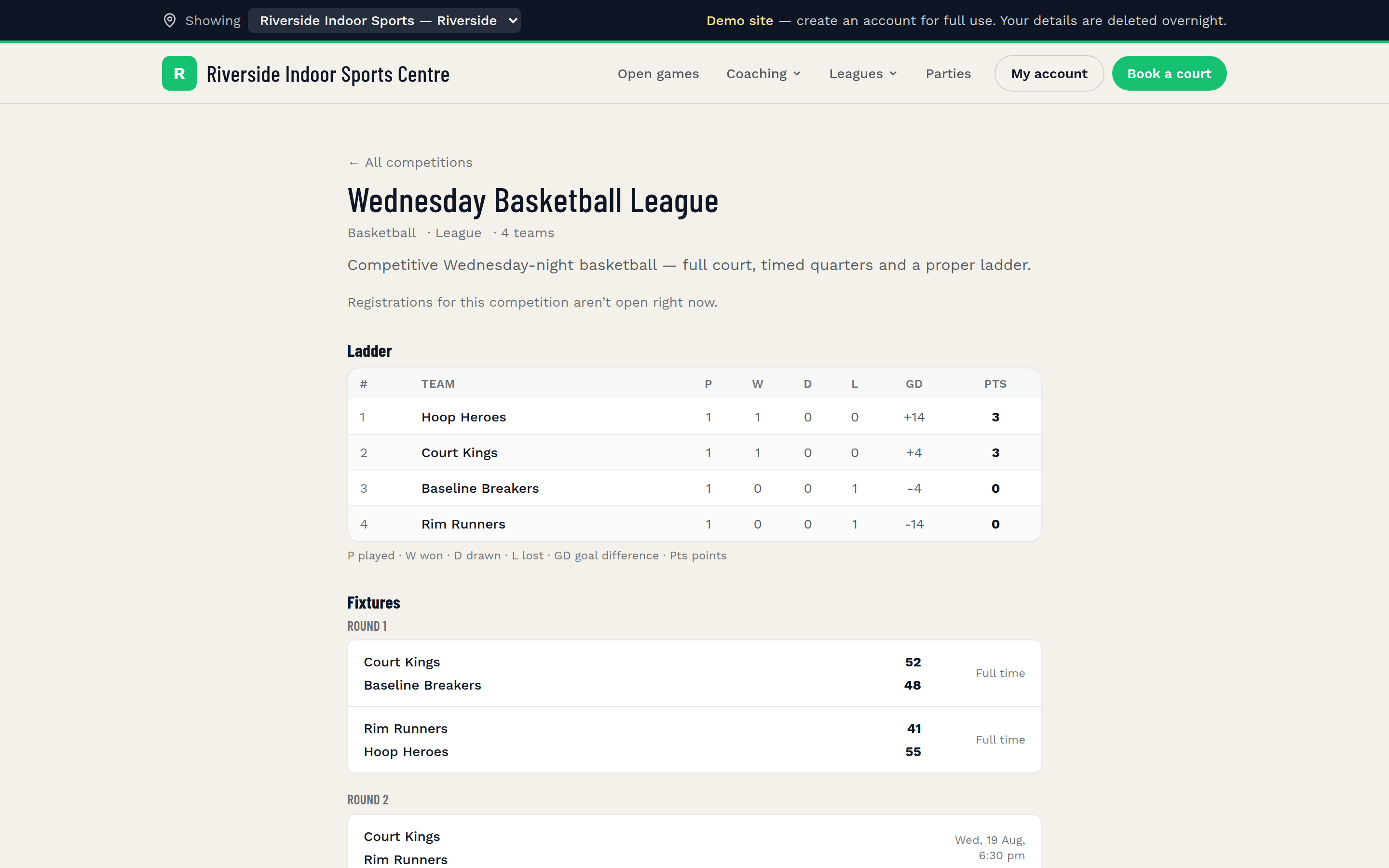
If your reminders are going out from three places, say a mail-merge, your personal phone and a spreadsheet of who's paid, this is where things slip. In Sweepa, the team's fee, its payment and your email and SMS to the manager live in one system, so you can check who's paid before you hit send. You can see how leagues and team registration fit together on our competitions page.
What happens on game night when a team still hasn't paid
A setup we see a lot: round one, 6:40pm, the 7pm teams are warming up, and the manager of an unpaid team is at the desk with their phone out, saying two players are transferring now. Behind them, a parent wants to know which court their kid is on, and the umpire is asking for the scoresheet.
This is the moment your published consequence earns its keep. If you said "pay at the desk before warm-up", send the payment link on the spot, watch it go through, and let them play. If you said "forfeit", be aware it punishes the opposition too, who turned up and paid. A common middle ground is pay-on-the-night for round one only, and forfeit from round two.
Whatever you pick, apply it to every team the same way. The other managers are watching, and the one exception you make in round one becomes everyone's expectation by round four.
Worked example: what one unpaid team actually costs
Assumptions: a 10-team social comp, a season fee of $800 per team, 12 rounds, and your desk time valued at $40 an hour. These are example figures, so swap in your own.
| Paid before round one | Chased through the season | |
|---|---|---|
| Money collected by round one | $800 | $0 |
| Chasing time | About 30 minutes across three reminders | Say 15 minutes a week for 8 weeks = 2 hours |
| Value of your time | About $20 | About $80 |
| Risk the team folds before paying | Low | You may never see the $800 |
Two unpaid teams makes that $1,600 uncollected and four hours of chasing, before you count the awkward conversations. The sequence isn't about being strict. It's about doing a week of light, organised work instead of a season of heavy, awkward work.
Common mistakes when chasing overdue team fees
- Chasing the whole team. Messaging every player embarrasses the manager and burns the relationship you need. Stick with the named payer unless they ask you to contact players.
- Inventing the consequence on the night. If it wasn't published at rego, it's an argument, not a rule.
- Changing tone mid-sequence. A cheerful step one and a furious step three reads as personal. Keep the tone steady and let the facts escalate.
- Naming teams in group messages. Never list unpaid teams in a group email or chat.
- Keeping no record. Reminders sent from your personal phone vanish when you take a week off. Keep them where the next person on the desk can see them.
The same rules for tone and length apply to team managers as to parents. Our guide to sports parent emails and SMS that actually get read has more on writing messages people act on.
Your Monday checklist
- Payment deadline and consequence published on the rego page
- One payment link per team, tested on a phone
- Step 1, 2 and 3 templates saved with your comp's details filled in
- Reminder dates in the calendar, counted back from round one
- A short list of who to ring on deadline morning
- A way to send a payment link from the desk on round one
- One rule for every team, written down so the next staff member applies it the same way
If you're weighing up running fees, reminders and the draw in one system, the plans and 30-day free trial are laid out on our pricing page.
FAQ
When should I start chasing unpaid team fees before a season?
Start about a week before round one, with a friendly reminder that includes the payment link and the deadline. Follow with a firmer reminder three days out and a final call 48 hours before the deadline. Starting earlier than that tends to get ignored, and starting later leaves you no time to fix real problems.
Should I let a team play round one if they haven't paid?
That depends on the consequence you published at registration, and it should be the same for every team. Forfeiting an unpaid team also punishes the opposition, so many organisers allow pay-on-the-night for round one and apply a forfeit from round two. Whatever you choose, decide it before the season, not at the desk.
Should I contact the players directly instead of the team manager?
Generally no. The team manager is the named payer, and going around them can embarrass them in front of their team and damage the relationship. Only contact players directly if the manager asks you to, or if the manager has stopped responding and the team still wants to play.
What if a team says they can't afford the full fee upfront?
Offer a short, written payment plan with set dates and amounts, and confirm it by text or email so there's a record. This keeps the team in the comp and turns a vague promise into a clear commitment. Make sure any plan you offer is one you'd be willing to offer every team in the same situation.
Can I charge a late fee on overdue team fees?
Some organisers do, but it should be clearly stated at registration, reasonable in size and applied consistently. Rules around fees and charges can vary, so check guidance from your state's fair trading or consumer affairs body before introducing one. A clear deadline and consequence often does more than a late fee anyway.
How do I stop teams paying late next season?
Ask for payment, or at least a deposit, as part of registration so a team isn't confirmed until money is in. Publish the deadline and the consequence on the rego page, and give each team one simple payment link. The reminder sequence then becomes a backup rather than your main way of collecting.